Explainer
Luxury First vs Assets First: The $30,000 Claim, Graded
A viral animation says buy the $30,000 house before the $30,000 car. The car maths is nearly right — the house part is fantasy. Here's the graded version.
In this article
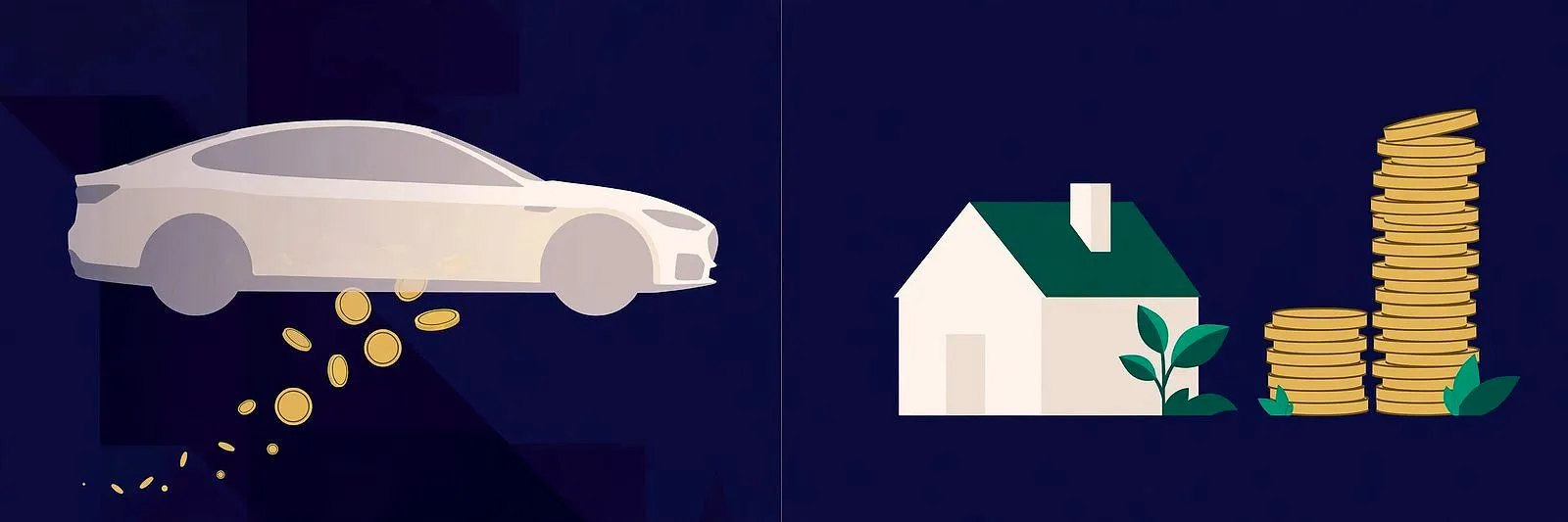
A 30-second animation has done what a thousand budgeting lectures could not: it made 160,000 people stop and argue about a car. Posted by NEURONVISUALS on 3 November 2026, the split-screen video gives one stick figure $30,000 and two ways to spend it. In the "Luxury First" path, the figure buys a $30,000 car straight away. In the "Assets First" path, the figure buys a $30,000 house first, waits, and buys the same car later — ending up with the house, the car, and coins to spare. The message is seductive: buy things that hold value before things that lose it.
The comments section, though, is where the video gets interesting. Half the replies praise the lesson; the other half tear it apart. "Find me a good house for $30k." "Drive ur house to work." "This vastly underestimates the cost of having a home." So which side is right? We graded every number in the animation against real data. The verdict: the car maths is nearly right, the house is a fantasy, and the ending quietly invents $30,000 out of thin air.
The animation, in 30 seconds
Both figures start with ten gold coins, each worth $3,000. The Luxury First figure spends all ten on a car. The car's value then falls year by year: $24,800, then $19,600, then $14,900, and finally $11,200 by year five — leaving the figure with zero coins and a heavily depreciated car. The Assets First figure spends the ten coins on a house, which the animation says "retains its value". By year four the coins have grown back to ten, the figure buys the same car in year five, and the video ends with the figure owning a $30,000 house, an $11,200 car, and two coins left over.
It is a clean story. It is also, as the commenters suspected, three different claims bundled into one animation — and they do not all survive contact with reality.
Grade 1: The car maths — mostly right, but worst-case
The animation's car loses 62.7% of its value in five years, falling from $30,000 to $11,200. That is a steep decline, and it is real — for the wrong kind of car. iSeeCars' 2026 study of more than 950,000 five-year-old cars sold between March 2025 and February 2026 found the average car loses 41.8% over five years, with roughly 20% gone in the first year alone. The worst performers in the study — the Nissan Leaf at 63.1% and the Range Rover at 61.7% — match the animation almost exactly. But those are the worst, not the typical.
| Car | 5-year value loss | $30,000 car worth after 5 years |
|---|---|---|
| The animation's car | 62.7% | $11,200 |
| Average car (iSeeCars 2026) | 41.8% | $17,460 |
| Toyota RAV4 | 25.2% | $22,440 |
| Honda Civic | 22.9% | $23,130 |
The animation's year-by-year drops — 17.3%, then 21%, 24% and 24.8% — are also plausible for a luxury car or an electric vehicle, where depreciation accelerates rather than slows. For an ordinary car, the pattern is front-loaded: the biggest hit comes in year one, then the curve flattens. Either way, the direction is right and the scale is exaggerated. A $30,000 car bought today will not usually be worth $11,200 in five years. On the average car, you keep about $6,000 more than the animation shows.
The animation's car loses value at the rate of the worst cars on the road — a Nissan Leaf or a Range Rover — not the average one. The lesson survives; the number is the pessimistic case.
Grade 2: The $30,000 house — the fantasy
Here is where the animation leaves reality behind. A $30,000 house that "retains its value" sounds reasonable until you ask what $30,000 actually buys. The cheapest major US housing markets — Decatur and Peoria in Illinois, Youngstown in Ohio, Toledo, and Cumberland on the Maryland–West Virginia line — have median prices under $150,000, according to Opendoor's 2026 ranking of National Association of Realtors data. The cheapest states run higher still: roughly $205,000 in Mississippi and $228,000 in Iowa. The national median existing-home price was $417,500 in September 2026. A $30,000 house is about 7% of the median home — and about a fifth of the median in the cheapest metro in the country.
So what does $30,000 buy? Distressed property: land-bank auctions, foreclosures, and fixer-uppers in fading Rust Belt streets and rural counties. Detroit's land bank lists vacant homes from $1,000, with average sales landing just under $5,000. Rural foreclosures in the $25,000–$40,000 range typically need another $30,000–$60,000 of renovation; urban distressed homes in the $30,000–$45,000 range often need $40,000–$80,000. As one 2026 guide to sub-$50,000 homes puts it: if the house is $30,000 and repairs could hit $40,000, you are really shopping at $70,000.
That is before the second problem: a $30,000 fixer-upper does not "retain its value" while you live in it. It needs a roof, plumbing, wiring, and heating before it is habitable, and it sits in a market where prices are flat or falling — that is why it costs $30,000 in the first place. The animation treats the house as a vault that holds $30,000 perfectly still for five years. In reality, the cheapest houses are the ones most likely to lose value, or to swallow tens of thousands in repairs just to stand still.
A $30,000 house is not a smaller version of a $417,500 house. It is a different product entirely — usually a distressed property that needs $30,000–$80,000 of work before anyone can live in it. Budget for the renovation, not just the listing price.
Grade 3: The coins that magically grow back
The animation's biggest sleight of hand is the quietest one. The Assets First figure spends all ten coins on the house — and by year four, the coins have "grown back to ten". Where did $30,000 come from? The video never says. Growing $30,000 back in four years means saving $7,500 a year, or $625 a month, every month, on top of owning a home. If the figure can save $625 a month, they could have done that while owning the car too. The animation credits the house with savings that actually belong to the saver's income.
It also charges the house nothing to own. A house is not a coin jar; it is a machine that bills you. A Zillow and Thumbtack study released on 22 October 2026 found the typical US homeowner pays $16,566 a year beyond the mortgage — $11,171 for maintenance, $3,129 for property taxes and $2,266 for homeowners insurance, with insurance premiums up 54% in five years. Those are national figures for a typical home, and a $30,000 house would cost less in tax and maintenance. But even scaled down generously — say $300 a year in tax at a 1.1% rate, $300 in maintenance at the standard 1%-of-value rule, and $1,500 or more for insurance, which is priced on rebuild cost rather than market value — a cheap house still costs roughly $2,000–$3,000 a year to hold, or $10,000–$15,000 over five years. The animation counts zero of it, and it counts none of the renovation either.
Put the two errors together and the ending collapses. The animation's Assets First figure ends with a $30,000 house, an $11,200 car and two coins — $47,200 of wealth from a $30,000 start, with no income and no costs in between. That is not a strategy. That is a magic trick.
The honest rebuild: what "assets first" actually looks like
The principle behind the video is sound — the execution is not. Depreciating assets really do eat wealth, and delaying a new car really does build it. So here is the same $30,000, rebuilt with real numbers and the assumptions stated plainly. All figures below are our own calculations, labelled as illustrations: a 7% annual return is used for investing, close to the S&P 500's long-run real return of about 6.8% a year since 1928, and running costs such as fuel and insurance are left out of both sides.
| Path | What you do with $30,000 | What you hold after 5 years |
|---|---|---|
| Luxury first (animation's car) | Buy a $30,000 new car | Car worth $11,200 — total $11,200 |
| Luxury first (average car) | Buy a $30,000 new car | Car worth $17,460 — total $17,460 |
| Assets first (animation) | Buy a $30,000 house, coins regrow | House $30,000 + car $11,200 + $6,000 — total $47,200* |
| Assets first (honest rebuild) | Buy a $10,000 used car, invest the other $20,000 at 7% | Car worth ~$7,000 + investments ~$28,051 — total ~$35,051 |
*The animation's total assumes $30,000 of unexplained new savings, zero renovation, and zero holding costs. It is shown for comparison, not as a realistic outcome.
The honest rebuild is less spectacular than the animation — $35,051 instead of $47,200 — but it is roughly three times better than buying the new car, and it does not require a $30,000 house to exist. The used car does the same job the animation's house was supposed to do: it gets you to work for a third of the money, and the $20,000 you did not spend compounds instead of depreciating. At 7% a year, $20,000 becomes about $28,051 in five years. If you had invested the whole $30,000 and kept your old car running, it would become about $42,077; at the stock market's long-run nominal average of about 10%, about $48,315.
What to actually do with $30,000
The video's real lesson is not "buy a house before a car". It is "do not spend your whole lump sum on the fastest-depreciating thing you own". Five moves turn that into a plan:
- Buy the car you need, not the car the animation sells. A two- or three-year-old car has already taken the biggest depreciation hit. A Honda Civic loses 22.9% over five years from new; a two-year-old one has most of its value left to keep.
- Cap the car at a third of the lump sum. On $30,000, that is $10,000 for transport. The remaining $20,000 is the part that builds wealth.
- Invest the difference the day you buy the car. Money left in a current account gets spent by default — prices and habits absorb it. A same-day transfer into an index fund or a high-yield savings account makes the saving real instead of theoretical.
- Price the house honestly if you do buy one. Add renovation, tax, insurance and maintenance before comparing it with renting or investing. A $30,000 listing plus $40,000 of repairs is a $70,000 house.
- Remember you may need the car to earn the money. The animation's most mocked comment — "drive ur house to work" — has a point. If the car is how you get to a job, delaying it is not free. The fix is a cheaper car, not no car.
The 30-second rule: if a purchase loses half its value in five years, pay for it with as little of your lump sum as possible — and move the rest somewhere it can grow the same day.
Frequently asked questions
Does a new car really lose 20% of its value in the first year?
About that, yes. Kelley Blue Book puts the typical first-year loss at roughly 20%, and iSeeCars' 2026 study found the average car loses 41.8% over five years. The exact figure depends on the model: a Honda Civic loses 22.9% over five years, while a Nissan Leaf loses 63.1%.
Can you actually buy a house for $30,000?
Yes, but almost never a move-in-ready one. At that price you are buying a distressed property — a land-bank home, a foreclosure, or a rural fixer-upper — and you should expect $30,000–$80,000 of renovation on top. The cheapest US metros have median prices under $150,000, and the national median is $417,500.
Is a house always a better asset than a car?
No. A house in a strong market can appreciate, but it also charges tax, insurance and maintenance every year — about $16,566 a year beyond the mortgage for the typical US homeowner, according to Zillow and Thumbtack. A car always depreciates, but a cheap used car depreciates slowly. The right comparison is total cost, not just the purchase price.
What should I do with $30,000 if I need a car?
Buy a reliable used car for roughly a third of it, and invest or save the rest the same day. On the numbers above, $10,000 on a used car plus $20,000 invested at 7% leaves you with about $35,000 of wealth after five years — against about $11,200–$17,460 if the whole sum went into a new car.
Does this work the same way in the UK?
The principle does, but the numbers differ. The average UK house cost £273,566 in October 2026, according to Nationwide, so a £30,000 house is essentially an auction property needing major work. UK cars depreciate on a similar curve — roughly 15–20% in year one for a typical model — and the same rule applies: buy used, invest the difference.
Key takeaways
- The animation's car maths is real but worst-case: its $30,000 car loses 62.7% in five years, matching a Nissan Leaf or Range Rover. The average car loses 41.8% and would be worth about $17,460.
- The $30,000 house is the fantasy. The cheapest US metros have medians under $150,000 and the national median is $417,500; a $30,000 home is a distressed property needing $30,000–$80,000 of repairs.
- The ending invents $30,000: the coins "grow back" only if the figure saves $625 a month, and the house is charged nothing for tax, insurance or maintenance.
- The honest version still wins: a $10,000 used car plus $20,000 invested at 7% leaves about $35,051 after five years — roughly triple the new car's $11,200.
- Buy the cheapest car that does the job, and move the money you saved somewhere it can grow the same day.
The NEURONVISUALS animation earned its 160,000 likes honestly: it makes an important idea visible in 30 seconds, and the idea is right. Buy assets before luxuries. Just do not buy the animation's version of it. The real assets-first move is smaller, slower and less cinematic — a used car, an invested lump sum, and a house bought at a price that includes the roof it still needs.
Sources
- NEURONVISUALS Instagram reel — Luxury First vs Assets First (3 Nov 2026)
- iSeeCars — Cars That Hold Their Value Study 2026
- Money Talks News — 15 Cars That Hold Value Best and Lose the Most
- Home Comfort Experts — Where Can You Buy a House for $50K?
- Zillow & Thumbtack hidden costs of homeownership 2026 (via PinScene)
- Amerisave — The Real Cost of Homeownership in 2026 (NAR median $429,100)
The MoneyHabit editorial desk researches, writes and reviews every article against our editorial policy.
The Sunday Habit
One useful money idea, every week.
A short, practical email every Sunday — no spam, no selling your address, unsubscribe anytime.
Advertisement
More in Smart Spending

Smart Spending · Guide
GTA 6 'Saves You $5,000'? The Viral Claim, Graded
A viral video says buying GTA 6 saves you $5,000. We checked the maths: the cost-per-hour case is real, but the headline only works on one big assumption.
5 November 2026 · 8 min read
Smart Spending · Guide
Cities That Pay You to Move: The Relocation Cash, Graded
US towns will pay you $5,000–$25,000 to move there. We graded the real programmes — Tulsa, Jackson, West Memphis and more — on cash, catches and worth.
6 November 2026 · 10 min read

Smart Spending · Guide
British Airways Just Changed How You Fight a Denied Claim
BA is leaving CEDR, the body that forced it to pay £5m+ in rejected claims. File before 31 December — after that, your odds of winning drop sharply.
6 November 2026 · 10 min read