Review
Paid to Film Your Chores? The Robot-Training Gig, Tested
Apps pay you to film yourself folding laundry and washing dishes — footage that trains household robots. We graded the pay, the payout rules and the catch.
In this article
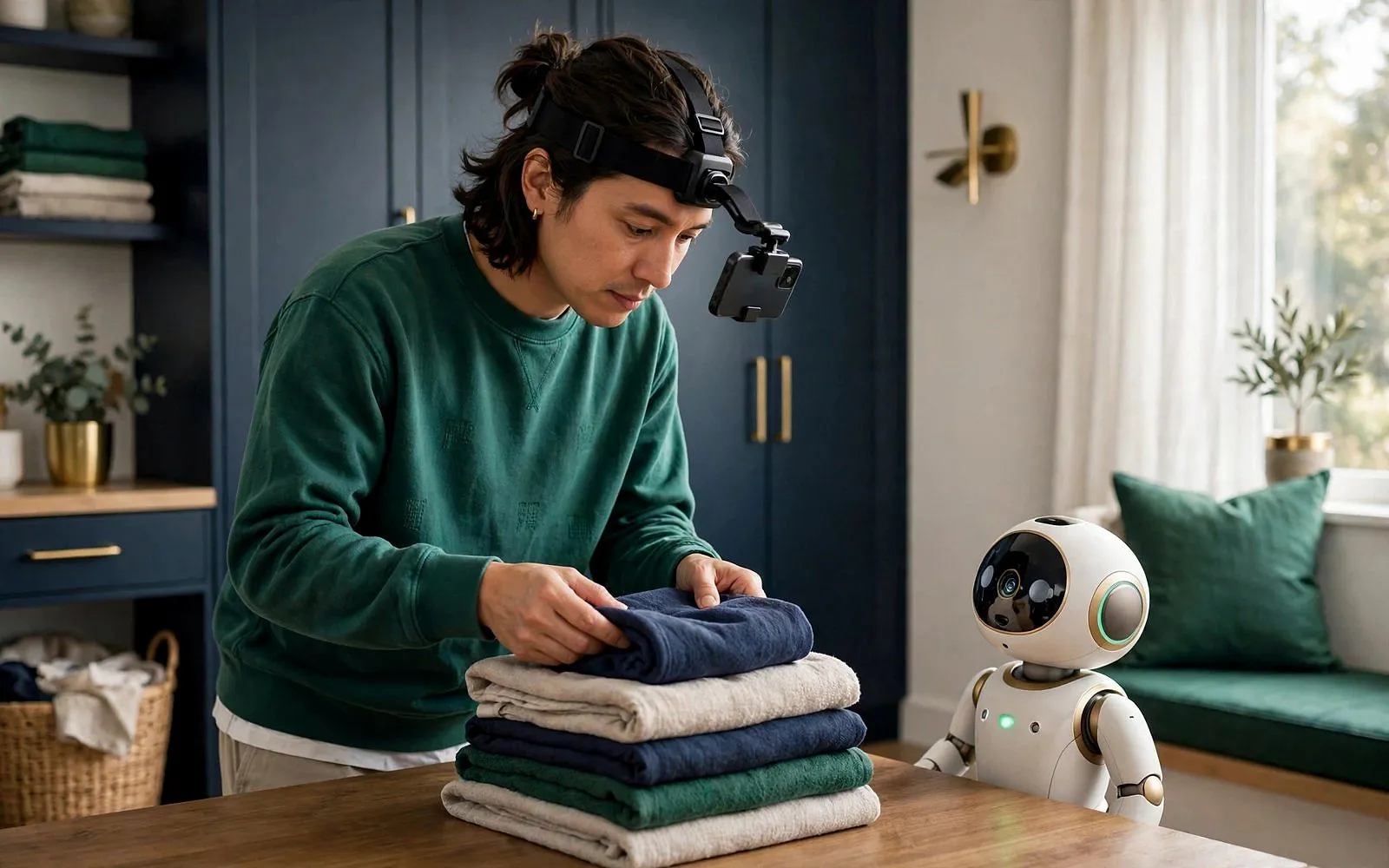
A mum films herself folding laundry. Not for TikTok, not for a vlog — for a paycheque. Her phone, strapped to her forehead, records every fold while an app calls out the next step. Somewhere else, that footage teaches a robot how to do the same chore. This is the newest side hustle going viral in personal-finance feeds: get paid to film your chores so machines can learn them.
The BBC reported on 23 October 2026 that hundreds of thousands of workers around the world are now recording their everyday activities — cutting hair, cooking, sweeping, folding laundry — for companies that sell the footage to technology firms training "physical AI", the systems that will control robots in the real world. And in the US, apps with names like Atlas Capture and Amelia Chores are recruiting ordinary people to do the same thing from their own kitchens. The pitch sounds almost too good: earn money doing chores you would do anyway. So we tested the claim — the apps, the pay rates, the payout rules and the catch — before you strap a camera to your head.
What the job actually is
Robots cannot learn to move through a real home from computer simulations alone. That is the argument made by Manish Agarwal, founder of Humyn Labs, one of the data-collection firms in the BBC report: a robot needs to see thousands of real humans opening dishwashers, wiping counters and folding shirts before it can do any of it reliably. So companies pay people to record themselves doing those tasks, usually from a first-person view with a phone mounted on the head, and sell the footage to robotics companies and AI research labs.
The work looks like this: you open the app, pick a task — fold laundry, do the dishes, water the plants, make the bed — and record it while the app calls out each step. The footage is then reviewed for hands in view, movement and video quality. Only approved hours get paid. That last sentence matters more than any headline rate, as we will see.
The BBC's report follows Mohammed Ashim, a 22-year-old barber in Bengaluru, who wears a head-mounted camera for five to six hours a day while cutting hair, and Jolly Arifur, a science teacher and mother in Guntakal, who has spent seven months filming herself cooking, sweeping and folding laundry around her teaching job. Their footage is collected by local firms — Rashdan Technologies and Humyn Labs, which says it has 96,000 data collectors across Latin America and Southeast Asia — and sold on to the companies building the robots.
The apps, graded side by side
Several apps and platforms are recruiting for this work right now, and their offers are not the same. Here is what each one actually promises, from its own site or job listing:
| App / platform | Advertised pay | How and when you get paid | What stands out |
|---|---|---|---|
| Atlas Capture | Per approved hour; rate varies by country and task, shown before each task | Monthly payouts once you reach $100; unpaid balance rolls over | Claims $2M+ paid out, 400,000+ people earning, 4.8 stars from 8,000+ app ratings; head mount free |
| Amelia Chores | $10/hour base, rising to $12–$13/hour with challenges and milestones | Paid every Friday via PayPal or direct deposit, in fixed 5-hour blocks ($50 at base rate); head-strap mount reimbursed | Job listing also claims $1,000–$2,000 a week — see the maths below |
| HUMXN Work | About $20 per accepted hour of footage | Via Stripe, once your balance reaches $10 | Claims 10 accepted hours a week is roughly $870 a month |
| Claru AI | $6/hour for Latin America | Via Wise, Payoneer or local equivalent | Claims most contributors earn around $40 a day, or $300 a week |
| OpenTrain (via Micro1) | $15/hour, US only | Per hour of accepted footage; project lasts 1–3 months | Estimated total project earnings $2,400 |
Two things jump out. First, the spread is enormous: roughly $0.50 to $20 an hour depending on where you live and which platform you use. Second, every rate is per approved or accepted hour — footage that fails review earns nothing.
The pay maths, worked out honestly
Headline rates are the marketing. The real question is what lands in your account for an hour of your time, so here is the arithmetic, using each source's own numbers.
Atlas Capture's own example. Its site shows a sample week: $68.40 earned, 12 hours approved, 3 in review, quality score 94%. Divide the pay by the approved hours and you get $5.70 per approved hour. That is the number to compare, not any rate shown before a task. It also shows the approval problem in miniature: 15 hours submitted, 12 approved — an 80% approval rate in their own example. The other three hours of filming earned nothing, at least not yet.
Amelia's $1,000–$2,000 a week claim fails its own maths. At the $10-an-hour base rate, $1,000 a week would need 100 hours of approved filming — more hours than there are waking hours in a week once you sleep. Even at the top $13-an-hour tier, $1,000 needs 77 approved hours. Treat that figure as a listing hook, not a plan.
The BBC's India numbers are the sobering end of the scale. Rashdan Technologies told the BBC it pays $5 to $10 for eight to ten hours of recorded work — $0.50 to $1.25 per recorded hour. Jolly Arifur earns $2 to $3 an hour filming chores for three to five hours a day, or roughly $6 to $15 a day. That is meaningful extra income on top of a teaching salary in Guntakal, and it is also far below the US federal minimum wage of $7.25 an hour. The same job, the same footage, pays wildly different amounts depending on which country's labour market you sit in.
What a month of filming could actually be worth. The table below assumes one approved hour a day, thirty days a month, and that every hour you film is approved — a generous assumption, given Atlas's own 80% example:
| Rate | 1 approved hour a day | What it really means |
|---|---|---|
| $5.70/hr (Atlas example) | ~$171/month | Useful top-up; you must still clear the $100 monthly payout threshold |
| $10/hr (Amelia base) | ~$300/month | Paid in $50 blocks; 8 hours of filming earns nothing until the 5-hour mark is passed twice |
| $15/hr (OpenTrain) | ~$450/month | US-only, project-based, 1–3 months — not an ongoing income |
| $20/hr (HUMXN) | ~$600/month | Best advertised rate; only accepted footage counts, and tasks are not guaranteed |
Filming chores you would do anyway is not free money. The filming, the re-takes and the waiting for approval are real work — and only the approved minutes pay.
The 5-hour rule is the trap to watch. Amelia pays out in fixed 5-hour increments: 5 hours is $50, 10 hours is $100. At 8 approved hours you have still only been paid for 5 — the other 3 sit unpaid until you film 2 more. Always check whether a platform pays per hour or per block before you start.
The catches nobody puts in the advert
Approval is the whole game. Every platform reviews footage against a checklist — hands in view, correct movement, video quality — and rejects what fails. A rejected hour is an hour of your evening gone for nothing. Ask what the approval rate is before you commit a week to it, and treat your first few tasks as a test, not a paycheque.
You are filming inside your home. First-person footage of your kitchen, your laundry and your children wandering through shot is being sold to third parties to train commercial systems. Check what the platform's terms say about who can buy the footage, how long it is kept, and whether faces in the background are blurred — the BBC noted Ashim's clients' faces are blurred, but that is one company's practice, not an industry rule. If anyone else lives with you, they are in the footage too.
Never pay to join. Real data-collection work pays you; it does not charge you. Atlas supplies the head mount free, and Amelia reimburses it. Any "training fee", deposit or kit charge is a red flag — walk away.
It is not passive income. The viral framing — money for chores you do anyway — skips the extra work: setting up the mount, following the app's step-by-step script, re-recording rejected takes, uploading large video files and waiting days for review. The chores were already happening; the filming, reviewing and waiting are new work on top.
Tax still applies. This is self-employed income in most countries: in the US it generally arrives without tax withheld and may need reporting, and in the UK it counts towards the £1,000 trading allowance before tax is due. Keep records from the first payout, not the first tax return.
Watch for copycat listings. The BBC story and the viral reels have spawned lookalike apps and job posts promising the same work at inflated rates. Verify any app against its own site and app-store reviews before you install it, and be wary of any listing that asks you to message a recruiter on WhatsApp or Telegram to "get started".
Who this is actually worth it for
The honest answer depends on your rate and your routine. If you are in the US or UK, can get onto a $15–$20-an-hour platform like OpenTrain or HUMXN, and already spend an hour a day on household tasks, filming them is a genuine side income of a few hundred dollars a month — provided your footage keeps passing review. If your only option is a $5–$6-an-hour platform, an hour a day is roughly $150–$180 a month for work that also hands a company video of your home: a trade many people will reasonably decline.
It is a poor fit if you need reliable money on a deadline — approval delays and payout thresholds mean the first paycheque can be weeks away — or if you are uncomfortable with cameras in your home. And if a listing promises $1,000 a week, run the maths first: at the platform's own hourly rate, the hours required are usually impossible.
Frequently asked questions
Do I need any special equipment?
A smartphone from the last five years and a head mount. Atlas Capture provides the mount free and Amelia Chores reimburses it; other platforms expect you to supply your own. A steady internet connection matters too — you will be uploading hours of video.
How much can I realistically earn?
It depends almost entirely on your country and platform. Verified examples range from $0.50–$1.25 per recorded hour in the BBC's India reporting, through $5.70 an hour in Atlas Capture's own example week, to $15–$20 an hour on US-focused platforms. One approved hour a day is roughly $170–$600 a month across that range — before rejected footage and payout thresholds.
Is filming chores for AI training legitimate work?
Yes — it is a real industry. Hundreds of thousands of people do it, and firms like Rashdan Technologies and Humyn Labs openly supply the footage to robotics companies. But "real industry" does not mean "every listing is real": use the established platforms, never pay to join, and read the privacy terms before you record.
Will the robots take the jobs of the people filming?
That is the uncomfortable question at the heart of the BBC story. The footage trains robots to do exactly the tasks being filmed — barbering, cleaning, laundry. The workers interviewed were aware of it; several said the extra income mattered more to them right now than a future they could not control. It is worth going in with your eyes open about what you are building.
What is the difference between this and other AI side hustles?
Most AI gig work — labelling text, rating chatbot answers, testing apps — pays per task or per hour at a desk. This one pays per approved hour of video of your physical movements, filmed in your home. The pay structure, the privacy trade-off and the approval risk are all different, which is why it deserves its own decision rather than being lumped in with "AI side hustles" generally.
Key takeaways
- Apps like Atlas Capture and Amelia Chores pay you to film household chores so the footage can train household robots — a real industry the BBC documented in October 2026, with hundreds of thousands of workers worldwide.
- Pay varies enormously: $0.50–$1.25 per recorded hour in the BBC's India reporting, $5.70 an hour in Atlas Capture's own example week, and $15–$20 an hour on US-focused platforms.
- Only approved footage pays — rejected hours earn nothing, and payout rules like Atlas's $100 monthly threshold and Amelia's 5-hour blocks delay your money.
- Run the maths on any big earnings claim: $1,000 a week at $10 an hour would need 100 approved hours.
- Never pay to join, read the privacy terms before filming inside your home, and treat the first week as a test of the approval rate.
The chore-filming hustle is real, and for the right person on the right platform it pays a genuine few hundred a month. But the viral version — effortless money for laundry you were doing anyway — leaves out the approval rejections, the payout thresholds and the camera in your kitchen. If you try it, pick an established platform, verify the rate shown before each task, and judge it after your first payout, not your first recording. That is the only review that counts.
Sources
The MoneyHabit editorial desk researches, writes and reviews every article against our editorial policy.
The Sunday Habit
One useful money idea, every week.
A short, practical email every Sunday — no spam, no selling your address, unsubscribe anytime.
Advertisement
More in Apps & Software Reviews

Apps & Software Reviews · Review
The Budget Apps Behind TikTok's Viral Money Wave, Tested
TikTok's budgeting wave named its favorite apps. We checked what Peek Money, Rocket Money, YNAB, Simplifi and Pocket Clear really cost — and which fits you.
4 November 2026 · 6 min read

Apps & Software Reviews · Review
Cashback Browser Extensions, Tested: Do They Beat the Apps?
Honey's 2026 legal saga changed the coupon-extension game. We review 2026 tests of Rakuten, Honey, Capital One Shopping and the UK options.
4 November 2026 · 8 min read

Apps & Software Reviews · Review
The Viral '8 Money Apps' Reel, Graded: Keep 6, Fix 2
A viral reel promises eight apps that fix your money. We checked every price and claim — six are worth keeping, one needs a swap, and one is dangerous.
17 November 2026 · 10 min read