Explainer
Rent vs the $8 Coffee: What the Maths Actually Says
Rent takes a third of most renters' pay, so is the $8 coffee really the problem? The maths says both sides of the viral debate are half right.
In this article
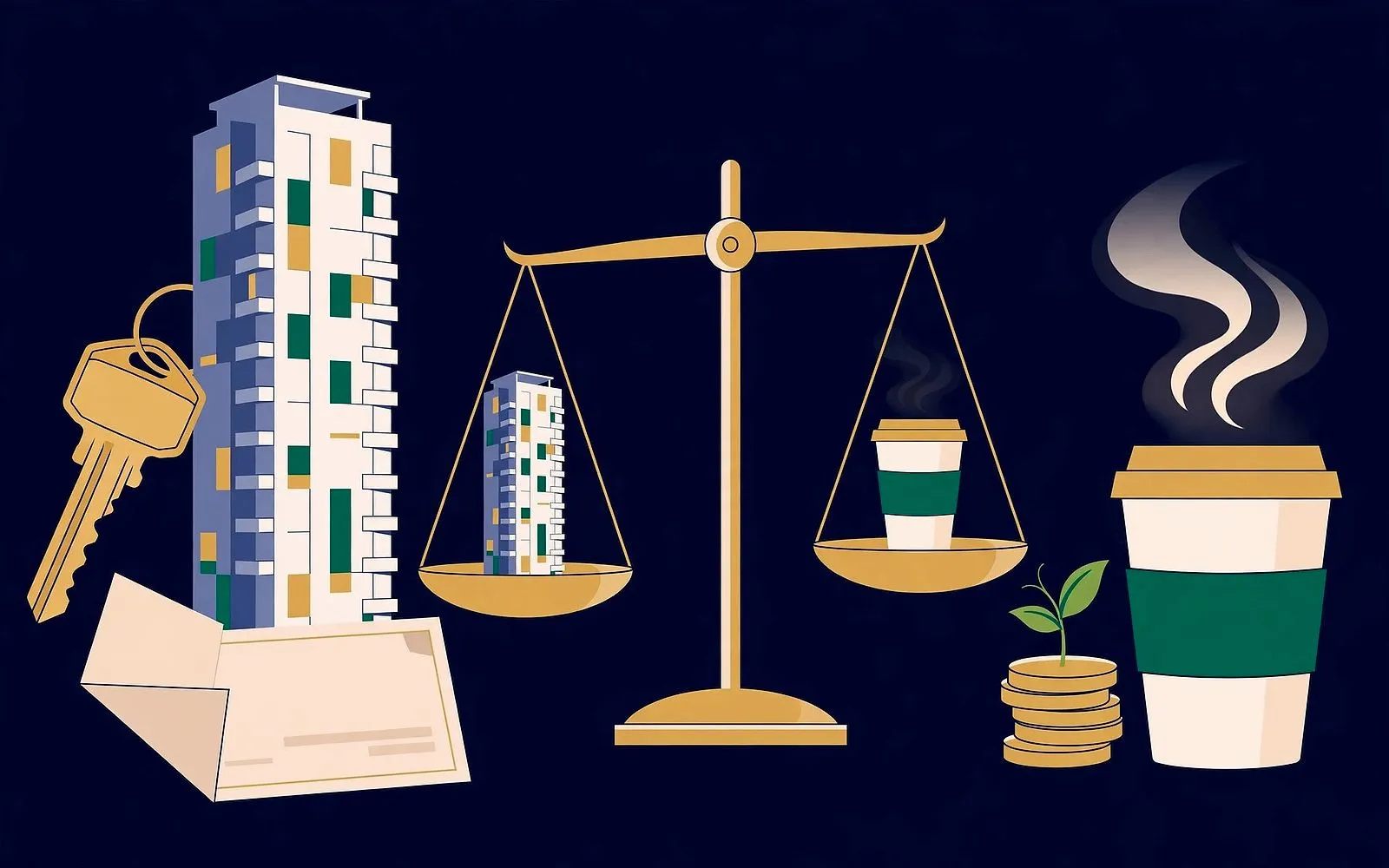
The internet's favourite money argument flared up again this week: is your rent unaffordable because of your landlord — or because of your $8 coffee? A viral post put it bluntly: grandparents bought a house on one paycheque, while today's renters complain about being broke over $14 iced lattes. The replies split into two camps, both convinced the other side is delusional. The maths says both are half right.
What the coffee critics get right
The case against the daily coffee is older than the viral post: financial author David Bach popularised it as the "latte factor" — small, daily, forgettable spending that adds up to serious money. An $8 coffee every day costs $2,920 a year — $243 a month. Over ten years, that $243 a month invested at a 5% average annual return grows to roughly $37,700 (our calculation; returns are never guaranteed).
That is a house deposit top-up or a paid-off card. The deeper point is psychological: a daily purchase you barely notice trains you to ignore your spending. If you cannot see $243 a month leaking out, you probably cannot see the subscriptions and delivery fees leaking alongside it. The coffee is the canary, not the whole mine.
What the rent defenders get right
But rent is not a small leak. Harvard University's Joint Center for Housing Studies found 22.7 million US renter households — 49% of all renters — spent more than 30% of their income on rent and utilities in 2024, a record, and 12.1 million spent more than half. The median renter now spends 31% of income on rent and utilities, up from 27% in 2001 — while median rent rose 30% after inflation, renter income rose just 9%.
Census figures sharpen the picture: median US rent is $1,557 a month — $18,684 a year — against a median renter household income of $57,048, so rent takes 32.8% of a typical renter's pay. In 35 of 51 states and DC, rent exceeds the 30% line. Now compare the coffee: $2,920 a year is about 16% of that annual rent bill. Even if you quit coffee entirely, your rent is still $15,764 a year — and for the 12.1 million households spending over half their income on housing, no amount of home brewing closes the gap. Rent is a structural problem; coffee is a marginal one. One side is talking about a $243-a-month habit, the other about a $1,557-a-month bill.
| Annual cost | Amount | What it means |
|---|---|---|
| Median US rent | $18,684 | 32.8% of median renter pay |
| $8 coffee, every day | $2,920 | About 16% of the annual rent bill |
| Rent burden if coffee is cut | 27.6% | From 32.8% — a dent, not a fix |
| Coffee money over 10 years at 5% | ~$37,700 | Serious money, over a decade |
Sources: Census ACS 2025 via CalcWise; Harvard JCHS. Coffee figures are our own calculations.
The mistake both sides make
The debate is framed as either-or, and that is the trap. Cutting coffee does not fix an unaffordable rent, and blaming rent does not make a $243-a-month habit free. Both matter, but in a strict order: housing, transport and food swallow most of what a typical renter earns, and the big ones only get fixed by decisions harder than skipping a latte — negotiating, moving, sharing, or earning more.
Rent is a structural problem; coffee is a marginal one. The trick is to fix the marginal one quickly, then aim your real energy at the structural one.
What actually works
Stop arguing in the abstract and run your own numbers:
- Work out your rent share: annual rent divided by annual take-home pay. Under 30% is comfortable; over 40% means housing is your problem, not coffee.
- Run a 30-day coffee audit. Do not quit — just track every coffee, delivery and impulse buy for a month. Most people find $150 to $300 they did not notice.
- Redirect the saving visibly. Move the money to savings on payday, automatically — a saving you cannot see is a saving you will spend.
- Attack the big lever. Ask about a longer lease for lower rent, look one neighbourhood further out, or take in a housemate. A $200-a-month rent saving beats a decade of skipped lattes.
- Keep one small joy. If coffee gets you out of the door, keep it and cut something you enjoy less. Budgets that ban everything fail within weeks.
Try this: for one month, make coffee at home on weekdays and keep the café coffee for weekends. A $5 weekday coffee swapped for a 50-cent home brew saves about $90 a month — and you still get your Saturday latte.
Watch out: do not "save" on coffee by putting it on a credit card you cannot pay off. An $8 coffee at 24% APR left on a card for a year costs far more than the coffee ever did.
The UK picture
Britain tells the same story. The average UK private rent was £1,400 a month in August 2026, up 3.8% on the year, according to the ONS, while renters spent an average of 32.7% of their income on rent in October 2026 (HomeLet Rental Index). In London, renters spent 41.6% of gross household income on rent in 2023–24. A £5 daily coffee costs £1,825 a year, about 11% of a £16,800 annual rent bill — the same story, in pounds.
Frequently asked questions
Does cutting out coffee really help?
Yes, at the margin. Quitting an $8-a-day habit saves $2,920 a year and would take the median renter's rent burden from 32.8% to about 27.6% of income — a genuine improvement, but no rescue for a household spending half its income on rent.
So is rent the real problem?
Mostly, yes. When half of all renters are cost-burdened and rents have risen three times faster than renter incomes since 2001, housing matters far more than any single habit. Coffee is the garnish, not the meal.
What should I cut first?
Cut what you will not miss: forgotten subscriptions, delivery fees, then daily treats bought on autopilot — but keep the one small pleasure that makes the rest bearable.
Is the "latte factor" a myth?
No — but it is incomplete. Small daily spending really does compound over a decade. The myth is that it is the reason people cannot afford housing. It is a contributor, not a cause.
Key takeaways
- An $8 daily coffee costs $2,920 a year — about 16% of the median annual rent bill.
- Half of US renters are cost-burdened, and the median renter spends 32.8% of income on rent. Coffee cannot fix that on its own.
- Quitting coffee would cut the median rent burden to about 27.6% — a real dent, not a rescue.
- Fix the small leaks fast, then aim your real energy at the big lever: the rent itself.
The debate will flare up again next month with a new price. Ignore the shouting and do the two calculations that matter: your rent as a share of your income, and your daily spending as a share of your rent. If the first is over 40%, your problem is housing: negotiate, move, or share. If the second surprises you, your problem is attention — a 30-day audit will fix it for free.
Sources
- CalcWise — Rent vs. Buy by State (Census ACS 2025, Freddie Mac)
- Multifamily Executive — Harvard Report: The Affordability Crunch Continues
- Rent vs Buy in 2026 (Realtor.com, NAR, Freddie Mac figures)
- ONS — Private rent and house prices, UK: October 2026
- Letting Agent Today — Share of income spent on rent rises (HomeLet, Oct 2026)
- Viral rent-vs-lattes debate post (Gab, 12 Nov 2026)
The MoneyHabit editorial desk researches, writes and reviews every article against our editorial policy.
The Sunday Habit
One useful money idea, every week.
A short, practical email every Sunday — no spam, no selling your address, unsubscribe anytime.
Advertisement
More in Budgeting & Saving

Budgeting & Saving · Guide
Your Rent Went Up: How to Rework Your Budget Fast
Your rent just went up. Check whether the rise is fair, rework your budget around the new number, negotiate — and decide if staying or moving costs less.
12 November 2026 · 8 min read

Budgeting & Saving · Guide
Moving Back Home to Save Money: The Real Maths
A viral post put city life at ₹68,000 a month and home at zero. The real saving is big — but only if the money actually gets saved. Here is the maths.
11 November 2026 · 14 min read

Budgeting & Saving · Guide
The Wedding Budget: What Couples Actually Spend
The average US wedding costs $34,000 — but the median is $24,000. Here's what couples actually spend, where the money goes, and how to cut without regret.
10 November 2026 · 13 min read