Explainer
The $5,000 Trump Dividend: What Happened
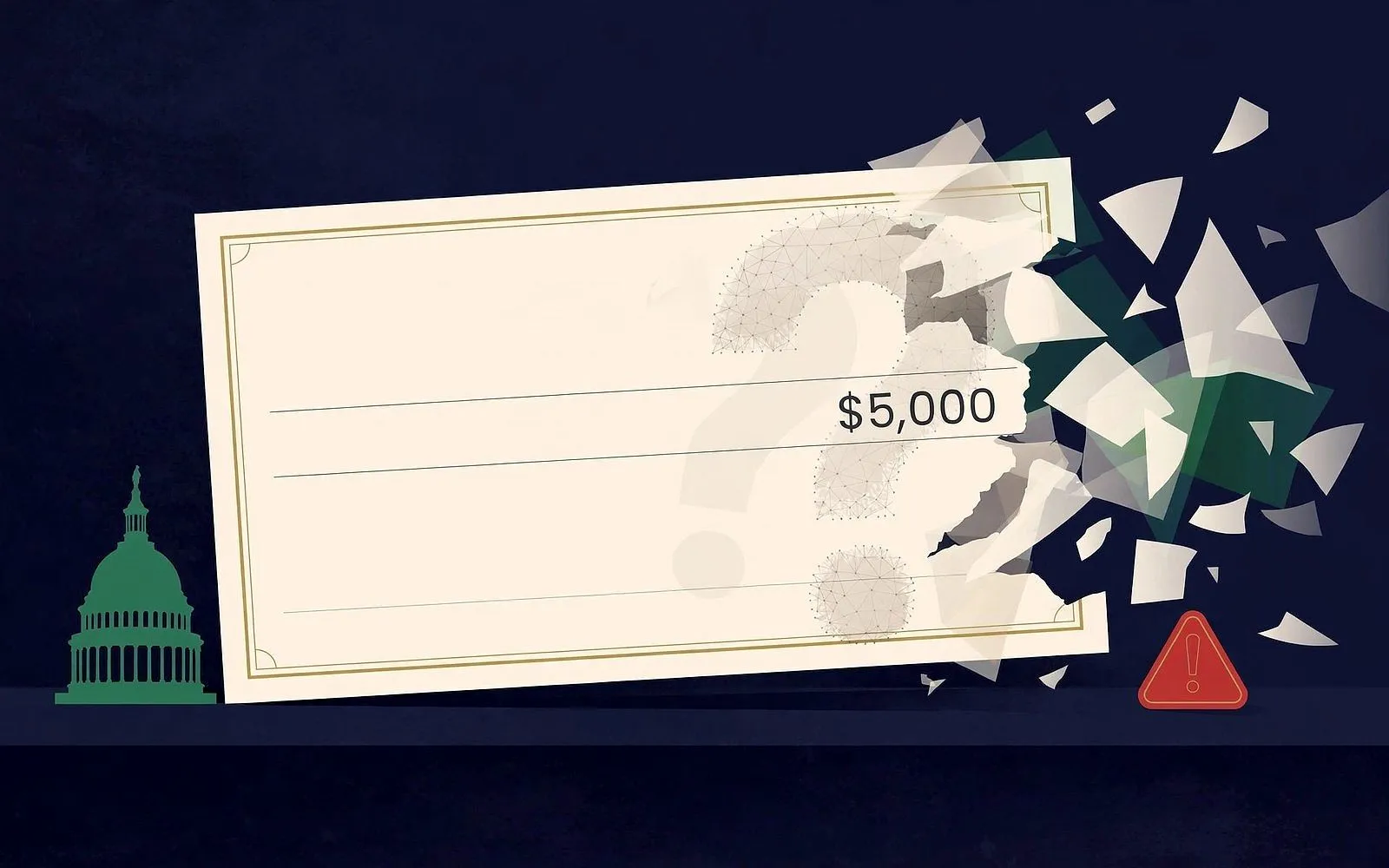
Trump promised every adult American $5,000 if Republicans kept Congress. Democrats won both chambers — so what happens to the check, and the scams around it?
In this article
On September 9, 2026, President Donald Trump stood on stage at the Republican midterm convention in Dallas and made a promise that instantly became one of the biggest money stories of the election: if Republicans kept control of Congress, every adult American citizen would get a $5,000 check. Two months later, the condition at the heart of that promise has failed. Democrats are projected to have won both chambers of Congress in the November 3 midterms, and no $5,000 payment is coming — at least not in the form Trump described. Here is what was promised, why the maths never added up, and the scams that sprang up around the rumour.
What Trump actually promised
The offer was simple and conditional. Speaking in Dallas on September 9, Trump told the crowd: "If the Republicans win the House of Representatives and the United States Senate, I will issue a dividend to every adult citizen in the United States of America for $5,000." He called it the "Trump dividend" and compared it to a company paying profits out to its shareholders. The only caveat he attached was that the money "must be spent in the United States of America" — though he never explained how that condition would be enforced.
He repeated the pledge through the campaign: in an October 3 video, and again in his closing speech before Election Day, where he warned that a Democrat-controlled Congress would mean no check at all. Vice President JD Vance backed the idea, pointing to tariff revenue as the funding source. Senator Bernie Moreno of Ohio went further, writing on X on September 10 that he would "get a bill ready so that we can get the Trump Dividend passed immediately after the November 3rd election."
Why the condition failed
The promise was never a standalone payment. It was explicitly tied to one outcome: Republicans holding both the House and the Senate. NBC News projected that Democrats won both chambers on November 3, and multiple outlets reported the same result. That means the condition Trump set was not met.
It also matters that a president cannot send out checks like these on his own. Any payment of this kind needs a law passed by Congress and signed by the president. As of this week, no bill authorising the payments has been introduced in either chamber, and no bill text from Senator Moreno's office exists yet — his spokeswoman said the Senate floor is not open for bill introduction until next week. The White House, asked whether the president still intends to pursue the payment, did not respond.
Until the new Congress is sworn in in January, Republicans keep the majorities they had going into Election Day — 219-214 in the House and 53-47 in the Senate. After that, a dividend bill would need Democratic votes to pass.
That lame-duck window is the last realistic opening. Congress returns on November 9, and government funding expires on December 11. A bill introduced now would still need to clear both chambers before the new, Democratic-controlled Congress takes over in January — after which it would need Democratic votes to pass at all.
The maths: what $5,000 each would actually cost
The reason the dividend was always a stretch is the size of the number. The Census Bureau estimates there are about 245 million adult US citizens. Multiply that by $5,000 and the cost of a single round of payments is about $1.2 trillion — the Committee for a Responsible Federal Budget put it at roughly $1.2 trillion, and one law professor estimated $1.3 trillion.
| Figure | Amount | Source |
|---|---|---|
| Adult US citizens | ~245 million | Census Bureau via PBS |
| One round of $5,000 checks | ~$1.2 trillion | Committee for a Responsible Federal Budget |
| Net customs duties, fiscal 2026 | $173.2 billion | Treasury Department monthly statement |
| Tariff revenue estimate, 2026 | ~$109 billion | Tax Foundation |
| US national debt | $40.5 trillion | US Treasury |
Put those numbers together and the funding problem is obvious. At fiscal 2026's customs-duty pace of $173.2 billion a year, one round of checks would take roughly seven years of tariff revenue to pay for — our own calculation: $1.225 trillion divided by $173.2 billion is about 7.1 years. The Tax Foundation's Erica York reached a similar conclusion from a different angle, writing that the checks would use almost all the revenue the new tariffs are expected to raise over an entire decade. Funding the payment by borrowing instead would add as much as $1.3 trillion to a national debt that already stands at $40.5 trillion, according to the Cato Institute.
The one-line version: the dividend was priced at about $1.2 trillion and pointed at a revenue stream worth roughly $173 billion a year. That gap is why it needed a law, a funding source, and a Congress willing to pass both — and it had none of the three.
This is not the first promised check
The $5,000 dividend was the third direct-payment proposal Trump has floated since February 2025 without delivering one. The pattern is worth knowing, because it is the same pattern scammers now exploit.
| Promise | When floated | What happened |
|---|---|---|
| "DOGE dividend" of about $5,000 | Early 2025 | Tied to savings claimed by the cost-cutting team. Never paid. |
| $2,000 "tariff dividend" checks | November 2025 | Never went out. The IRS later debunked rumours of a $2,000 tariff-refund deposit. |
| $1,776 "Warrior Dividend" for service members | 2025 | Paid in December. The IRS described it as a supplemental housing allowance, mainly for lower-ranked active-duty members. |
| $5,000 "Trump dividend" | September 9, 2026 | Conditional on a GOP Congress. Condition not met; no bill introduced. |
Voters were sceptical even before the election: an Economist/YouGov survey found 57% of registered voters did not think Trump would deliver the $5,000 payments.
The scams riding the rumour
Whenever a government payment is rumoured, scammers move faster than the government does. Two versions are circulating right now, and both are worth naming clearly.
The fake "cancellation" claim. On November 4, an X post claimed Trump had announced that "NO ONE is getting their $5,000 Freedom Dividend anymore." That claim is misleading: Trump made no such announcement. His public comments after the results focused on other issues, and no statement matching the viral post exists. The post simply repackaged the election result — Democrats winning Congress — as a fresh announcement from Trump. It is a reminder that a screenshot of a claim is not the claim itself.
The fake USDP crypto token. A separate wave of posts promotes a "United States Dividend Program" (USDP) supposedly launching on November 15, complete with a fabricated post attributed to Watcher.Guru, a fake White House post describing USDP as a "tokenized fund" backed by $1.2 trillion, and a website urging people to "BUY $USDP ON CANDLES." There is no such programme. There is no government token, no registration portal, and no November 15 launch. The multiple similarly-named low-value tokens already trading under the USDP name have nothing to do with the government — they are the trap, not the payment.
Three rules that catch nearly every version of this scam: a real federal payment never asks you to buy a token, pay a fee, or "register early" to save your place. No application, portal, or hotline exists for the $5,000 dividend, because the programme does not exist in law. And anyone asking for your Social Security number or bank details to "release" a payment is a scammer — the IRS, the FTC, and state attorneys general have all warned about fake tariff-check messages.
What federal money IS actually moving this fall
It helps to separate the rumour from the real payments that are going out, because the confusion is the scammers' raw material:
- No new federal stimulus check is approved or scheduled for November 2026. USA TODAY Network reporting on October 30 confirmed that no nationwide federal payment is scheduled this month, and the IRS has not opened an application for one.
- A one-time $90 Medicare Part B rebate is going to about 20.8 million people this fall — a real, narrow payment, not a universal check.
- Alaska's Permanent Fund dividend of $1,200 is real, paid to approved Alaskan applicants on October 1 and October 22, with monthly catch-up payments after that. It is a state programme, not a federal one.
- The $2,000 tariff refund some posts promise does not exist. The IRS debunked it in August 2026.
What to do if you were counting on $5,000
If the dividend was part of your mental budget for the holidays or a debt payoff, the honest move is to take it out of the plan now and rebuild around money you can actually control.
- Do not budget for it. No bill exists, no payment date exists, and the condition that would have triggered it was not met. Treat any post with a deposit date as false until a real government source says otherwise.
- Check what is real for you. The Medicare Part B rebate and state programmes like Alaska's dividend have narrow eligibility — check the official source for your situation rather than a social-media summary.
- Report the fakes. If a post asks you to buy a token or share bank details for a "dividend," report it on the platform and, in the US, to the FTC at reportfraud.ftc.gov. The reports are how these operations get shut down.
For UK readers, the short version is simpler: this was a US-only proposal with no UK equivalent, and no payment of this kind is coming to anyone outside the United States. The scam warning travels, though — the same fake-token and fake-registration tricks appear around every major UK payment announcement too, from cost-of-living payments to winter fuel support.
Frequently asked questions
Will I still get the $5,000 Trump dividend?
Not as promised. The payment was conditional on Republicans holding both chambers of Congress, and Democrats are projected to have won both. No bill authorising the payments has been introduced, and no payment date exists.
Did Trump cancel the $5,000 dividend?
No. A viral X post claimed he announced that nobody would receive it, but no such statement exists. The dividend simply never became law, because its condition was not met.
Is the USDP token connected to the government?
No. The "United States Dividend Program" token is a scam built on fabricated social-media posts and a website urging people to buy $USDP. The government has no token, no November 15 launch, and no registration portal.
How much would the dividend have cost?
About $1.2 trillion for a single round, based on roughly 245 million adult US citizens receiving $5,000 each. That is about seven years of fiscal 2026 customs-duty revenue.
Is there any stimulus check coming in November 2026?
No. There is no newly approved nationwide federal stimulus check scheduled for November 2026. The real payments moving this fall are narrow ones, like the one-time $90 Medicare Part B rebate and Alaska's $1,200 state dividend.
Key takeaways
- The $5,000 "Trump dividend" was a real pledge, made on September 9, 2026 — but it was conditional on Republicans keeping Congress, and Democrats are projected to have won both chambers.
- One round would have cost about $1.2 trillion, against roughly $173 billion a year in customs duties. The funding maths never worked.
- No bill has been introduced, no payment date exists, and the White House has not said it will pursue the payment another way.
- Two scams are riding the rumour: a fake "cancellation" announcement and a fake USDP crypto token with a supposed November 15 launch. Neither is real.
- The only federal money actually moving this fall is narrow and specific — a $90 Medicare Part B rebate and Alaska's $1,200 state dividend — not a universal check.
The $5,000 dividend is a useful case study in how a real political promise becomes a scam magnet: the pledge was genuine, the condition was public, and the outcome is now known. The check is not coming as promised. The next step is the unglamorous one — ignore the deposit-date posts, report the token scams, and build your holiday budget on money that actually exists.
Sources
- Nacionale — $5,000 Trump dividend hinged on a GOP Congress it lost
- MEAWw — Fact check: Did Trump cancel the promised $5,000 Freedom Dividend?
- Providence Journal — Trump's $5,000 'dividend' promise fades after Democrats win Congress
- The Center Square — Trump promised $5,000 if the GOP held Congress. It didn't.
- GovtSchemes — Stimulus Check 2026 tracker
The MoneyHabit editorial desk researches, writes and reviews every article against our editorial policy.
The Sunday Habit
One useful money idea, every week.
A short, practical email every Sunday — no spam, no selling your address, unsubscribe anytime.
Advertisement
More in Money News & Explainers

Money News & Explainers · News
Mercado Bitcoin's $48.6M Hack: What Happened Next
Brazil's largest crypto exchange lost $48.6M on 2 November. Cash is moving again — but crypto is still frozen. The full timeline, and what it means for you.
18 November 2026 · 10 min read

Money News & Explainers · News
Is a $2,000 Stimulus Check Coming? The Fact-Check
No $2,000 stimulus check is coming in November 2026. Here is what happened to the tariff rebate idea and the real payments going out now.
17 November 2026 · 10 min read

Money News & Explainers · News
Westpac's A$10,000 Crypto Cap: What Changes on 1 December
From 1 December, Westpac caps payments to crypto exchanges at A$10,000 a month. Here is what counts, what does not, and what to do if you hit the cap.
16 November 2026 · 10 min read