Habit
The 24-Hour Rule: Stop Impulse Buys Before They Happen
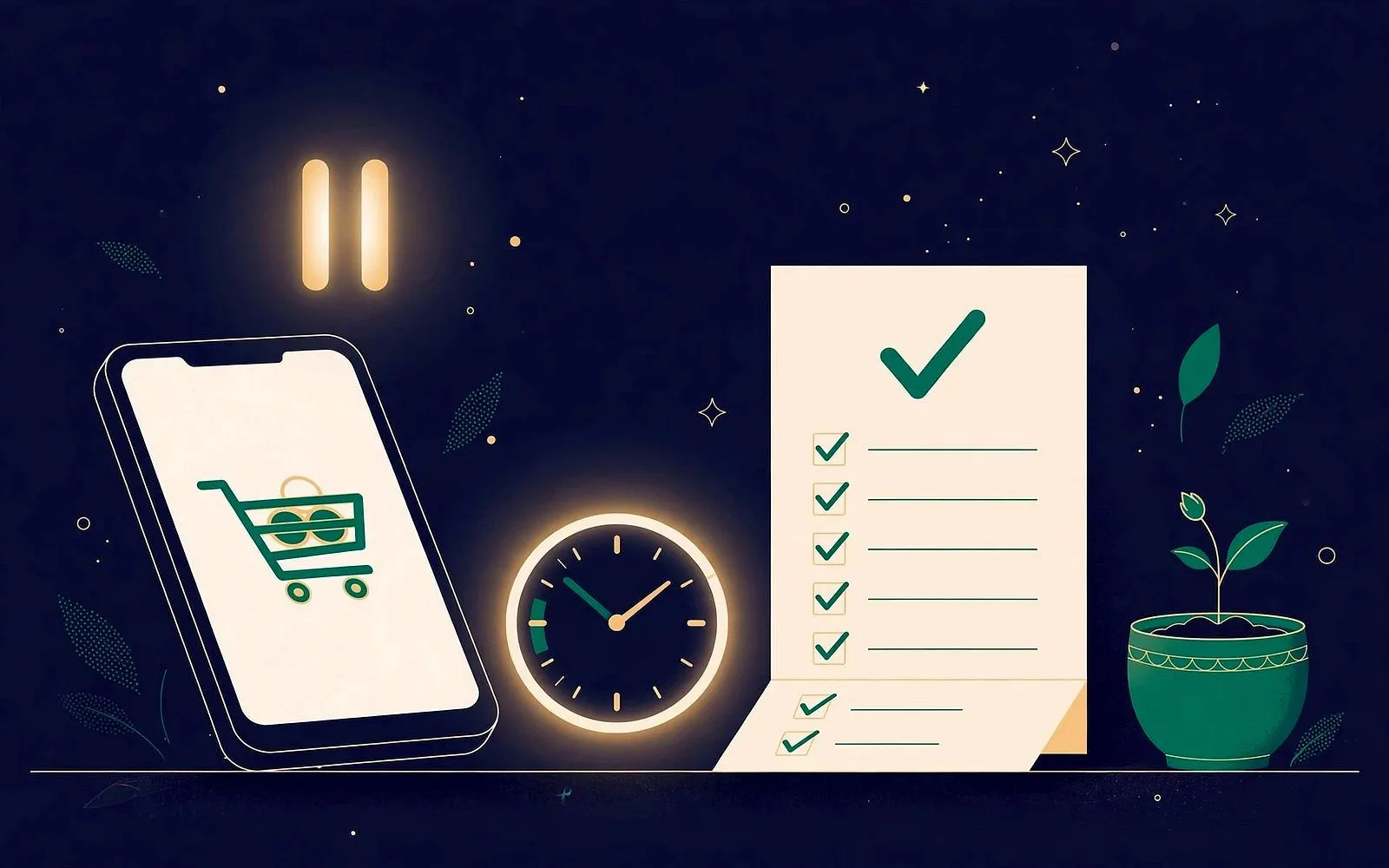
Wait a day before buying anything unplanned. The 24-hour rule turns impulse into a decision — here's the science, the maths, and how to automate it.
In this article
You know the feeling. You open your phone to check one thing, and twenty minutes later a parcel is on its way to your door. You did not plan to buy it. You did not need it yesterday. But the advert, the countdown timer, the "only 2 left" warning and the one-click checkout did their job before your rational brain had time to catch up.
That is not a character flaw. It is a system working exactly as designed — and the 24-hour rule is the simplest way to break it. The rule is one sentence long: if a purchase was not planned, wait a full day before buying it. No spreadsheets, no willpower contest, no guilt. Just a pause. This guide explains why the pause works, what it is worth in real money, and — most importantly — how to make it automatic, so you do not have to rely on discipline in the moment you are least likely to have it.
How big is the impulse problem?
Bigger than most of us admit. A PartnerCentric survey of 1,007 US consumers in late March 2026 found that 81% had already made at least one impulse purchase that year — an average of seven impulse buys, totalling $350, in the first quarter alone, with a median spend of $50 per purchase. The average person's single biggest impulse buy of the year so far cost $355. And this happened while 53% of the same respondents said their overall budget was tighter in 2026 than in 2025. People are not impulse-buying because they feel rich. They are impulse-buying while feeling squeezed.
The pattern is strongest among younger shoppers: 86% of Gen Z and 85% of millennials reported impulse buying in 2026. The most common impulse categories were food and drink (54%), clothing (53%), electronics (35%) and shoes or accessories (26%). Online, the habit is near-universal: an Adobe study of 1,003 US consumers published in June 2026 found that 86% make at least one unplanned online purchase every month, and nearly one in five spends more than $1,800 a year on unplanned buys. Capital One Shopping's 2026 research puts the average monthly impulse spend at roughly $250–$282 — around $3,000–$3,400 a year. That is not a rounding error. For many households it is larger than a month's rent, a holiday, or the entire emergency fund they have been meaning to build.
Why your brain buys before you think
Impulse buying has been studied for decades. Consumer researcher Dennis Rook defined it in 1987 as a "sudden, often powerful and persistent urge to buy something immediately" — and the key word is immediately. The urge is designed to collapse the gap between wanting and owning, because that gap is where rational thought lives.
The chemistry is well documented. Dopamine, the brain's reward chemical, spikes at the prospect of acquiring something, not at owning it. That is why the high peaks while you are browsing and fades within days of the parcel arriving — and why buyer's remorse is so common. Research on intertemporal choice by Pine and colleagues found that raising dopamine activity made people more impulsive by changing how they valued sooner versus later rewards. Economist George Loewenstein's 1996 work on "visceral influences" showed the same thing from the other side: intense in-the-moment states — cravings, moods, excitement — crowd out long-term goals. Brain-imaging research agrees: a 2007 study by Knutson and colleagues, published in Neuron, found that liking a product and seeing an excessive price activated different brain regions, and both helped predict whether someone would buy. The purchase decision is, quite literally, a contest between two parts of your brain — and the part that wants the thing gets a head start.
The urge to buy is not a flaw in your character. It is a feature of the environment: one-click checkout, saved cards, countdown timers and "buy now, pay later" all exist to shrink the gap between wanting and owning to zero. A waiting rule simply puts the gap back.
Retailers have spent billions removing friction from that gap. Saved payment details mean you never type a card number. One-click checkout means you never see a total before committing. Buy-now-pay-later splits the price into four painless-looking instalments. And paying by card or phone already weakens the "pain of paying": classic research by Prelec and Simester found people spend more readily with cards than with cash, because cash makes the cost feel real in a way a tap does not. The 24-hour rule is not a test of willpower. It is a piece of friction you install on purpose, in a world that has removed all the natural friction.
What the 24-hour rule actually is
The rule is simple: when you want to buy something you did not plan to buy, write it down and wait 24 hours. If you still want it tomorrow, and you can say why in one sentence, buy it. If the urge has faded — and most of the time it will have — you have just kept the money.
The wait should scale with the price. A flat 24 hours is fine for a £15 gadget, but a £400 purchase deserves longer. A practical tiered version, used by many budgeting writers, looks like this:
| Price of the unplanned item | Wait before buying | Why |
|---|---|---|
| Under £50 / $50 | 24 hours | Enough for the dopamine spike to fade and the "want" to be tested |
| £50–£200 / $50–$200 | 72 hours (3 days) | Bigger stakes, more time to check the budget and compare prices |
| Over £200 / $200 | 30 days | Use the 30-day list: if it still matters in a month, it is a real want, not a mood |
Three clarifications keep the rule honest. First, it applies to unplanned purchases — things you were not shopping for. A planned purchase you have researched and budgeted for is not an impulse, even if you buy it the same day. Second, genuine needs are exempt: a replacement for something broken that you use daily, food, medicine, and anything where waiting genuinely costs you more than buying. Third, the rule is about the decision, not the item. A £20 item you still want tomorrow is a fine purchase. A £20 item you forgot about by tomorrow was never a want at all — it was a feeling, and feelings are free.
The maths: what a day's wait is worth
The rule sounds small. The numbers are not. Take the PartnerCentric figures as a starting point and do the arithmetic yourself — these are our own calculations, labelled as such, built on the survey's published medians.
The median impulse buy is $50, and the average respondent made seven of them in a single quarter. That is $350 a quarter, or $1,400 a year at that pace. If a waiting rule stops just half of those purchases — the ones that were pure mood, not real wants — that is $700 a year back in your pocket. Use Capital One Shopping's higher monthly average of about $282 instead, and stopping half is worth roughly $1,700 a year. And for the one in five online shoppers Adobe found spending over $1,800 a year on unplanned buys, cutting that in half frees $900 a year.
| If you impulse-spend… | Per year | Stopping half saves |
|---|---|---|
| 7 buys a quarter at the $50 median (PartnerCentric) | ~$1,400 | ~$700 |
| ~$282 a month (Capital One Shopping average) | ~$3,384 | ~$1,692 |
| Over $1,800 a year (Adobe: ~1 in 5 shoppers) | $1,800+ | $900+ |
Put the same money somewhere it compounds and the picture gets sharper. Our own calculation: $700 a year, invested at a 7% average annual return, grows to roughly $7,200 after 10 years and about $28,500 after 30 years — and that assumes the impulse spending never grows, which it usually does. These are illustrations, not promises; returns vary and are never guaranteed. But they show what is really at stake. The 24-hour rule is not about denying yourself small pleasures. It is about deciding which pleasures are actually yours.
The one-sentence test: when the 24 hours are up, finish this sentence out loud — "I am buying this because…" If the honest ending is "because it was on sale" or "because I had a bad day", skip it. If the ending is a real use — "because my headphones broke and I use them every day" — buy it and enjoy it.
Making it automatic: the system does the waiting
Here is the part most advice skips. A rule you have to remember in the heat of the moment is a rule that will fail exactly when you need it. Psychologist Walter Mischel's delay-of-gratification work showed that the children who waited best used strategies — they looked away, reframed the treat, distracted themselves — rather than raw willpower. The goal is the same here: build a setup where the wait happens by default.
Start with the checkout itself. Delete saved cards from your shopping apps and browser so every purchase requires finding your wallet and typing sixteen digits. That thirty-second delay is often enough on its own. Turn off one-click ordering and "buy it now" buttons wherever you can. Log out of shopping apps after each use, or delete the apps entirely and shop only from a desktop browser. Each of these adds a small step — and small steps are exactly what impulse buying cannot survive.
Next, replace the cart with a list. When you see something you want, do not add it to your basket — add it to a wishlist, a notes app, or a screenshot folder with the date. Writing an item down satisfies a surprising amount of the urge: the brain registers the want as "captured" rather than "lost". Then set a phone reminder for 24 hours later. When it pings, open the list and ask the one-sentence question. Most items will look faintly embarrassing by then. That is the rule working.
Then automate the money side. Give impulse spending a home: a small "fun money" amount in your budget — say £50 a month — that you can spend on anything, no questions asked, no guilt attached. When it is gone, it is gone until next month. And automate the opposite direction too: set a payday transfer that moves money to savings the moment you are paid, before you have a chance to spend it. The combination is powerful: the fun-money pot makes the rule feel fair instead of punishing, and the payday transfer means the money you are protecting is already out of reach.
Watch for the workarounds. Buy-now-pay-later is the biggest one: splitting a £120 purchase into four £30 payments makes it feel like a £30 purchase, which is exactly the point. Treat BNPL as a purchase at full price, run it through the same 24-hour wait, and never use it to buy something you could not afford outright. The same goes for "free" trials that convert to paid subscriptions and for "limited-time" sales — most sales repeat within weeks, and a discount you miss is not a loss.
Finally, add one human element: tell someone. A partner, a friend, a group chat — anyone you can text with "talk me out of this". Saying a purchase out loud to another person breaks the private little world in which impulse buying thrives.
What to do during the 24 hours
The wait is not empty time. Use it to run five quick checks — they take about three minutes total:
- Do I already own something that does this? Check the cupboard, the drawer, the app you already pay for. Duplicate purchases are the most common impulse regret.
- Where will it live? If you cannot name the shelf, the hook or the folder, you are buying clutter, not a thing.
- What happens if I do not buy it? If the honest answer is "nothing", the purchase is entertainment, not a need — and entertainment is fine, but only if you choose it deliberately.
- Check the price elsewhere. A 24-hour wait gives you time to find the same item cheaper, or to discover it is cheaper every other week and the "sale" is theatre.
- Check the budget. Look at your fun-money balance. If the item fits inside it, buy it tomorrow without guilt. If it does not, the rule has just done its job.
If the item survives all five checks and you still want it tomorrow, buy it. The rule is not a punishment. A purchase that survives a day of scrutiny is usually a good purchase — and enjoying it without the aftertaste of regret is the whole point.
When waiting is the wrong move
No rule fits every situation. Skip the wait for genuine needs: food, medicine, a replacement for something you use daily that has broken, and anything where delay has a real cost — a train ticket that genuinely rises in price, a bill deadline. The rule targets unplanned wants, not life's logistics.
Two other things are worth knowing. First, in the UK you already have a legal cooling-off period: under the Consumer Contracts Regulations 2013, most goods bought online, by phone or by mail order can be cancelled within 14 days of receiving them, for any reason. That is a safety net, not a strategy — returning things costs time, postage and hassle, and the money is gone from your account until the refund lands. Waiting 24 hours before buying beats returning something for 14 days after. (In the US there is no equivalent general cooling-off right for online purchases, so the wait matters even more.)
Frequently asked questions
Does the 24-hour rule work for small purchases too?
Yes — small purchases are where it earns most. A $50 median buy feels too small to think about, which is why seven of them a quarter quietly add up to $350. If a purchase is under your personal "trivial" threshold — say £5 — skip the wait; below that, the admin costs more than the saving.
What if the sale ends tonight?
Ask whether the sale is real. Most "ends tonight" sales return within weeks, often at the same price — retailers run them on rotation. If it is a genuine one-off, like a one-day event ticket you have wanted for a while, that is a planned purchase, not an impulse, and the rule does not apply. The rule targets things you discovered today.
What about food and groceries?
Food is the most common impulse category (54% in the PartnerCentric survey), but you cannot wait a day to buy dinner. Use a lighter version: a shopping list, no shopping while hungry, and anything not on the list goes back on the shelf. The full 24-hour rule is for non-essentials.
How is this different from the 30-day list?
They are the same idea at different scales. The 24-hour rule is for everyday impulse buys — the social-media find, the late-night cart, the "treat yourself" gadget. The 30-day list is for bigger wants over £200: write them down and revisit them a month later. Use the 24-hour rule as your daily filter and the 30-day list as your big-ticket escalation.
What if I still want it after 24 hours?
Then buy it — that is the rule working as intended. The point was never to stop buying things. It was to stop buying things you do not actually want. A purchase that survives a day, five checks and a one-sentence reason is a considered purchase, and considered purchases are the ones you enjoy rather than regret.
Key takeaways
- 81% of consumers impulse-bought in 2026, averaging seven buys and $350 in the first quarter alone — with a $50 median per purchase.
- Impulse buying is driven by dopamine at the moment of wanting, not owning — which is why the high fades and the regret arrives after delivery.
- The 24-hour rule: any unplanned purchase waits a full day. Scale the wait with price — 24 hours under £50, 72 hours up to £200, 30 days above that.
- The maths is real: stopping half of median-level impulse buys is worth roughly $700 a year, and about $1,700 a year at Capital One Shopping's higher average.
- Make it automatic: delete saved cards, turn off one-click, wishlist instead of cart, and give yourself a guilt-free fun-money pot so the rule feels fair.
- If you still want it tomorrow and can say why in one sentence, buy it and enjoy it — the rule is a filter, not a punishment.
Start tonight. Open your most-used shopping app, delete the saved card, and move one item from your cart to a wishlist with tomorrow's date on it. That is the whole system: a pause, a list, and a default that says "not yet". Most of the things on that list will never get bought — and you will not miss a single one of them.
Sources
- PartnerCentric — Impulse Buying Statistics 2026
- USA Today — Impulse buying is up despite financial crunch
- QuestionPro — Impulsive Buying: What It Is and How to Stop It
- Fortunly — Impulse Buying Statistics 2026
- PPC Land — Adobe data on 86% unplanned buys
- 403fin — The 24-Hour Rule, the 30-Day List, and the $100 Test
- Yes or No Wheel Picker — How to Stop Impulse Buying: 6 Rules
- Practical Saver — The 24-Hour Rule
- Which? — What's a cooling-off period?
The MoneyHabit editorial desk researches, writes and reviews every article against our editorial policy.
The Sunday Habit
One useful money idea, every week.
A short, practical email every Sunday — no spam, no selling your address, unsubscribe anytime.
Advertisement
More in Money Habits

Money Habits · Habit
The 48-hour rule for non-essential purchases
A pause between wanting and buying is one of the cheapest habits you can build.
17 October 2026 · 6 min read

Money Habits · Guide
Never Lend Money to Family? The Gift Rule, Explained
Dave Ramsey's viral rule is blunt: never lend money to family — give it as a gift or say no. Here's what the surveys say, and how to decide.
19 November 2026 · 10 min read
Money Habits · Habit
Millionaires Mastered Boredom. That's Why They're Rich
A viral clip says millionaires mastered boredom. The science and the Fidelity data agree — boring habits are what actually build wealth.
19 November 2026 · 10 min read