Habit
The Windfall Protocol: Decide Before the Money Lands
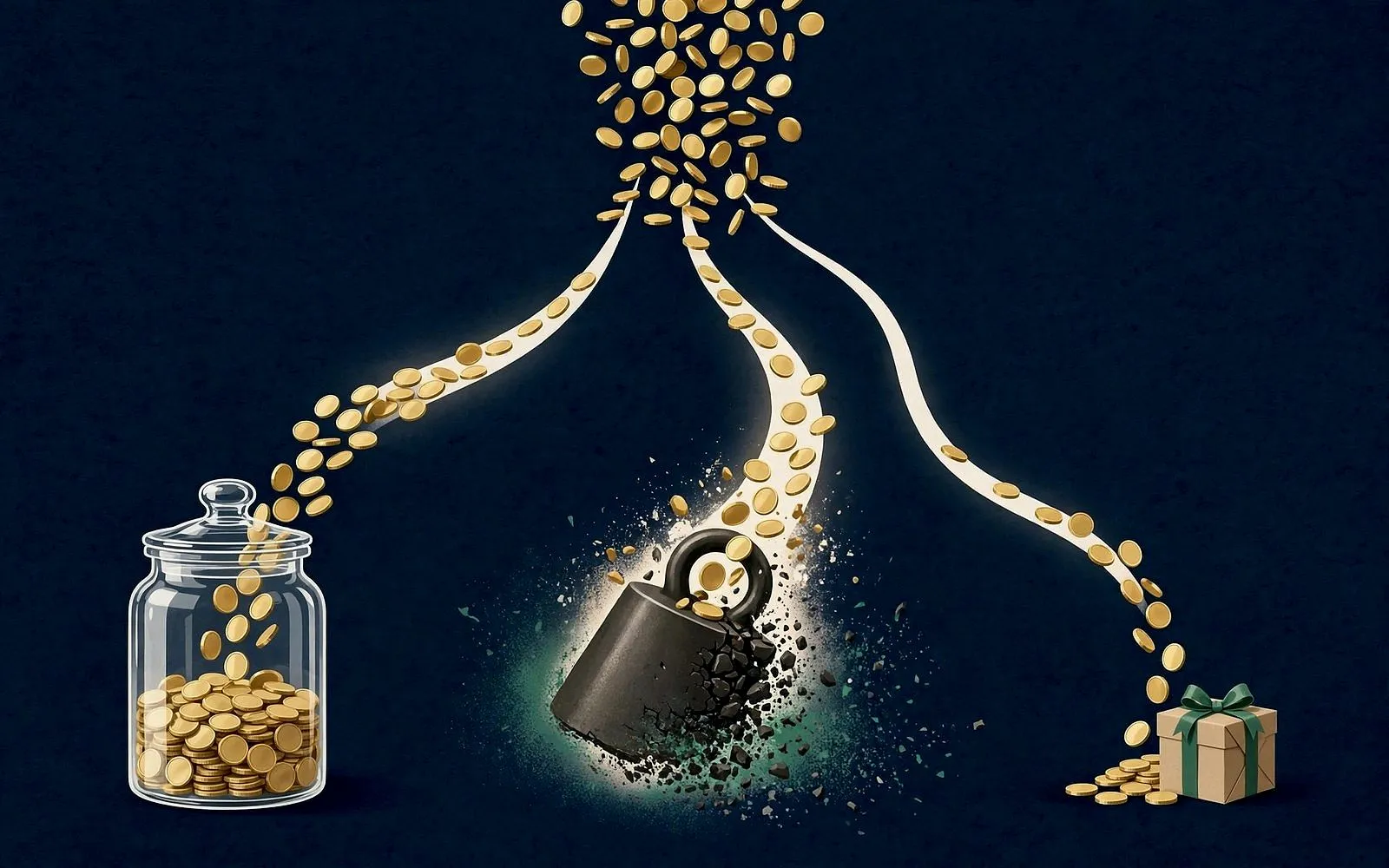
Bonuses, tax refunds and pay rises feel like free money — which is why they vanish. A protocol, decided before the cash lands, puts every dollar to work.
In this article
- Why windfalls vanish faster than wages
- The three windfalls, in numbers
- 1. The year-end bonus
- 2. The tax refund
- 3. The pay rise
- The protocol: five steps, decided in advance
- Step 1 — Name the windfall and the date
- Step 2 — Split it with the 50/40/10 rule
- Step 3 — Pay the expensive debt first
- Step 4 — Capture the raise before you feel it
- Step 5 — The 72-hour rule for the fun slice
- The mistakes that undo the protocol
- A note for UK readers
- Frequently asked questions
- Key takeaways
Some money arrives on a schedule. Your salary lands, the bills go out, and the month rolls on. Other money arrives all at once: a year-end bonus in December, a tax refund in spring, a pay rise that quietly lifts next month's pay. It feels like found money — and that feeling is exactly why it disappears.
This article is about a habit, not a windfall. The windfall protocol is a decision you make before the money lands: where every pound or dollar of it goes, written down in advance, so that by the time it arrives there is nothing left to decide in the heat of the moment. It takes about twenty minutes to set up, and it is the difference between a bonus that changes your year and a bonus you cannot remember spending.
Why windfalls vanish faster than wages
Money is supposed to be fungible — a dollar is a dollar, wherever it came from. Your brain does not agree. The economist Richard Thaler called the gap mental accounting: we sort money into mental buckets and treat each bucket by different rules, even when the amounts are identical. A 2026 reading from the Federal Reserve Bank of St. Louis puts it plainly: people spend gifts and refunds far more easily than wages, and a tax refund is the classic case — it feels like a bonus, but it is really your own money, overpaid during the year and now returned.
The research behind that feeling is consistent. A 2025 meta-analysis of 36 studies on the "house-money effect" — the tendency to take more risks and spend more freely after an unexpected gain — found a real, if modest, effect across the experiments (Frontiers in Psychology, 2025). And in a well-known experiment by Epley and colleagues, students who received a tuition refund spent significantly more of it when it was described to them as a "bonus" than when the identical sum was described as a "rebate". The amount was the same. The label changed the behaviour.
Real-world data shows the same pattern at scale. In LendingTree's March 2026 survey of more than 1,500 US tax filers, 54% said they expected to use their refund within a month of receiving it, and 46% said they were relying on getting one. An Omnisend survey of 1,370 Americans the same month found 47.5% planned to spend up to a quarter of their refund on shopping, while 24% expected to spend half or more of it. The money is not being wasted, exactly — most of it goes to bills, savings and debt — but it is being spent fast, and usually without a plan made in advance.
Your brain guards the money it worked for and treats money that showed up unexpectedly as free to spend. The protocol exists to close that gap before the money arrives.
The three windfalls, in numbers
Windfalls come in three shapes, and each one has its own trap.
1. The year-end bonus
Bonuses are rarer than people assume. Payroll data from Gusto, covering more than 400,000 small businesses, found the average year-end bonus paid in December 2025 was $2,789, up 11.5% on the year before — but only 18% of employees received one at all. The Bureau of Labor Statistics reports that just 15% of private-industry workers had access to an end-of-year bonus as of March 2026. The trap with a bonus is the gross figure: in the US, bonuses are typically withheld at a flat 22% federal supplemental rate, so a $2,789 bonus arrives closer to $2,175 before state tax and other deductions. Budgeting the headline number is the first mistake.
2. The tax refund
The average US federal tax refund in the 2026 filing season was $3,273, according to IRS filing-season statistics through 1 May 2026 — 97.9 million refunds totalling $320.5 billion. It is the largest single lump sum most households receive all year, and the most psychologically dangerous, because it feels like a gift from the government. It is not: it is an interest-free loan you gave the government, now repaid. The trap is treating it as income rather than as a correction.
3. The pay rise
A raise is the quietest windfall, and the easiest to lose. Employer surveys put the average 2026 merit increase at about 3.1%, with total salary-increase budgets around 3.5% (Mercer/WTW via WorldatWork). On a $60,000 salary, a 3.1% rise is $1,860 a year — about $155 a month before tax, roughly $121 after tax at a 22% marginal rate (own calculations). That is small enough to vanish into everyday spending without a trace, and large enough to matter enormously if it is captured: $155 a month invested at a 7% average annual return grows to roughly $26,800 over ten years (own calculation, assuming steady monthly contributions and no withdrawals — a real return would vary). The trap is lifestyle creep: the raise lands, spending drifts up by exactly the same amount, and a year later nothing has changed except the salary figure.
The protocol: five steps, decided in advance
The protocol has one rule that matters more than the rest: decide the split before the money lands. Write it down — in a note on your phone, on paper, anywhere you will see it. A decision made in advance beats a decision made with the money already in your account, because the second decision is made by the part of your brain that treats windfalls as free.
Step 1 — Name the windfall and the date
Write down what is coming, when, and roughly how much. "December bonus, about $2,800 gross, expect around $2,200 after tax." "Tax refund, filed in February, last year's was $3,100." "Raise effective 1 January, about $155 a month." Naming the date matters: a decision with a deadline gets made; a vague intention does not.
Step 2 — Split it with the 50/40/10 rule
For a lump sum, use a simple default split: 50% to expensive debt, 40% to savings or goals, 10% to fun. Adjust the ratio to your situation — if you have no high-interest debt, move that 50% to savings; if your emergency fund is empty, it goes there first. The 10% fun slice is not a weakness in the plan; it is what keeps the plan alive. A protocol that allows nothing enjoyable gets abandoned the first time a windfall arrives.
| Windfall | Amount | Debt (50%) | Savings (40%) | Fun (10%) |
|---|---|---|---|---|
| Year-end bonus (after tax) | ~$2,175 | ~$1,088 | ~$870 | ~$218 |
| Average tax refund | $3,273 | ~$1,637 | ~$1,309 | ~$327 |
| Pay rise (per month) | ~$155 gross | — | — | — |
The pay rise is different: it is a monthly windfall, so it gets a different treatment, in step 4.
Step 3 — Pay the expensive debt first
Order matters more than the split. High-interest debt comes before everything except overdue bills and a small emergency cushion. The maths is blunt: putting $1,637 of a refund toward a credit card charging 22% APR saves about $360 a year in interest (own calculation). No savings account or investment reliably beats that, because paying off a 22% card is the equivalent of earning a guaranteed 22% return. Work through debts from the highest interest rate down, and ignore the balances — a small card at 26% costs more per dollar than a large loan at 7%.
Start with a cushion, not a clean slate. If you have no emergency savings at all, keep the first $500–$1,000 of the windfall in an easy-access account before attacking debt. Otherwise the next unexpected bill goes straight back onto the card you just paid off — and the protocol fails for a reason that was entirely predictable.
Step 4 — Capture the raise before you feel it
A pay rise is the one windfall you can make invisible. On the day the raise is confirmed — not the day it first appears in your pay — increase your pension or retirement contribution, or your automatic savings transfer, by the same amount. If your employer lets you split the raise, send half to the pension and keep half in your pay as a reward; the half you never see is the half that compounds. The key is timing: adjust the contribution before the first larger paycheck lands, while your spending is still calibrated to the old salary. Once spending rises to meet the new pay, capturing it requires willpower. Before it lands, it requires one form.
Step 5 — The 72-hour rule for the fun slice
The 10% fun slice is yours to enjoy — but give it a 72-hour cooling-off period for any single purchase over about $100. The house-money effect is strongest in the first days after money arrives, when it still feels like someone else's. Three days is enough for the "free money" feeling to fade and for you to notice whether you actually want the thing, or just the feeling of spending. If you still want it after 72 hours, buy it without guilt. That is what the slice is for.
The mistakes that undo the protocol
Spending it before it arrives. The most expensive windfall mistake is committing the money — a holiday, a car deposit, a new sofa — before the bonus is confirmed or the refund is in the account. Bonuses get cut, refunds get delayed, raises get frozen. The protocol only covers money that has actually landed.
Beyond that, four mistakes recur:
- Budgeting the gross, not the net. A $2,789 bonus is not $2,789 of spending power. Tax, and in some countries social charges, come off first. Plan from the after-tax figure.
- Treating a refund as a raise. A refund is a one-off correction, not a pay increase. Spending it as if your income has permanently risen is how a $3,273 refund becomes a $3,273-a-year lifestyle increase you cannot afford.
- Paying the smallest debt first for the wrong reason. Clearing a small balance feels good, but if a larger balance charges a higher rate, the maths says otherwise. Pay by interest rate, not by balance — unless the small win is what keeps you going, in which case name that trade-off honestly.
- Skipping the fun slice. A plan with no enjoyment in it is a plan you will break. The 10% is not a leak; it is the seal that keeps the other 90% in place.
A note for UK readers
The protocol works the same way in the UK, with different plumbing. Bonuses are taxed through PAYE in the month they are paid, so a large December bonus can push you into a higher tax band for that month — and the tax is usually corrected automatically in later months, not refunded in a lump sum. Tax refunds from HMRC typically arrive after a P800 tax calculation or a self-assessment claim, and they are your own overpaid tax coming back, just like a US refund. The most powerful place to send a captured pay rise is often a pension via salary sacrifice, where it also saves National Insurance, or an ISA — the 2026/27 allowance is £20,000 across all ISAs. The same rule applies: decide the split before the money lands, and let the fun slice be 10%, not 100%.
Frequently asked questions
What if my windfall is tiny — is the protocol worth it?
Yes, and the smaller the windfall, the more the protocol matters. A $300 rebate split 50/40/10 is $150 off a card, $120 into savings and $30 of fun — small numbers, but the habit is the asset. The protocol is a decision-making system, not a wealth threshold.
Should I pay off debt or save first?
Keep a small cushion first ($500–$1,000 if you have none), then attack debt charging roughly 8–10% or more. Below that rate, the choice between debt and saving is closer, and building the emergency fund to one month of essentials usually wins. Above it, the debt almost always wins.
What if I already spent this year's bonus?
Then the protocol starts with the next windfall, not with guilt about the last one. Write the split for the next one now — the refund, the next bonus, the next raise — and set a calendar reminder for the week before it lands. The protocol is forward-looking by design.
Does the 10% fun slice really matter?
It matters more than the other 90% combined, in one sense: it is what makes the plan survivable. Research on windfalls shows that money labelled as a "bonus" gets spent more freely than the same money labelled a "rebate". Giving the fun impulse a bounded, pre-approved outlet uses that psychology instead of fighting it.
How do I handle a pay rise if my employer auto-enrols me in a pension?
Check whether your contribution is a percentage of salary — if it is, part of the raise is already captured automatically. Then decide what to do with the rest before the first larger paycheck: raise the percentage by a point or two, or set up an automatic transfer for the same day the new pay lands.
Key takeaways
- Windfalls feel like free money because of mental accounting — your brain treats unexpected cash differently from wages, and the house-money effect is real.
- Decide the split before the money lands: 50% to expensive debt, 40% to savings or goals, 10% to fun is a strong default.
- A $3,273 average refund or a $2,789 average bonus is the biggest lump sum most households see all year — plan it from the after-tax figure, not the headline.
- Capture a pay rise the day it is confirmed by raising your pension or savings contribution before the first bigger paycheck arrives.
- Keep a small emergency cushion first, pay the highest-rate debt next, and give the fun slice a 72-hour cooling-off rule.
The windfall protocol is not about being strict. It is about being early. A bonus, a refund or a raise is only a windfall once — after that, it is either part of your progress or part of your spending. Twenty minutes with a note on your phone, written before the money lands, decides which one it becomes. Your next windfall is already on its way. Decide what it is for, now.
Sources
- IRS — 2026 filing season statistics (May 1, 2026)
- Federal Reserve Bank of St. Louis — How Mental Accounting Shapes Our Financial Choices
- Frontiers in Psychology — House-money effect meta-analysis (2025)
- LendingTree — 2026 tax refund survey
- Omnisend — Tax refunds 2026 spending survey
- Gusto — Year-end bonuses 2026
- BLS — Nonproduction bonuses factsheet
- WorldatWork — Mercer forecasts 3.5% salary increase budgets for 2026
The MoneyHabit editorial desk researches, writes and reviews every article against our editorial policy.
The Sunday Habit
One useful money idea, every week.
A short, practical email every Sunday — no spam, no selling your address, unsubscribe anytime.
Advertisement
More in Money Habits

Money Habits · Checklist
The End-of-Year Money Audit: 7 Checks to Run Before January
Late October is the sweet spot for a 60-minute money audit: 7 checks that catch wasted subscriptions, expiring tax deadlines and safety gaps before December.
24 October 2026 · 6 min read
Money Habits · Guide
How to Split Money With a Roommate Fairly
Splitting rent and bills with a roommate sounds simple until the first late payment. Here is a fair system — and the agreement that keeps the friendship intact.
20 November 2026 · 11 min read

Money Habits · Guide
Never Lend Money to Family? The Gift Rule, Explained
Dave Ramsey's viral rule is blunt: never lend money to family — give it as a gift or say no. Here's what the surveys say, and how to decide.
19 November 2026 · 10 min read