Guide
The 30-Day List: A Calmer Way to Handle Wants
Write every want on a list, date it, and wait 30 days. What still matters gets bought; the rest fades — saving the average impulse shopper over $1,500 a year.
In this article
You know the feeling. You see something — a jacket, a gadget, a pair of shoes you did not know existed ten minutes ago — and suddenly it feels urgent. Not "nice to have" urgent. Buy it now or regret it forever urgent. So you buy it. And a month later it sits unworn, unopened, or quietly resold at a loss.
The numbers say this is not a rare slip. It is a routine. Capital One Shopping's 2025 analysis of real purchase data puts the average American's impulse spending at $254 a month — roughly ten unplanned purchases at about $26 each, or $3,045 a year. More than nine in ten shoppers (92%) have impulse-bought, and over half have spent $100 or more on a single impulse buy.
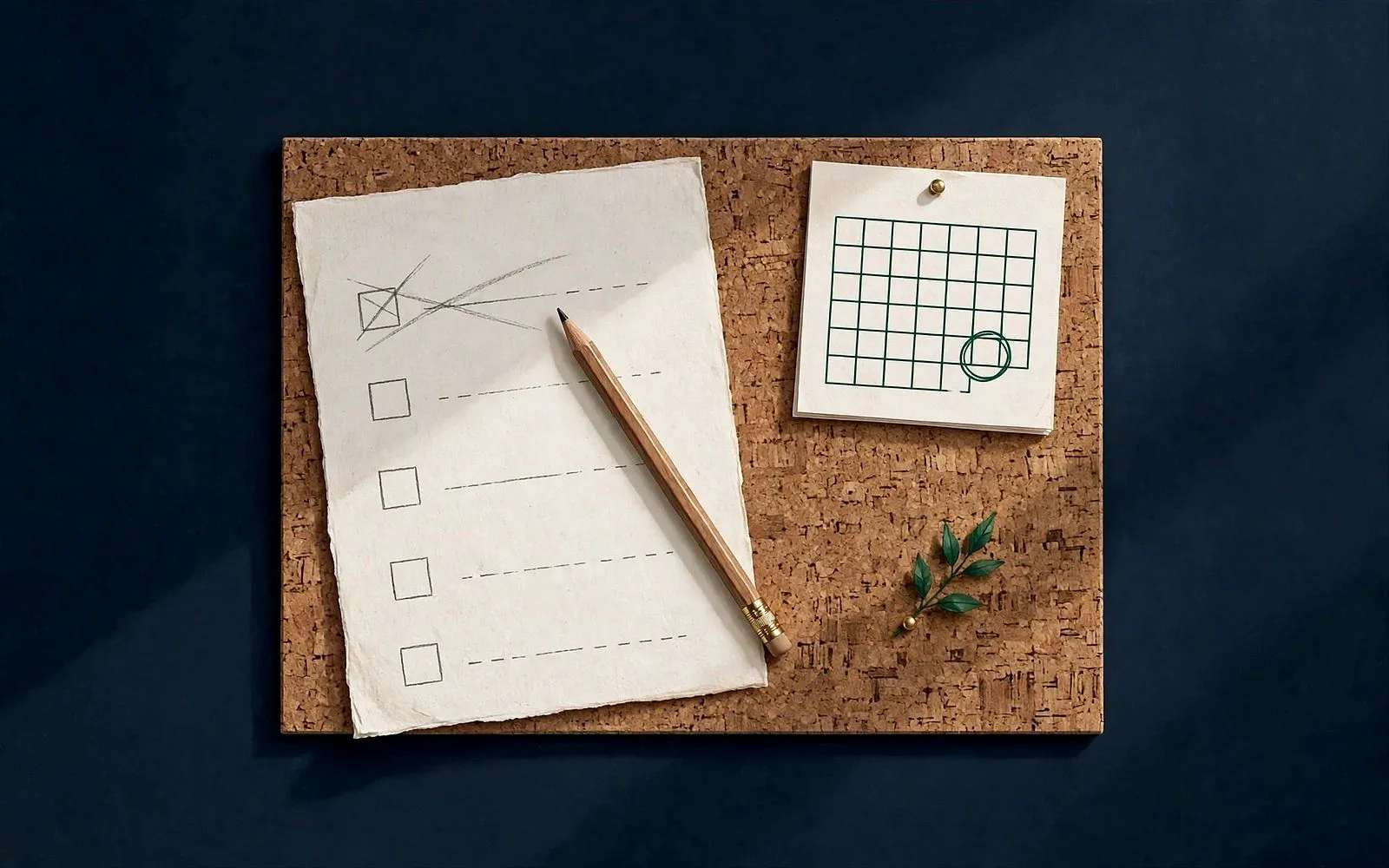
The 30-day list is the simplest system I know for breaking that cycle. It is not a budget, a ban, or a test of willpower. It is a piece of paper — physical or digital — where every non-essential want goes to wait for 30 days. If you still want it after a month, you buy it, guilt-free. Most of the time, you will not.
Why wants feel so urgent
Impulse buying is not a character flaw. It is a predictable response to an environment designed to make you buy fast. Three forces do most of the work.
First, shopping genuinely changes how you feel. A study published in the Journal of Consumer Psychology found, across three experiments, that making shopping decisions reduced lingering sadness by restoring a sense of personal control. That is why a bad day so often ends with a parcel on the way: the purchase is not really about the item, it is about feeling in control again. A 2025 LendingTree survey of 2,000 American consumers found that 63% acknowledge emotions influence their purchases — and among those emotional shoppers, 74% said their feelings had caused them to overspend.
Second, social media turned wanting into a feed. Bankrate found that Americans spent an estimated $71 billion on social-media-inspired impulse purchases in a single year, with those buyers averaging $754 a year from that channel alone. The want arrives pre-packaged: a creator you trust, a link in the bio, a discount code that expires tonight.
Third, friction has disappeared. One-click checkout, saved cards and buy-now-pay-later mean the gap between "I want it" and "I bought it" is now seconds. A 2025 PartnerCentric survey of more than 1,000 shoppers found that 77% made a purchase within a week of starting their research — and 15% checked out the same day. Capital One Shopping's data shows 35% of people paid for their most recent impulse buy with a credit card, and nearly 10% used buy-now-pay-later. When buying takes no effort, not buying takes all of it.
The key insight: an impulse is a spike, not a preference. It peaks fast and fades fast. The 30-day list works because it does not fight the spike — it simply refuses to transact during it.
What the 30-day list actually is
The rule is one sentence: when you want something non-essential, write it on the list with today's date and the price — and do not buy it for 30 days.
That is the whole system. It differs from the better-known 30/30 rule popularised by The Minimalists — wait 30 hours for anything over $30, and 30 days for anything over $100 — in one important way: the list keeps a record. The 30/30 rule is a pause; the 30-day list is a pause with a memory. You can see, at a glance, everything you wanted last month and how little of it you still want. That record is what makes the system stick, because it turns an abstract claim ("I waste money on impulse buys") into evidence you wrote yourself.
What goes on the list: clothes, gadgets, homeware, hobby gear, books, games, cosmetics, decor — anything that is a want rather than a need. What does not: groceries, cleaning supplies, replacement essentials (a broken phone charger, worn-out work shoes), bills, and anything genuinely time-sensitive, like a gift for a birthday this weekend.
How to run your list in five steps
1. Capture it immediately. The moment you want something, add it: item, price, date, and where you saw it. A notes app works; a shared note works better if a partner or housemate is doing it with you. The capture itself is the intervention — writing "£85 linen jacket, 8 Nov" takes thirty seconds and breaks the trance of the checkout page.
2. Close the tab. Do not leave it in a cart. Carts are designed to pull you back with "low stock" emails and "your item is waiting" nudges. If the shop offers a wishlist, use that instead — or just trust the list. If you cannot find it again in 30 days, that is useful information too.
3. Let it sit. Do nothing. No researching reviews, no checking for price drops, no "just looking". The list does the work while you get on with your life. Most items will quietly stop mattering somewhere around day ten.
4. Review once a week. A two-minute Sunday scan is enough. Delete anything that now looks silly. Notice patterns: is it always the same category? The same time of day? The same app? The review is where the list teaches you about yourself.
5. Decide at day 30. When an item reaches its date, ask the three questions below. If it passes, buy it — deliberately, and enjoy it. A purchase that survives 30 days of cooling off is almost never a regret.
The three questions at day 30
| Question | What it catches |
|---|---|
| Do I still want it — really? | The want that evaporated. If you forgot the item existed, the answer is no. |
| Will I use it in the next 30 days? | The aspirational buy: the bread maker, the running shoes, the hobby kit for a hobby you do not have. |
| Can I pay for it without borrowing? | The buy that would land on a credit card and linger. If the answer is no, the item goes back on the list, not into a cart. |
If an item fails any of the three, cross it off. Do not move it to a new list or extend the deadline — that is just procrastination with extra steps. The crossed-off items are the point: each one is money you kept.
What the maths says
Start with the average. At $254 a month in impulse spending, the typical shopper spends about $3,045 a year on things they did not plan to buy. The list will not eliminate all of that — some items will pass the 30 days and be worth buying. But if it filters out even half, the saving is around $1,520 a year. That is the honest, conservative version of the claim: not "never buy anything fun again", just "buy the half you actually still want".
| If the list filters out… | You keep per year | After 10 years, invested at 7%* |
|---|---|---|
| 25% of impulse buys | ≈ $760 | ≈ $11,000 |
| 50% of impulse buys | ≈ $1,520 | ≈ $22,000 |
| 75% of impulse buys | ≈ $2,280 | ≈ $33,000 |
*Own calculations: monthly savings invested at 7% annual return, compounded monthly. Investing involves risk; 7% is an illustrative assumption, not a forecast.
Smaller numbers tell the same story at human scale. Six $85 impulse buys skipped in a year is $510 kept. A $120 pair of shoes worn 40 times costs $3 per wear; a $60 pair worn three times costs $20 per wear — the "cheaper" buy was the expensive one, and the 30-day wait is usually what reveals which pair you actually are.
Most of what we call "wanting" something is really just wanting the feeling of having decided. The list lets you have the decision without paying for it.
What your list will teach you
After a month or two, the list stops being a spending tool and becomes a mirror. Common patterns people discover:
- The same category, over and over. If eight of your ten list items are kitchen gadgets, the problem is not willpower — it is that cooking content is your trigger. Unfollowing two accounts may do more than any budget.
- The same time of day. Late-night scrolling is the classic impulse window: tired, bored, defences down. A "no buying after 9pm" rule, layered on the list, catches most of it.
- The same emotional trigger. Stress, boredom and celebration are the three usual suspects. Once you can name yours, you can give it a cheaper outlet — a walk, a call, a bath — instead of a parcel.
- The "sale" items you never wanted at full price. If you would not buy it at full price, a 40%-off tag has not made it a bargain. It has made a thing you did not want slightly cheaper.
Watch the traps: "sale ends tonight", "only 2 left in stock" and "free returns" are designed to defeat a waiting rule. A genuine deadline — a gift, a trip, a price that is provably about to rise — is rare. If a shop tells you the offer expires today, assume it will be back next week. It almost always is.
Where the list breaks down
Honesty requires the limits. The list is a poor fit for true emergencies and for anything with a real deadline. It also struggles with genuinely scarce items — a one-off second-hand find, a ticketed event — where waiting means losing it. For those, use a shorter pause: 24 hours, and the same three questions.
It also will not fix a budget that is broken elsewhere. If impulse buys are a symptom of a paycheque that never stretches, the list helps at the margins but the bigger levers — housing, transport, debt interest — matter more. And if shopping has become a compulsion you cannot stop despite real harm, that is beyond a list: free, confidential help exists, including StepChange and the National Debtline in the UK, and the National Foundation for Credit Counseling in the US.
Frequently asked questions
What if the price goes up while I wait?
Sometimes it does — and that is useful information. If a price rise makes you want it less, it was the price, not the item, that tempted you. If you still want it at the higher price, you have learned something real about how much it matters to you.
Does the 30-day rule apply to small purchases too?
Strictly, no. The Minimalists' version handles this well: under $30, a 30-hour wait is enough. The list is for the purchases that actually move your money — roughly $30 and above, or whatever threshold feels meaningful for your budget. Tracking every $4 coffee on the list would make the system a chore, and chores get abandoned.
What about gifts and things other people ask me to buy?
Gifts with a date are exempt — a birthday present is not an impulse buy. But the list is still useful for the gift you saw "for later" with no occasion attached. If it is still on the list when the occasion arrives, it was a good gift idea all along.
Can I use the list with buy-now-pay-later?
You can, but be careful: BNPL makes the list's job harder, because it splits the pain of paying into pieces that feel smaller than they are. If an item passes its 30 days, pay for it outright if you can. If you need BNPL to afford it, that is the list telling you the answer — the third question already caught it.
What if I still want everything after 30 days?
Then buy it — and congratulate yourself. A list where everything survives means your wants are considered, not impulsive, and the system has done its job by confirming that. If that happens every month, your threshold may simply be too low: try raising the list's minimum price.
Key takeaways
- The average shopper spends about $254 a month on impulse buys — $3,045 a year, according to Capital One Shopping's 2025 data.
- The 30-day list captures every non-essential want with a date and a price, then forbids buying it for 30 days.
- At day 30, three questions decide: do I still want it, will I use it in the next 30 days, and can I pay without borrowing?
- Filtering out just half of impulse buys keeps roughly $1,520 a year — about $22,000 over a decade if invested.
- The crossed-off items are the point: each one is money kept, and the pattern of what you cross off teaches you your real triggers.
- Exempt genuine needs, gifts with dates and true emergencies — and treat "sale ends tonight" as a trap, not a deadline.
Your next step: open a note on your phone right now and title it "30-day list". The next time something catches your eye — today, probably — write it down instead of buying it. In thirty days, you will know whether it was a want or just a moment. Most of the time, it was a moment. And moments are free.
A note for UK readers: if you do buy online and change your mind, the Consumer Contracts Regulations give you 14 days to cancel most online and telephone purchases for a full refund — a useful safety net, but a poor substitute for the 30 days that stop the purchase in the first place.
Sources
- Capital One Shopping — Impulse Buying Statistics
- Retail Brew — Consumers are still making impulse purchases — and then regretting them
- The Minimalists — The 30/30 Rule
- Penn State Pecunia — The 30-Day Rule: Stop Impulse Spending
- Newswav — Bad Day at Work, $150 Target Run: Why Stress Makes Spending Feel Better
- DontPayFull — Impulse Buying Statistics 2026
The MoneyHabit editorial desk researches, writes and reviews every article against our editorial policy.
The Sunday Habit
One useful money idea, every week.
A short, practical email every Sunday — no spam, no selling your address, unsubscribe anytime.
Advertisement
More in Smart Spending

Smart Spending · Guide
Should You Leave the Heating on Low All Day?
Martin Lewis just settled the heating debate on live TV. For most homes, heating only when you need it wins — but heavy brick houses are the exception.
14 November 2026 · 8 min read
Smart Spending · Guide
Car Insurance Renewal: The 21-Day Rule That Cuts Your Quote
Renewing your car insurance on the wrong day can cost £300+. The data says 22–26 days before renewal is cheapest — here is the full renewal playbook.
9 November 2026 · 13 min read
Smart Spending · Guide
5 Purchases That Keep You Broke — The Viral List, Costed
A viral reel lists five purchases that keep you broke. We priced each one — car, delivery, BNPL, phone and subscriptions — and the total is sobering.
5 November 2026 · 8 min read