Guide
Dollar General Shelf-Price Lawsuit, Explained
The FTC and 20 states allege Dollar General charged more at the register than the shelf showed. Here is what it costs you, and the check that protects you.
In this article
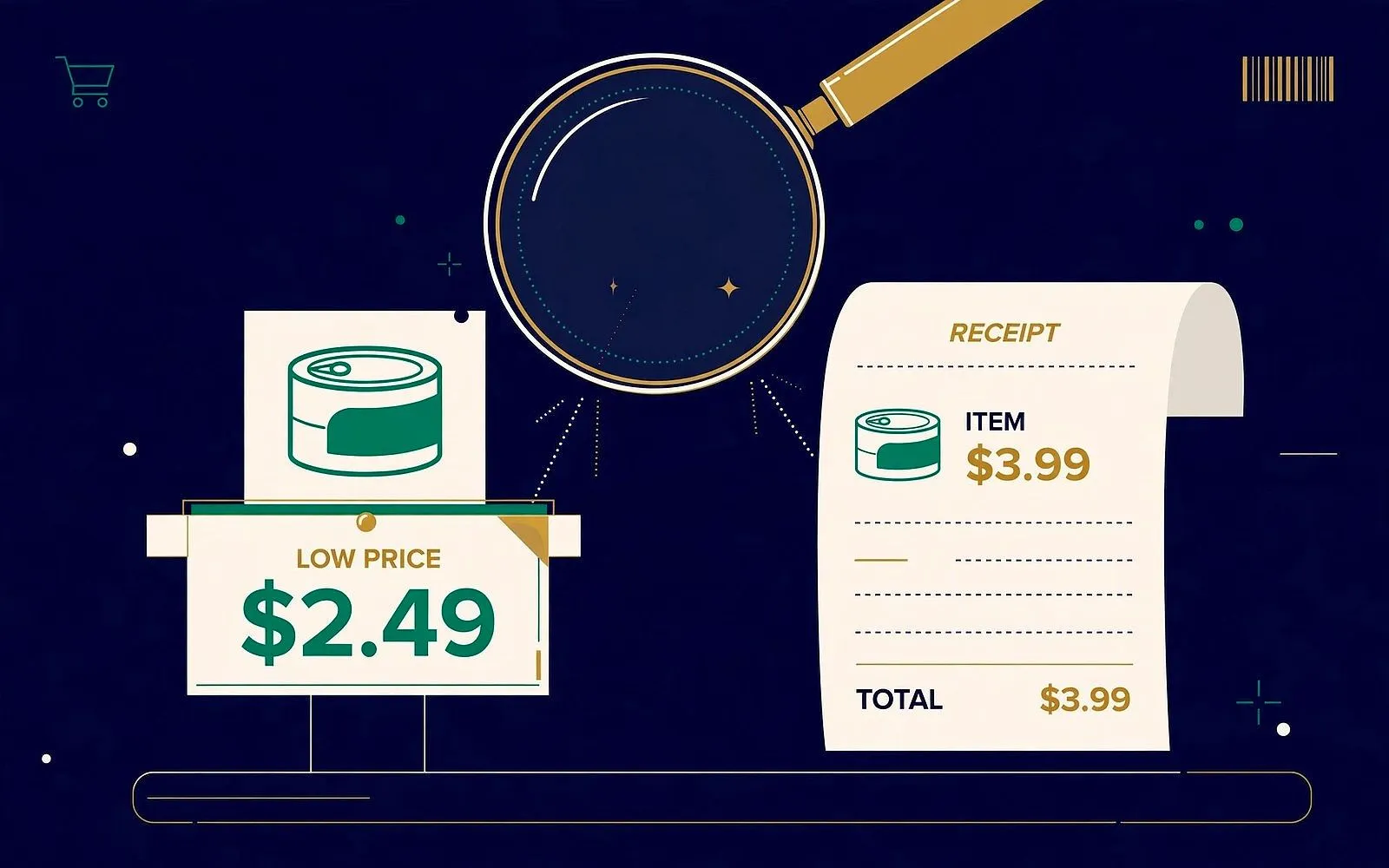
On a shelf in Ohio in 2023, a carton of eggs was marked $5.10. At the register, the same eggs rang up at $6.35. That $1.25 gap — quoted in the federal complaint — is now at the centre of one of the biggest retail pricing cases in years.
On October 26, 2026, the Federal Trade Commission and 20 states sued Dollar General in federal court in Tennessee, alleging the discount chain routinely charged shoppers more at checkout than the price shown on shelves, tags and ads. These are allegations, not findings: no court has ruled, and Dollar General says it aims for "100% accuracy between shelf and register prices" and will defend the case vigorously. But the numbers in the complaint are striking — and the lesson for your wallet is immediate. The price on the shelf is a promise. The register is where that promise gets tested.
What the lawsuit alleges
The complaint, filed in the U.S. District Court for the Middle District of Tennessee (case 3:26-cv-01693), says the problem persisted for years despite complaints, inspections and earlier settlements. The headline figures:
| Figure | What it is |
|---|---|
| 29,265 | Customer complaints Dollar General logged as "Did Not Honor Marked Price," January 2023 to March 2026, from all 48 states where it operates |
| 4 of 4 | FTC undercover purchases (January to April 2026) that ended with a net overcharge |
| 8.5%–22.4% | Share of items that rang up at a different price on those four undercover trips |
| Over 39% | Share of Kansas pricing inspections Dollar General failed, January 2023 to March 2026 |
| 53% | Share of New Mexico inspections that failed — 73 inspections between January and April 2026 |
| 7 | Prior state pricing settlements since 2019, totalling more than $6 million |
| 8 | Pricing-accuracy class actions filed against the company since 2022 |
The undercover trips are worth a closer look, because the details show how small the individual amounts are — and why the case is about the pattern, not any single receipt:
| Store | Items checked | Mispriced | Net overcharge |
|---|---|---|---|
| Cleveland, Ohio (Jan 16) | 58 | 13 (22.4%) | $3.25 |
| Springfield, Missouri | 59 | 6 | $4.07 |
| Sharpsburg, Pennsylvania | 60 | 6 | $2.60 |
| Baltimore, Maryland | 59 | 5 | $3.65 |
Two honest caveats. First, on three of the four trips, some of the errors were undercharges in the shopper's favour — the figures above are net overcharges. Second, 29,265 is a count of complaints, not transactions, and the inspection failure rates are state-specific. None of these numbers is a national error rate. The regulators' argument is that the errors kept happening, in the same direction, after the company knew about them.
The FTC's Bureau of Consumer Protection director said Dollar General "has betrayed the trust of millions of American consumers." The scale matters: the chain runs more than 21,000 stores, roughly 80% of them in towns of 20,000 people or fewer, and about 75% of Americans live within five miles of one.
Why the shelf and the register disagree
According to the complaint, the mismatch is structural. Register prices update centrally and automatically. Shelf tags change by hand — and the complaint says the company gives that job five hours a week, a slot staff call "Compliance Tuesday." Price changes are, in the complaint's words, "generally increases," so when the two systems drift apart, the lag usually runs in one direction: toward an overcharge.
The complaint also says that when shoppers spot the difference and ask for the lower price, employees often do not correct it — even though company policy, and at least two state settlements, require them to honour the lowest price. The Colorado and Pennsylvania settlements require signs telling shoppers the store will honour the lowest price. And at the register itself, the complaint says prices flash quickly on the screen, and in some stores the customer-facing display does not clearly show each item's price at all.
None of this is proven. But the history is what makes the case unusual: seven settlements since 2019 with six states, totalling more than $6 million — including $1.2 million to New Jersey in 2023 and $1.55 million to Pennsylvania in 2025, plus a $1 million Ohio settlement in 2023 after the state sued in 2022. The FTC's argument is that the company was put on notice repeatedly and the pattern continued anyway.
What it costs you
A few dollars at a register does not feel like a money problem. For a household counting every dollar, it is part of the same maths — and Dollar General's customer base is disproportionately low- and fixed-income shoppers who budget from advertised prices.
Worked illustration, using only the complaint's own numbers: the four undercover trips netted overcharges of $2.60 to $4.07 each. If a weekly shop picked up just $1 of overcharge a week, that is $52 a year — the price of a full weekly shop, gone in drips. The Ohio eggs example is starker: $1.25 on a single item is 24.5% more than the shelf price. You do not need a conspiracy to lose real money this way. You only need to never look at the receipt.
The one habit that pays: check the receipt before you leave the counter. It takes ten seconds, it is free, and it is easier to fix at the register than from the parking lot. The full five-step version is below.
There is no refund — yet
This is the part most headlines skip. The lawsuit asks the court for a permanent injunction, monetary relief, civil penalties and restitution — but the complaint names no dollar figure and sets up no claim form, no deadline and no process for individual shoppers to get paid. The first case-management conference is set for February 22, 2027. If the case ends in a settlement or judgment, a refund process would have to be created at that point. Nobody can tell you yet whether it will be.
That also means the earlier, separate $8.5 million Dollar General class settlement is a different case — and its claim deadline, April 13, 2026, has already passed. Do not confuse the two.
Watch for refund scams. As of today there is no claim process, so treat any message asking you to pay a fee, click a link or hand over a bank login to "claim your Dollar General refund" as a scam. Report it at reportfraud.ftc.gov.
Your rights at the register today
You do not have to wait for a court. The complaint alleges that charging more than the advertised price is unlawful in all 50 states — but the remedies differ from state to state. Two states' laws show how specific the protection can be:
| State | What the law says |
|---|---|
| Michigan | Under the Shopping Reform and Modernization Act, notify the seller within 30 days with evidence of the loss. If the seller pays within two days, you get the difference plus 10 times the difference — a bonus of at least $1 and at most $5. A 50-cent overcharge settles at $5.50. If the seller does not pay, you may sue for actual damages or $250 per day, plus attorneys' fees capped at $300. |
| Wisconsin | Under Statute 98.08, a seller using an electronic scanner must refund the difference between the posted price and the price charged, and must display a conspicuous sign saying so. |
If you live elsewhere, your state's weights-and-measures office is the place to ask — the National Institute of Standards and Technology keeps a directory of state directors. And everywhere, the first move is the same: ask for the lower price at the register, at the time.
The 10-second receipt check
- Watch the screen while items scan. If a price flashes by too fast, ask the cashier to slow down.
- Check the receipt before you leave the counter. Compare the total against what you expected, and scan the lines for anything you do not recognise.
- Photograph the shelf tag for anything that looks off, with the product visible. A photo documents the shelf price — and in states like Michigan, your notice must include evidence of the loss.
- Ask for the lower price right then. Company policy and some state settlements require employees to honour it.
- If they refuse, keep the receipt and the photo, note the store, date and time, and report it to your state attorney general or weights-and-measures office. That report is not a refund claim — but it is how patterns get built.
Frequently asked questions
Will I get a refund from the Dollar General lawsuit?
Not from this case, not yet. The complaint asks the court for monetary relief and restitution, but it describes no claim form, no deadline and no process for paying individual shoppers. If a settlement or judgment creates one, it will be announced — keep receipts and photos of shelf tags in the meantime, since any future process will likely ask for proof you shopped there.
Has Dollar General been found guilty?
No. A complaint is the document that starts a lawsuit; it states what the plaintiffs allege. Dollar General disputes the allegations and says it will defend the case vigorously. The case is pending, with the first case-management conference set for February 22, 2027.
Does this only happen at Dollar General?
Price errors happen at every kind of store — scanners misread, tags lag behind price changes. What makes this case different is the alleged pattern: tens of thousands of complaints, repeated failed inspections and seven prior settlements, all about the same problem. The receipt check in this article works at any retailer.
What if the store refuses to honour the shelf price?
Ask at the register first — politely, with the shelf tag photo if you have it. If that fails, pay, keep the receipt and the photo, and report it to your state attorney general or weights-and-measures office. In Michigan and Wisconsin, the scanner laws above give you specific remedies; in other states, ask the weights-and-measures office what applies.
I shop at Dollar General every week. What should I do differently?
Nothing dramatic — just the ten-second check. Watch the screen, read the receipt before you leave the counter, and photograph any shelf tag that does not match. If you are overcharged, ask for the lower price on the spot. Over a year of weekly shops, even a dollar a trip adds up to $52.
Key takeaways
- The FTC and 20 states sued Dollar General on October 26, 2026, alleging shoppers were routinely charged more at the register than the shelf showed. These are allegations; no court has ruled.
- The complaint cites 29,265 "Did Not Honor Marked Price" complaints, four undercover trips that all netted overcharges, and seven prior state settlements worth more than $6 million.
- There is no refund or claim process from this case yet — and any "claim your refund" message asking for a fee or bank login is a scam.
- Your protection today is the receipt check: watch the screen, read the receipt at the counter, photograph the shelf tag, and ask for the lower price on the spot.
- Some states pay you back with interest: Michigan's scanner law can return the difference plus ten times the difference, up to a $5 bonus.
The shelf price is the deal you agreed to. The register is supposed to honour it. Until the courts decide whether Dollar General's did, the cheapest protection you have is ten seconds at the counter — and a photo of the tag before you walk away.
Note for UK readers: charging more than the displayed price can breach UK consumer protection law against misleading pricing. Ask for the displayed price at the till, and report persistent problems to Trading Standards via Citizens Advice.
Sources
- FTC — FTC and State Partners Sue Dollar General
- FTC — Dollar General Shelf Pricing case page
- Get Out of Debt — Dollar General FTC Lawsuit: Can You Get a Refund?
- Alabama Attorney General — Alabama joins FTC in suing Dollar General
- Open Class Actions — FTC and 20 States Sue Dollar General Over Shelf Prices
- MTCSTW — Dollar General: A Tale of Two Prices
The MoneyHabit editorial desk researches, writes and reviews every article against our editorial policy.
The Sunday Habit
One useful money idea, every week.
A short, practical email every Sunday — no spam, no selling your address, unsubscribe anytime.
Advertisement
More in Smart Spending
Smart Spending · Guide
Card Surcharges and Convenience Fees Explained
A third of small businesses now add a surcharge to card payments. Here's what each fee is allowed to cost you, where it's banned, and how to dodge it.
11 November 2026 · 18 min read

Smart Spending · Guide
Moneymaxxing: Squeeze More Value From Every Dollar
Moneymaxxing — squeezing more value from every dollar — is 2026’s viral money trend. Here’s how to do it right, with the three moves that matter most.
19 October 2026 · 6 min read

Smart Spending · Habit
Compare the unit price, not the sticker price
The small number on the shelf label often tells the real story.
17 October 2026 · 6 min read