Guide
Good Debt vs Bad Debt: The Difference That Matters
Not all debt is bad — but the wrong kind at 22% interest can quietly eat your future. Here's how to tell good debt from bad debt, with the real numbers.
In this article
On 10 November 2026, finance creator Vivian Tu posted a reel that stopped a lot of people mid-scroll. "Is debt a GOOD thing??" she asked her 4.2 million Instagram followers, before arguing that a mortgage is not the same kind of debt as a credit card balance — and that swapping a 25% card rate for a 7–15% personal loan can be the move that finally gets the balance falling. The video drew 2,800 likes and nearly 500 comments in its first day, and the debate in the replies was fierce: some called the distinction life-changing, others called the loan pitch a trap.
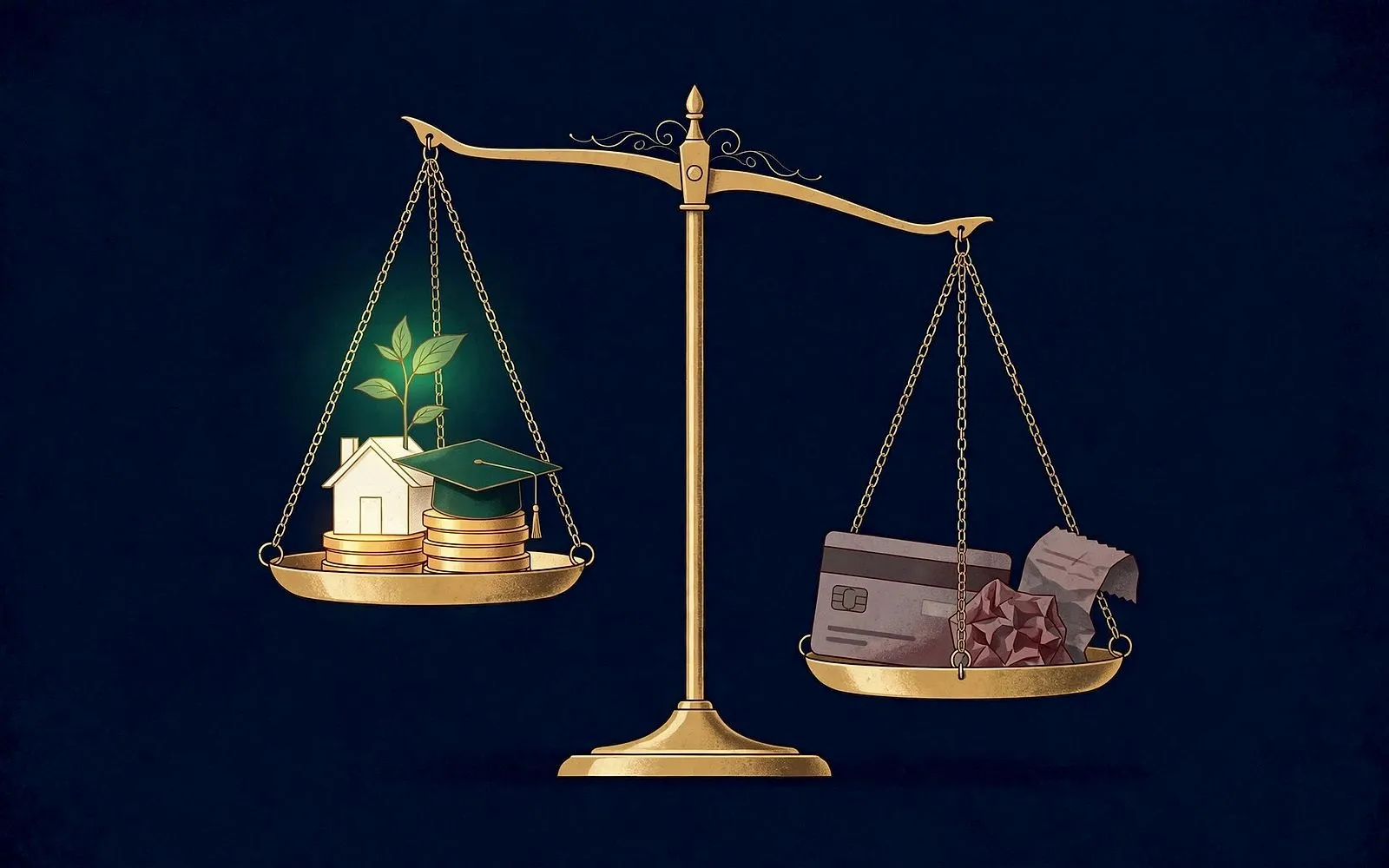
Both sides have a point. Debt is not one thing. A loan that buys an appreciating asset or a higher income at a low, fixed rate is a fundamentally different financial instrument from a revolving balance at 22% that bought dinners and shoes. But the line between the two is thinner than the reel suggests — and the personal-loan rates Tu quoted are not the rates most borrowers actually get. This guide works through the distinction honestly, with the real rates and the real maths, so you can judge every debt you hold — or are about to take on — on its own merits.
The three-question test
Forget the labels for a moment. Any debt can be judged by three questions, and a debt only earns the "good" label if it passes all three:
- Does it buy something that grows in value or raises your income? A home that historically appreciates, a degree that lifts your earnings, or equipment that lets a business earn more. If what you bought is worth less the day after you buy it, the debt is working against you.
- Is the interest rate low enough that the thing you bought can out-earn it? A 6.5% student loan is cheap next to the earnings a degree typically unlocks. A 22% card balance is expensive next to almost anything.
- Can you afford the payments even if life wobbles? A debt you can service comfortably through a bad month is a tool. The same debt at a payment that leaves no margin is a trap — whatever it bought.
Equifax puts it in similar terms: "good" debt is generally debt you can repay responsibly that finances something offering a return, while "bad" debt is debt you cannot repay or that finances something with no return. Discover's framing matches: good debt tends to carry lower rates and improve your net worth over time; bad debt carries high rates and fees that prevent progress toward your goals.
Debt is not a moral category. It is a maths problem with three variables: what it bought, what it costs, and whether you can carry it.
What "good debt" actually looks like
A mortgage. The classic example, and usually a fair one. The average 30-year fixed mortgage rate was 7.18% in Freddie Mac's survey of 5 November 2026 — high by recent standards, but still far below card rates, and the loan buys an asset that has historically risen in value. On a $400,000 loan at 7.18%, the payment is about $2,710 a month. The catch, which the 28/36 rule captures: housing costs should stay near 28% of gross income, and all debt payments combined near 36%. A mortgage above that stops being good debt, whatever the rate.
Federal student loans. For loans first disbursed between 1 July 2026 and 30 June 2027, undergraduate Direct Loans carry a fixed 6.52% rate, graduate loans 8.07%, and Parent PLUS 9.07%. The rate never changes for the life of the loan, and federal loans come with income-driven repayment options private loans do not offer. The earnings case is real: in the third quarter of 2026, full-time workers aged 25 and over with at least a bachelor's degree earned a median $1,752 a week, against $993 for high-school graduates with no college, according to the Bureau of Labor Statistics. That gap — roughly $39,000 a year — is why a degree loan at 6.52% can be good debt. But the gap is a median, not a promise: borrow $80,000 for a degree with weak earnings prospects and the same loan becomes a burden.
A business loan that buys income. Borrowing to buy equipment, stock, or premises that generate more than the loan costs is the textbook case of good debt — the debt pays for itself. The test is strict: the income must be real, documented, and larger than the payments, not hoped for.
A home equity loan for a genuine improvement. Borrowing against your home to add a bedroom or replace a failing roof can count — it protects or adds to the asset's value, at a secured rate. Borrowing against your home for a holiday or a car does not.
What "bad debt" actually looks like
Credit card balances carried month to month. The average interest rate on US credit card accounts assessed interest was 22.36% in August 2026, according to the Federal Reserve's G.19 release. In the UK, the Bank of England's quoted rate on representative cards was 24.71% in September 2026 — the highest since the series began in 1995 — and the rate borrowers actually paid on interest-bearing balances was 21.71%. At those rates, a balance barely shrinks: on a $4,350 balance at 22.36%, paying $100 a month takes about 90 months and costs about $4,661 in interest — more than the original balance (own calculation).
Payday loans and other very-high-cost credit. Short-term loans with triple-digit annual rates are bad debt by definition: no asset, no income gain, and a rate that makes repayment harder the longer you hold it.
Car loans — usually. A car is essential for many people, but it loses value from the day you drive it away, which is why most guides class car finance as bad debt even when it is necessary. The numbers underline it: in the third quarter of 2026, the average new-car loan carried a 7.0% APR and the average used-car loan 10.6%, on a record average new-car payment of $787 a month. If you must borrow for a car, keep the term short and the car modest — a seven-year loan on a depreciating asset is the worst of both worlds.
Personal loans for things that do not last. Holidays, weddings, gadgets, designer clothes: a personal loan turns a one-off purchase into years of payments for something that is gone, broken, or out of fashion long before the loan ends. The loan itself is not the villain — the purchase is.
Buy-now-pay-later balances that roll over. BNPL is interest-free only while you pay on time. Miss a payment and late fees and interest can apply, and stacked BNPL plans across several retailers are easy to lose track of — which is exactly how a "free" instalment plan becomes bad debt.
| Debt | Typical rate (2026) | What it buys | Verdict |
|---|---|---|---|
| Mortgage (US 30-yr fixed) | 7.18% | A home that usually appreciates | Usually good |
| Federal student loan (undergrad) | 6.52% fixed | A degree and higher earnings | Usually good |
| Business loan for equipment | Varies | Income-generating assets | Good if income exceeds cost |
| Car loan (new / used) | 7.0% / 10.6% | A depreciating asset | Usually bad |
| Credit card balance | 22.36% (US) / 21.71% (UK effective) | Consumables | Bad |
| Personal loan for a holiday | 11.90%–27.42% by credit score | Nothing lasting | Bad |
| Payday loan | Triple-digit APRs | Nothing | Bad |
The maths that decides it
The argument for swapping card debt for a personal loan sounds compelling: trade 22% for something cheaper and the balance finally falls. The question is what "something cheaper" actually costs. NerdWallet's November 2026 data, based on anonymised pre-qualification offers, puts the average personal loan APR at 19.91% overall — and the rate depends heavily on your credit score: about 15.06% for excellent credit (720–850), 19.65% for good credit (690–719), 23.87% for fair credit (630–689), and 27.42% for bad credit. The Federal Reserve's figure for a two-year loan from a commercial bank is lower, 11.90%, but that is the bank average — online lenders range from 6% to 36%, and federal credit unions cap at 18%.
Take a $5,000 card balance and work it through (own calculations, using the rates above):
| Route | Monthly payment | Time to clear | Total interest |
|---|---|---|---|
| Stay on the card at 22.36%, pay $150/month | $150 | ~53 months | ~$2,885 |
| Personal loan at 11.90% (bank average), 36 months | ~$166 | 36 months | ~$970 |
| Personal loan at 15.06% (excellent credit), 36 months | ~$173 | 36 months | ~$1,245 |
| Personal loan at 19.65% (good credit), 36 months | ~$185 | 36 months | ~$1,657 |
| Personal loan at 23.87% (fair credit), 36 months | ~$196 | 36 months | ~$2,050 |
Consolidation genuinely helps when the new rate is well below the card rate: at the 11.90% bank average, you save roughly $1,915 in interest and clear the debt 17 months sooner than paying $150 a month on the card. At 19.65% — the average for good-credit borrowers — you still save about $1,228. But at 23.87%, the average for fair-credit borrowers, the saving shrinks to about $835 over three years, and you are paying $196 a month instead of $150 — a higher payment for a modest gain. And if your score puts you at 27.42%, the loan costs more than the card it replaces.
The consolidation trap. Vivian Tu's reel suggests swapping a 25% card for a 7–15% personal loan. The verified figures say that range is realistic only for borrowers with excellent credit and bank loans: the average excellent-credit borrower was offered 15.06%, and the average across all borrowers was 19.91%. Before you consolidate, get your actual offer in writing and run the table above with your real numbers — and remember the second trap: a consolidation loan only works if the cards stay paid off. Clear the cards, then run them back up, and you now have the loan and the card debt.
When good debt turns bad
The labels describe the debt, not the borrower — and good debt turns bad more often than people admit. Three ways it happens:
Too much of it. A mortgage is good debt at 28% of your income. At 45% of your income, with a car payment and a student loan on top, it is a debt you cannot carry through a job loss or a broken boiler. The 28/36 rule exists for this reason: keep housing near 28% of gross income and all debt payments combined near 36%.
The rate is not what you thought. A variable-rate loan, a 0% balance transfer that reverts to 24% after the promo period, or a student loan taken privately at a variable rate can all change character after you sign. Fixed rates are part of what makes federal student loans good debt; the absence of a fixed rate is part of what makes many private loans risky.
The thing it bought does not deliver. A degree from a weak programme, a business that never finds customers, a home bought at the top of the market in a town whose employer just left — the debt stays the same size while the asset or income behind it shrinks. Good debt is a judgement about the future, and judgements can be wrong. That is why the affordability question matters as much as the purpose question: borrow less than the maximum on offer, and keep an emergency fund between you and the payments.
Getting out of bad debt, in order
If the test above puts most of your debt in the "bad" column, the order of operations matters more than the method:
- Stop adding to it. No new charges on the cards you are paying down. If willpower is the weak link, take the cards out of your wallet and delete them from shopping apps — the friction is the point.
- Pay more than the minimum, on the most expensive debt first. This is the avalanche method: list debts by interest rate, pay the minimum on all of them, and throw every spare pound or dollar at the highest rate. The snowball method — smallest balance first, for the motivation of quick wins — costs a little more in interest but works better for some people. Either beats minimum payments: remember, $100 a month on a $4,350 card balance at 22.36% takes about 90 months and $4,661 of interest.
- Consider a 0% balance transfer — with the maths done first. A 0% deal can freeze interest for 12–21 months in the US and up to 26 months in the UK, but transfer fees of 3–5% apply, and the rate after the promo period is usually 20% or more. Only take one if you can clear the transferred balance inside the promo window.
- Consolidate only if the new rate is genuinely lower. Use the table above with your actual offer. A consolidation loan also converts revolving debt into instalment debt with a fixed end date — genuinely useful — but only if you do not re-borrow on the cleared cards.
- Get free help before it gets worse. In the US, nonprofit credit counsellors through the National Foundation for Credit Counseling can negotiate lower rates and a structured repayment plan. In the UK, StepChange and Citizens Advice offer free, impartial debt advice. Both are free; if someone asks you to pay upfront for debt help, walk away.
One number to check tonight: add up every monthly debt payment you make — mortgage, cards, loans, BNPL, car — and divide by your gross monthly income. Under 36% and your debt is probably manageable. Over 43% and it is time to treat the total as the problem, not any single balance.
The UK version
The framework is the same in the UK; the numbers differ. The average quoted credit card rate was 24.71% in September 2026 (Bank of England) — the highest since the series began in 1995 — while the effective rate borrowers actually paid on interest-bearing balances was 21.71%. Mortgages look cheaper than in the US: the average two-year fixed rate was 5.97% and the five-year fix 6.00% in early November 2026, with the Bank of England base rate at 4% after its 5 November rise. UK student loans work differently again: they are repaid as a percentage of earnings above a threshold, not as a fixed monthly bill, and the balance is written off after a set period — which makes them far less dangerous than their headline balance suggests, but also means the "good debt" case rests on the earnings gain rather than the loan terms. And UK borrowers have a strong free-advice safety net in StepChange, National Debtline, and Citizens Advice — use them before a debt becomes a court matter.
Frequently asked questions
Is a mortgage always good debt?
No. A mortgage is usually good debt because it buys an appreciating asset at a relatively low, secured rate — but borrow beyond what you can afford, or buy at a price that leaves you with no emergency fund, and it becomes the debt that causes the most damage, because it is also the largest.
Is a car loan always bad debt?
Almost always, because the car loses value while you pay interest on it. The exception is narrow: a short-term loan at a low rate for a reliable car you genuinely need for work, bought for a sensible price. A seven-year loan on a new car at 7% is bad debt with a bow on it.
Should I take a personal loan to pay off my credit cards?
Only if the loan's APR is clearly lower than your card's rate, the monthly payment fits your budget, and you will not run the cards back up. Check the actual offer, not the advertised range: the average good-credit borrower was offered 19.65% in November 2026, and fair-credit borrowers averaged 23.87% — barely below the average card rate of 22.36%.
Is student debt good debt?
Federal student debt usually is: a fixed 6.52% rate for undergraduates in 2026–27, income-driven repayment, and a large median earnings premium for graduates. It stops being good when the amount borrowed is out of proportion to the earnings the degree is likely to produce, or when the loan is private, variable-rate, and without income-based protections.
Can bad debt ever help my credit score?
Carrying a balance does not help your score — that is a myth. What helps is a long history of on-time payments and a mix of account types, both of which you can build without ever paying a penny of interest. Paying a card in full every month builds the same history for free.
Key takeaways
- Debt is good when it buys something that grows in value or raises your income, at a rate the purchase can out-earn, with payments you can afford even in a bad month.
- Mortgages (7.18% US) and federal student loans (6.52% fixed for undergraduates) usually pass the test; card balances at 22.36% and payday loans almost never do.
- Consolidation only saves money when the new rate is genuinely lower — excellent-credit borrowers averaged 15.06% on personal loans in November 2026, but fair-credit borrowers averaged 23.87%, barely below the average card rate.
- Keep total debt payments near 36% of gross income or below; above 43%, treat the total as the problem.
- Clear bad debt highest-rate first, consider a 0% balance transfer only if you can clear it inside the promo window, and get free help from a nonprofit counsellor before a debt becomes a crisis.
Debt is a tool, and like any tool it is judged by the job it does. Run your own debts through the three-question test tonight — what it bought, what it costs, whether you can carry it — and you will know which ones are working for you and which ones are working against you. Then start with the most expensive bad debt, pay more than the minimum, and check the total against the 36% line. That single evening of honest arithmetic is worth more than any viral reel, including the one that started this article.
Sources
- Vivian Tu — 'Is debt a GOOD thing??' (Instagram reel, 10 Nov 2026)
- Equifax — Good Debt vs. Bad Debt
- Discover — What Is Good Debt vs. Bad Debt?
- NerdWallet — Average Personal Loan Interest Rates for November 2026
- Federal Student Aid — 2026-27 Direct Loan rates (via Eastern Oregon University)
- ClearScore — Average credit card interest rates in the UK (2026)
- Freddie Mac — Primary Mortgage Market Survey
- Federal Reserve — G.19 Consumer Credit
- BLS — Median weekly earnings by educational attainment, Q3 2026
The MoneyHabit editorial desk researches, writes and reviews every article against our editorial policy.
The Sunday Habit
One useful money idea, every week.
A short, practical email every Sunday — no spam, no selling your address, unsubscribe anytime.
Advertisement
More in Debt & Credit Education
Debt & Credit Education · Guide
Pay Off Debt or Invest First? The Maths That Settles It
Two viral reels say opposite things about debt vs investing. The maths settles it: compare your debt's guaranteed cost with what investing might earn.
9 November 2026 · 13 min read

Debt & Credit Education · Guide
Micro-Payments: The Daily Debt Trick Going Viral
Creators are paying off debt a few dollars at a time and posting every payment. Here's how micro-payments work and when the maths helps.
17 November 2026 · 10 min read

Debt & Credit Education · Guide
What to Say When a Debt Collector Calls
Viral videos promise a magic script that makes debt collectors pay you. Here is what the law actually gives you — and the exact words to use on the call.
14 November 2026 · 10 min read