Guide
Are Sale Prices Really Lower? How to Check Before You Buy
Black Friday is 27 Nov and the fool price debate is viral. A third of deals were cheaper earlier in the season. Here is the 5-minute check.
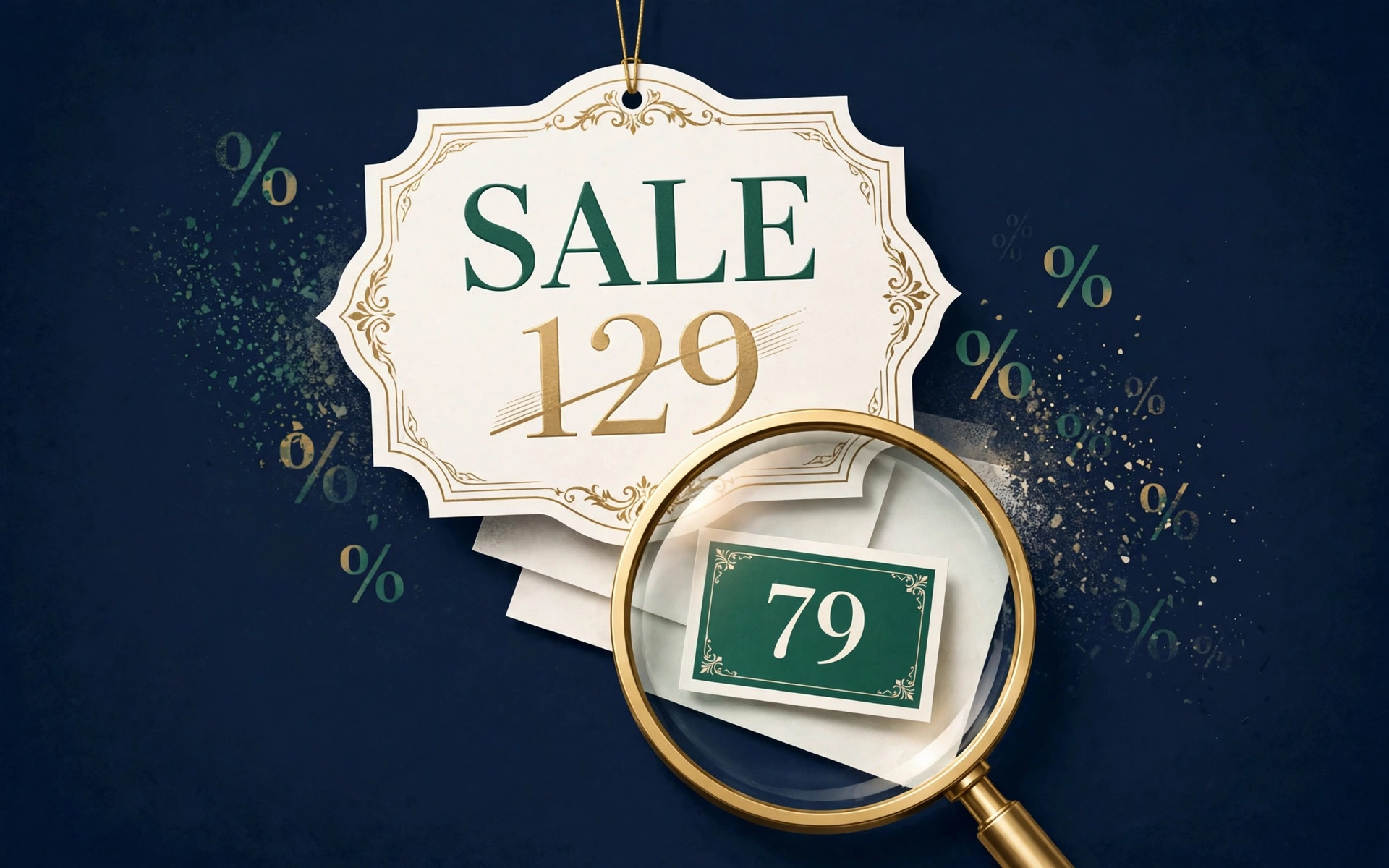
A viral clip doing the rounds this week shows a young man staring at a price tag. He writes $299 on a whiteboard: too expensive. Then he writes $600 above it, crosses it out, and suddenly $299 looks like a steal. The host of The Minimalists podcast, where the clip went viral, delivers the verdict: "Don't call it sale price. Call it fool price." His punchline: "It's 100% off if you don't buy it."
With Black Friday landing on 27 November and early deal flyers already dropping, the joke is worth real money. US households plan to spend an average of $1,654 this holiday season, up 4% on last year, according to Deloitte's 2026 Holiday Retail Survey. So the question behind the laugh deserves an answer: are those crossed-out prices real, or is the "saving" printed on the tag?
What the price trackers actually found
Consumer groups and tracking firms have answered this by doing the one thing shoppers rarely do: writing the price down and watching it.
The UK consumer group Which? tracked 208 Black Friday deals at eight major retailers for six months before and after Black Friday 2022. Only five of them — 2% — were cheapest on the day itself, and 86% were the same price or cheaper at other times of year. Second-generation Apple AirPods sold for £119 on Black Friday at Argos and Currys, but had cost £99 to £109 between May and September.
A 2025 US study by price-tracking firm Visualping, reported by ConsumerAffairs this week, monitored more than 2,600 products from 1 October to Cyber Monday. Roughly one-third of Black Friday and Cyber Monday "deals" had been cheaper earlier in the season, averaging 37% above the lowest price seen in the window. A MacBook Air advertised at $1,439.99 around Black Friday had sold for $1,337.46 earlier in November — a $100 "discount" built on a price that wasn't real. And when Adobe Analytics reports peak discounts of 30.9% on electronics, that figure is measured off the listed price, not the year's lowest price — the percentage is quoted against a reference number the retailer chooses.
| Category | Share of "deals" that were cheaper earlier |
|---|---|
| Luggage | 61% |
| Microwaves | 50% |
| Video game consoles | 14% |
| Backpacks | 4% |
The risk isn't evenly spread — luggage and microwave "deals" were mostly fiction, while backpack prices were largely honest. Source: Visualping 2025 tracking via ConsumerAffairs.
Why your brain loves the "was" price
The trick works through anchoring: the first number you see sets the scale, and everything after is judged against it. $299 feels expensive until $600 appears above it; then $299 feels like winning. Retailers didn't invent this bias, but sale signage is engineered around it.
The most expensive lesson in retail history proves how deep the habit runs. In February 2012, JCPenney's new CEO Ron Johnson — the man who built the Apple Store — launched "Fair and Square" pricing: no coupons, no more 590 annual promotional events, just honest everyday low prices. Shoppers hated it. Within a year, sales collapsed from $17.3 billion to $12.99 billion, the company lost $985 million, and Johnson was fired in April 2013, about seventeen months into the job. Prices were genuinely lower — and customers walked away from the store that refused to play the discount game.
The discount is loud; the real price is quiet. Every crossed-out number on a sale tag is trying to be the loud one.
What the law says about "was" prices
A fake reference price isn't just annoying — regulators have rules for it.
In the US, the FTC's Guides Against Deceptive Pricing say a "was" price must be a genuine price the product was openly offered at for "a reasonably substantial period of time." A price raised briefly just to mark down doesn't count, and a perpetual "sale" is treated as the regular price by another name. Enforcement is real: Boohoo agreed to a $197 million settlement in 2023 over allegedly inflated reference prices. California and New Jersey add state-level look-back rules on advertised former prices. Suspected fakes can be reported at ReportFraud.ftc.gov.
In the EU, the Omnibus Directive's Article 6a requires every announced reduction to show the prior price — defined as the lowest price charged in at least the 30 days before the reduction. In force since May 2022, it was tightened by the Court of Justice's September 2024 Aldi Süd ruling: percentage discounts must be calculated from that 30-day low. In the Commission's most recent Black Friday sweep, 30% of 314 online traders checked still got it wrong.
In the UK, the post-Brexit position is weaker — Britain hasn't adopted the Omnibus rule, though Which? campaigns for it, and misleading pricing remains covered by consumer protection law. Either way, the law sets a floor, not a ceiling: a "was" price can be perfectly legal and still be a bad deal if three competitors beat it today.
Watch the three classic patterns: a price briefly spiked just before the sale so it can be "cut"; a perpetual sale that never ends (the sale price is the price); and "compare at" MSRP references — "was" claims the store charged that price, while "compare at" usually invokes the manufacturer's suggested price that no nearby store actually charged.
The 5-minute price floor test
Black Friday is three weeks away — enough time to build a baseline no retailer can fake:
- Pull the price history. On Amazon, CamelCamelCamel or Keepa show months of data free. Elsewhere, Google Shopping's price history covers many products. Set 60–90 days. The test: the deal price should beat or match the lowest recent price, not just the "was" price.
- Cover the "was" price. The JCPenney lesson in one move: ignore the crossed-out number and ask whether you'd buy at the sale price on an ordinary Tuesday. If the answer is no, the "discount" is the only thing you're buying.
- Check two other retailers. A genuine discount usually appears in more than one store. A "deal" at exactly one retailer is a pricing decision, not a market event.
- Know the risky categories. Recent tracking says luggage and microwaves deserve extra scepticism; consoles and backpacks have been fair. Spend your five minutes where the data says it matters.
- Read the reference. "Was" claims the store charged it; "compare at" usually means MSRP. EU shoppers get a free tool: the "lowest price in the last 30 days" line is legally required on every discount.
Start a watchlist today: item, today's price, and the maximum you'll pay. Screenshot the price page when you first spot an item — in three weeks you'll hold a personal price history no tag can argue with.
Frequently asked questions
Is a fake "was" price actually illegal?
It can be. In the US, the FTC's deception standard treats a fictitious former price as misleading, and state laws add teeth — California and New Jersey both impose look-back requirements on advertised former prices. In the EU, the Omnibus Directive makes the 30-day lowest price the only legal reference. The catch is enforcement happens case by case, so most fake discounts die of shopper indifference rather than prosecution.
If Black Friday isn't the cheapest day, when is?
Often later — or earlier. Which? found 35% of tracked products became cheaper after the Black Friday sales period ended. TVs tend to bottom out in late November, laptops often dip again on Cyber Monday (30 November this year), and plenty of "doorbusters" return at the same price in January clearances. Waiting is rarely punished.
Do price trackers work outside Amazon?
Partially. Google Shopping shows price history for many products, and Idealo covers European retail well. For the rest, the manual method works: screenshot the price the first time you consider an item. Three weeks before Black Friday is plenty of time to build your own baseline.
Key takeaways
- Price trackers keep finding the same thing: only a small fraction of Black Friday deals are genuinely cheapest on the day — about one-third were cheaper earlier in the 2025 season.
- The percentage off is measured against a reference price the retailer chooses, so judge the sale price against the item's actual price history, not the crossed-out number.
- US law requires a "was" price to be genuine and recent; EU law requires the 30-day lowest price as the reference. Both are floors, not guarantees of a good deal.
- The 5-minute price floor test — history check, cover-the-was test, two-retailer comparison, category risk, reference check — fits any item you're eyeing for 27 November.
- The best discount is the one where you buy something you actually wanted, at a price you'd have paid anyway.
So is the sale price really lower? Sometimes — but the tag won't tell you. The price history will. Build your watchlist this week, screenshot today's prices, and when 27 November arrives you'll be the shopper the "fool price" clip can't fool.
Sources
- ConsumerAffairs — Visualping Black Friday 2025 price study
- Nerdlyst — Which? Black Friday price tracking (208 deals, 2022)
- LegalClarity — FTC Guides Against Deceptive Pricing
- JD Supra — deceptive pricing enforcement, Boohoo $197M settlement
- LegalClarity — EU Omnibus Directive 30-day lowest-price rule
- Headcount Coffee — JCPenney 'Fair and Square' pricing disaster
- Experian — November 2026 personal finance news (Deloitte holiday survey)
More in Smart Spending

Smart Spending · Guide
The Viral AI Trick That Cuts Your Grocery Bill
Creators are getting AI chatbots to slash their grocery bills with a simple prompt trick. Here's how the viral meal-planning method works — and how to make it work for you.
3 November 2026 · 6 min read
Smart Spending · Guide
Holiday Gift Sets: Are They Actually a Good Deal?
That 'worth £80' gift set at £40 might not be a bargain at all. A 60-second check reveals whether a holiday gift-set discount is genuinely a good deal.
2 November 2026 · 7 min read

Smart Spending · Guide
Holiday Flights Are at a 10-Year High: How to Pay Less
Thanksgiving fares are up 31% and Christmas fares 23%, both hitting 10-year highs. Here is what is driving the surge — and the booking moves that still work.
1 November 2026 · 8 min read