Guide
Pay Yourself First: Automate Savings on Payday
Save first, spend second: set up one automatic transfer on payday so saving happens before spending gets a chance.
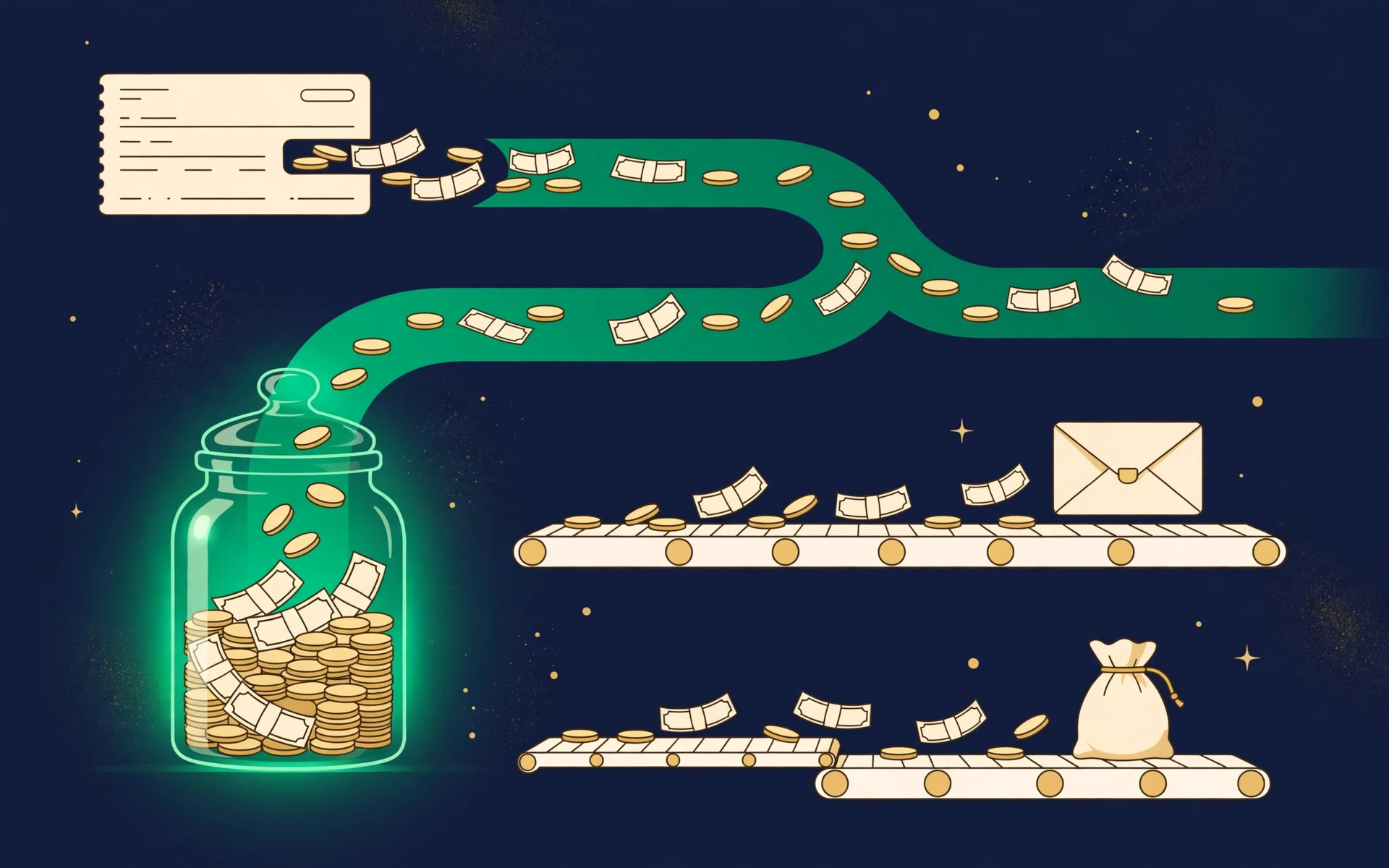
This week, a simple piece of money advice is doing the rounds on social media again: when payday lands, save first, then spend. One viral reel lists ten rules for a growing bank balance, and the first two are the whole system in miniature — move money to savings the moment you are paid, and automate it every month so you never have to decide again. It sounds almost too simple to work. It works precisely because it is simple.
Paying yourself first means flipping the usual order of operations. Instead of spending through the month and saving whatever happens to be left, you move a set amount into savings on payday, before anything else gets a chance at it. Your future self gets paid first, and everything else — bills, groceries, fun — is planned around what remains.
Why saving what's left almost never works
The problem with saving what's left is that there is rarely anything left. This is not a character flaw; it is how spending behaves when money sits in a spending account. Every day brings a small, reasonable reason to spend — a takeaway, a top-up shop, a sale that ends tonight — and by the end of the month the balance has quietly absorbed them all.
Behavioural economists call this present bias: we value spending today far more than saving for a tomorrow we cannot see. An automatic transfer sidesteps it entirely. When savings leave your account on payday, you never make the decision to save at all — the decision was made once, when you set the transfer up, and then it just happens.
The people who save consistently are rarely the people with the most willpower. They are the people who removed willpower from the process.
The stakes are real. A 2023 Bankrate emergency savings report found that only 43% of Americans could cover a $1,000 emergency from savings alone — the rest would have to borrow, use a credit card, or ask for help. That gap exists almost entirely because people save last rather than first.
The payday sequence that makes it work
Paying yourself first does not mean ignoring your bills. It means giving every pound or dollar a job in the right order, on payday, before spending starts:
- Pay arrives. Work from your net pay — the amount after tax and deductions — because that is the number you actually control.
- Essentials and bills are covered. Rent or mortgage, utilities, phone, insurance, transport and basic groceries come first. These are the costs that cause the most trouble when missed.
- Debt minimums are protected. Schedule the minimum payment on each debt before anything else is spent, so you never pick up a late fee by accident.
- The savings transfer happens. A set amount moves to a separate savings account on payday itself. This is the pay-yourself-first step, and it happens before discretionary spending begins.
- Irregular costs get their share. A small slice goes toward costs that do not arrive monthly but always arrive eventually — car insurance, holidays, gifts, repairs.
- Only then does flexible spending remain. Eating out, entertainment and personal spending come from what is left, which is now a number you can enjoy without guilt.
How to set it up in about 15 minutes
The setup differs slightly between the US and the UK, but the principle is identical: the money must move without you touching it.
In the US: split your direct deposit
Many employers let you split your paycheck across two accounts. Ask payroll to send a fixed amount or percentage straight to savings, with the rest landing in checking. The savings portion never appears in your spending balance, so you never feel it leaving. If your employer does not offer this, set a recurring transfer in your bank's app for the morning of payday.
In the UK: a payday standing order
Set a standing order from your current account to a separate savings account, dated the day your salary lands. Even a small amount works — the habit matters more than the size. Keeping the savings account at a different bank from your everyday account adds useful friction: it is no longer one tap away on a Friday night.
Use the right account for the goal
An emergency fund belongs in an account you can reach quickly in a real emergency but not casually — an easy-access savings account works, and keeping it separate from spending money is the point. For longer-term goals, employer retirement contributions are the most powerful version of paying yourself first: the money leaves your paycheck before you ever see it, and an employer match, where offered, is effectively free money for doing it. In the UK, workplace pension auto-enrolment already does this for most employees; checking that you are enrolled, and at what rate, is a five-minute job worth doing.
Start with an amount that barely hurts — even $10 or £10 per payday. A small transfer that actually happens beats a large one you cancel in week three. You can raise it later; the system only needs to survive its first month.
How much should you pay yourself first?
Common guidance is to aim for 10–20% of take-home pay toward savings and extra debt payments over time, but that is a destination, not a starting line. If 20% is not realistic today, start at 2% or 5% and raise it by a small step every month or two. A useful trick: raise your savings rate every time your pay rises, so your lifestyle never absorbs the whole increase first.
Small, regular amounts compound into serious sums faster than most people expect:
| Automatic transfer | After 1 year | After 5 years |
|---|---|---|
| $10 / £10 per week | $520 / £520 | $2,600 / £2,600 |
| $25 / £25 per week | $1,300 / £1,300 | $6,500 / £6,500 |
| $50 / £50 per week | $2,600 / £2,600 | $13,000 / £13,000 |
| $200 / £200 per month | $2,400 / £2,400 | $12,000 / £12,000 |
These figures leave out interest, so with a savings account paying interest you would end up with a little more. The point is the shape of it: a weekly habit you barely notice builds a four-figure cushion within a year.
What if your income is irregular?
Freelancers, gig workers and tipped workers can still pay themselves first — they just automate differently. Instead of a fixed amount, use a percentage rule: every time money lands in your account, move a set percentage to savings that same day. On a $900 week, 20% is $180; on a $400 week, it is $80. The percentage flexes with your income, but the rule never changes: the money moves immediately, before it starts looking like spending money.
It also helps to smooth the lumpy months. If you can, hold one month of essential bills in a buffer account so a quiet week does not force you to raid savings or reach for a credit card. That buffer is itself a pay-yourself-first project — and the first one worth finishing.
Three mistakes that break the system
Keeping savings in your spending account. Money you can see gets spent. If your savings sit in the same account as your daily spending, the transfer has not really happened — move it somewhere separate.
Second, setting the amount too high. A transfer that bounces or forces you to pull money back mid-month teaches you that the system does not work, when in fact the amount was simply wrong. Start low, prove it works for a month, then raise it.
Third, never raising it. The most common regret is not starting too small but staying small forever. Review your transfers every three months — a 15-minute calendar reminder is enough — and nudge the amount up when your pay rises or a bill disappears. Saving $10 a week is a great start; it should not still be $10 a week in five years.
Frequently asked questions
Should I pay off debt or save first?
Do both, in order: protect every debt minimum first, then build a small starter cushion — enough to cover a typical surprise, often around $500 to $1,000 — and then throw extra money at the highest-interest debt. Without any cushion, every surprise lands back on a card and the cycle restarts.
What if I cannot afford to save anything?
Start with an amount so small it feels almost pointless, even $5 a week. The goal in month one is not the money, it is the system: proof that a transfer can leave on payday and life still works. Most people find room to raise it once the habit exists.
Should savings be in a different bank?
It helps. A separate account — ideally at a different institution from your everyday bank — adds just enough friction to stop impulse raids while keeping the money reachable in a genuine emergency. In the US, check the account is FDIC-insured; in the UK, look for FSCS protection.
Does paying myself first mean I cannot enjoy my money?
The opposite. Because savings and bills are already handled, the money left over is genuinely yours to spend. A budget that funds fun on purpose is far more enjoyable than one where every purchase carries a quiet worry about the end of the month.
Key takeaways
- Pay yourself first: move money to savings on payday, before spending starts — not from whatever is left at month-end.
- Automate it once — a split direct deposit in the US or a payday standing order in the UK — so willpower is never part of the process.
- Start small enough that it survives: even $10 a week becomes $520 in a year, and you can raise it from there.
- Keep savings in a separate account, protect debt minimums first, and review your transfers every three months.
- Irregular income works too: move a fixed percentage to savings the day each payment lands.
Payday is the one moment in the month when your money is fully under your control — before rent, before subscriptions, before the slow drip of daily spending. This week's viral advice is right about the order: save first, spend second, automate the whole thing. Set up one transfer today, dated for your next payday, and let your future self get paid first from now on.
Sources
More in Budgeting & Saving

Budgeting & Saving · Guide
CD vs High-Yield Savings: Which Wins Now?
CDs pay up to 5.25% but lock your cash away; high-yield savings pays up to 5.00% and stays flexible. Here is how to pick a winner after the Fed rate hike.
23 October 2026 · 6 min read

Budgeting & Saving · Guide
Holiday Spending Plan: Enjoy December, Not Debt
A practical plan to cover gifts, food, travel and the long January pay gap — so December's fun doesn't become January's debt.
22 October 2026 · 7 min read
Budgeting & Saving · Guide
One Month Ahead: Escape the Paycheck-to-Paycheck Cycle
Paycheck-to-paycheck living is often a timing problem, not an income problem. Here is the viral one-month bill buffer method, step by step.
21 October 2026 · 6 min read