Explainer
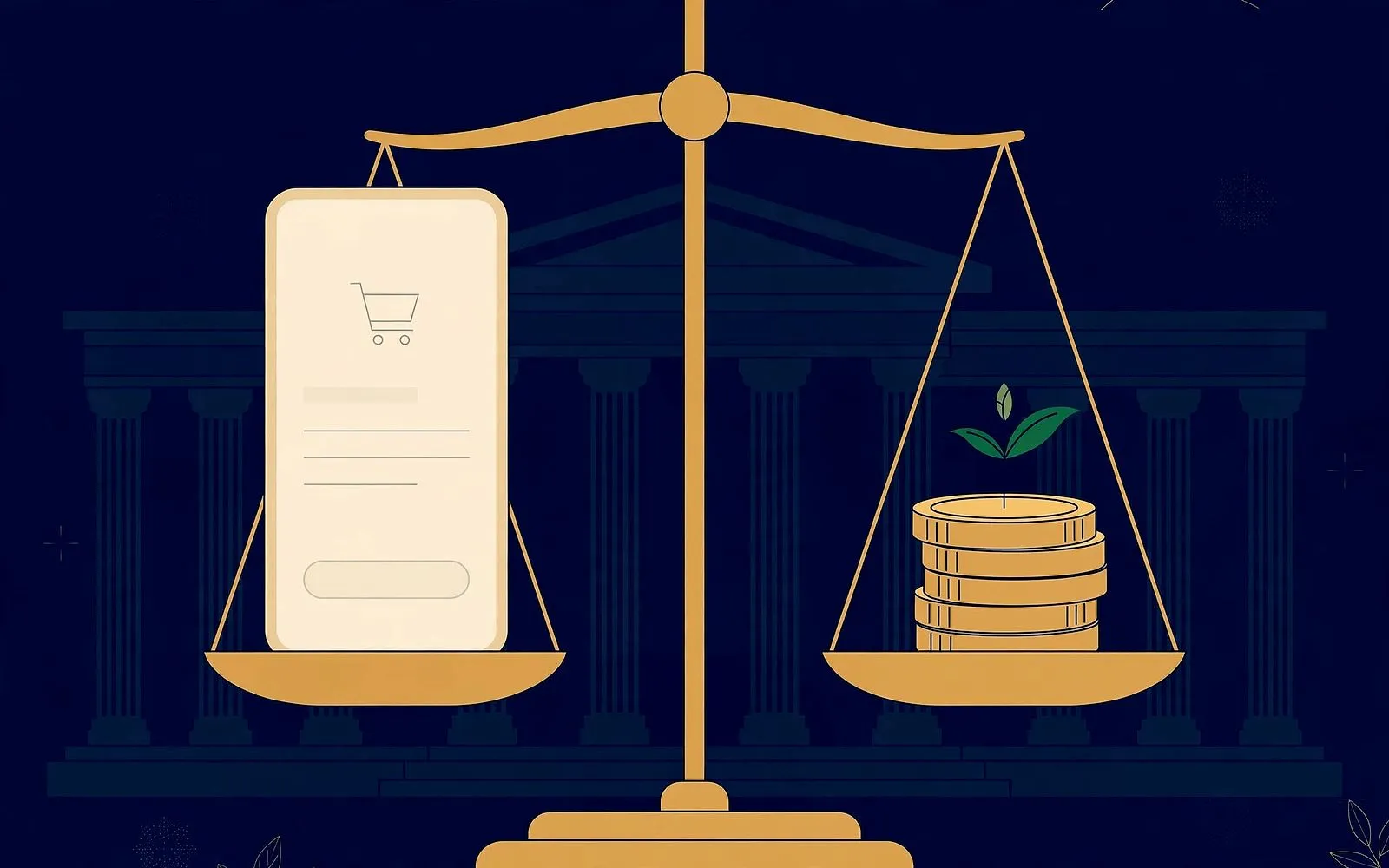
PayPal's Surcharge Ban May Be Illegal in Germany
Germany's competition watchdog says PayPal's ban on merchant surcharges may break the law. Here's what it means for shoppers, sellers, and your checkout.
In this article
PayPal is the way most Germans pay online — and for years, shops in Germany have been barred from charging you extra for choosing it. On 11 November 2026, Germany's competition watchdog said that ban may be illegal. If the ruling goes against PayPal, the price you see at checkout could start depending on how you pay — and the fees hiding inside every online price could finally become visible.
What happened on 11 November
Germany's Federal Cartel Office — the Bundeskartellamt — sent PayPal a preliminary legal assessment saying its rules for online merchants may restrict competition and breach German and European competition law. The assessment is an interim view, not a final decision: PayPal disputes it and now has the chance to respond.
The case is not new. The authority opened proceedings on 23 January 2023 against PayPal (Europe) S.à r.l. et Cie, S.C.A., collecting internal documents and questioning businesses that receive online payments. The review invokes Article 102 of the Treaty on the Functioning of the European Union and Sections 19 and 20 of Germany's Competition Act — the rules against abuse of market power. What is new is the direction of travel: after nearly four years, the authority has said PayPal's terms look like a competition problem, and it is even considering whether PayPal should hand over profits gained from the disputed practices.
What PayPal's rules actually say
Two clauses in PayPal's German user agreement are at the centre of the case. Together they mean a shop that accepts PayPal cannot show you what PayPal costs — or steer you towards anything cheaper.
- No surcharges. Merchants may not add a fee, service charge or higher shipping cost for customers who choose PayPal. The ban has been in PayPal's terms since 2018.
- Equal prominence. Merchants must present PayPal at least on par with other payment methods — in logo placement, the order of options and checkout design. They may not present a competing method more favourably, or offer lower prices to customers who pick a cheaper method.
Why the watchdog thinks it matters: the money
PayPal charges German merchants a standard fee of 2.49% to 2.99% of each transaction, plus a fixed charge of 34 to 39 cents — the rates the Bundeskartellamt cited when it opened the case. Its current published German rate is 2.99% plus €0.39 on a domestic sale. The authority describes those fees as above average.
How far above average? The EHI Retail Institute, which tracks payment costs across a panel of 172 German online shops, puts the average cost of PayPal at 1.94% of revenue, against 1.42% for invoice payments and 0.65% for direct debit. On €10,000 of monthly sales, that is roughly €194 through PayPal versus €65 by direct debit — a gap of about €129 a month, or €1,548 a year, on the same sales (own calculation from EHI's averages).
| Payment method | Share of German online revenue, 2025 | Average merchant cost |
|---|---|---|
| PayPal | 28.7% | 1.94% of revenue |
| Invoice (Kauf auf Rechnung) | 26.1% | 1.42% |
| Direct debit | 14.4% | 0.65% |
| Credit and debit cards | 13.7% | — |
PayPal is also the biggest single method, taking 28.7% of online revenue in the EHI panel's 2025 figures, and the Bundesbank's study of how Germans pay puts internet payment methods at 6% of all payments in 2025, with PayPal accounting for about 86% of that slice. That scale is what turns a contract clause into a competition question: when the dominant method forbids price signals, cheaper rivals struggle to compete on price at all.
Here is the hidden cost: because shops cannot pass PayPal's fee to the people who choose PayPal, they build it into their prices instead. That means even customers who pay by bank transfer or invoice help cover PayPal's fees — a point the Bundeskartellamt makes explicitly.
The court ruling that complicates things
PayPal has one strong card already on the table. In 2021, Germany's Federal Court of Justice ruled in case I ZR 203/19 that charging a fee for using PayPal was not barred by Section 270a of the German Civil Code, when the fee was charged solely for PayPal use. But that decision was about civil law, not competition law: a practice can be lawful under one set of rules and still restrict competition under another — and that is the argument the authority is now testing.
What could change if PayPal loses
Nothing changes yet. The assessment is preliminary, and a final decision could still be months away. But if the authority ultimately finds an infringement, the checkout you know could look different.
| Outcome | What it could mean at checkout |
|---|---|
| Surcharge ban lifted | German shops could add a small fee — or a discount for cheaper methods — when you pick PayPal |
| Presentation rules relaxed | Shops could highlight cheaper options first, or list PayPal further down |
| Profit disgorgement | PayPal could be ordered to hand over gains linked to the disputed terms — no figure named |
| No infringement found | The ban stays, and prices keep absorbing PayPal's fees invisibly |
The most likely first effect is not a flood of surcharges but a nudge: shops could offer a small discount for invoice or direct debit, or list PayPal below the cheaper options. That is exactly the kind of price signal the watchdog says is missing today.
As long as PayPal has to be offered without extra charge, consumers have fewer incentives for using another payment method. — Bundeskartellamt, via Reuters, 11 November 2026
What it means for you
If you shop online in Germany: watch your checkout. If surcharges appear, compare the total — a €2 fee on a €50 order is a 4% premium for PayPal's buyer protection and convenience, and on some orders invoice or direct debit will be the better deal. Remember the trade-off: PayPal offers buyer protection on eligible purchases; invoice and direct debit do not work the same way.
If you sell online in Germany: review your fee stack now. A shop doing €10,000 a month through PayPal pays roughly €194 in payment costs on EHI's averages; the same sales by direct debit would cost about €65. If the ban falls, steering even a quarter of PayPal volume to cheaper methods could save over €300 a year — but weigh that against conversion, since PayPal's recognition helps shoppers complete a purchase.
If you are outside Germany: this case is German for now, but the logic travels. PayPal's German rate of 2.99% plus €0.39 is close to its UK rate of 2.9% plus £0.30 and its US checkout rate of 3.49% plus $0.49. A European ruling would be watched by regulators elsewhere — and by Wero, the European banks' wallet that launched for online shopping in Germany in November 2025 and is still small: a July survey found only 39% of Germans could even identify it. Cheaper rivals need visible price differences to grow, and this case is about whether they are allowed to show them.
Do not expect surcharges tomorrow. This is a preliminary assessment, not a ruling — no fee, fine or final order exists yet, and PayPal disputes the finding. Any shop that starts charging a PayPal surcharge in Germany today is acting before the law has changed.
Frequently asked questions
Is PayPal banned in Germany?
No. PayPal remains one of Germany's most widely used ways to pay online, taking 28.7% of online revenue in 2025. The case is about two contract clauses in its merchant terms, not about whether Germans can use PayPal.
Would I have to pay extra to use PayPal?
Not yet — and possibly never. The Bundeskartellamt has only issued a preliminary assessment. If it ultimately rules against PayPal, German merchants could add surcharges or offer discounts for cheaper methods, but each shop would decide for itself.
Why does the watchdog care about a checkout clause?
Because PayPal charges merchants more than most alternatives and holds the largest share of German online payments. When the biggest player forbids any price signal, shoppers cannot see that cheaper options exist — and rivals cannot compete by being cheaper.
Does this affect PayPal in the UK or US?
Not directly — the case concerns PayPal's German agreement and German and EU competition law. But the reasoning could influence regulators elsewhere.
Key takeaways
- Germany's Bundeskartellamt said on 11 November 2026 that PayPal's ban on merchant surcharges may restrict competition and breach German and EU law — but it is a preliminary assessment, not a final ruling.
- PayPal charges German merchants 2.49–2.99% plus 34–39 cents per sale, and its terms also force shops to give it equal prominence at checkout.
- Because shops cannot pass the fee on, they build it into prices — so even customers who never use PayPal help pay for it.
- PayPal took 28.7% of German online revenue in 2025, which is why a contract clause becomes a competition question.
- If the ban falls, expect discounts for cheaper methods and clearer checkout prices — not an overnight flood of surcharges.
The surcharge ban has shaped German checkouts since 2018, quietly and invisibly. The next step is PayPal's response to the Bundeskartellamt — and whether the authority turns a preliminary view into a decision that lets shoppers finally see what their payment method costs. Until then, the most useful habit is the simplest one: read the total at checkout, and know that the payment option you pick has a price, whether or not anyone shows it to you.
Sources
- Reuters: German antitrust authority says PayPal practices may restrict competition
- PYMNTS: PayPal Under Pressure as German Watchdog Flags Competition Risks
- Bars Across: PayPal Faces Antitrust Scrutiny in Germany Over Merchant Fees
- Crypto Briefing: German antitrust authority probes PayPal's no-surcharge policy
- Profitvana: Global Fee Index 2026
- Sola: Online payment methods in Germany — 2026 guide
- Basic Tutorials: PayPal Fees — Antitrust Authority Rules Surcharge Ban Anti-Competitive
The MoneyHabit editorial desk researches, writes and reviews every article against our editorial policy.
The Sunday Habit
One useful money idea, every week.
A short, practical email every Sunday — no spam, no selling your address, unsubscribe anytime.
Advertisement
More in Financial Technology
Financial Technology · Guide
PayPal Will Pay You Two Days Early: How It Works
PayPal has teamed up with Workday and Paychex to pay workers up to two days early. Here is who qualifies, how it works, and the catches to check first.
14 November 2026 · 10 min read
Financial Technology · Explainer
MoonPay Wants to Become a Bank: What It Means for You
MoonPay has applied for a US national trust bank charter. Here is what the proposed bank would — and would not — do, and what it means for your money.
20 November 2026 · 11 min read
Financial Technology · Guide
How to Close Old Bank Accounts Safely
Old bank accounts quietly cost you fees, leak your data, and can end up with the state. Here is how to close them safely — in the right order.
20 November 2026 · 12 min read