Guide
Personal Loan vs Credit Card: Which Costs Less?
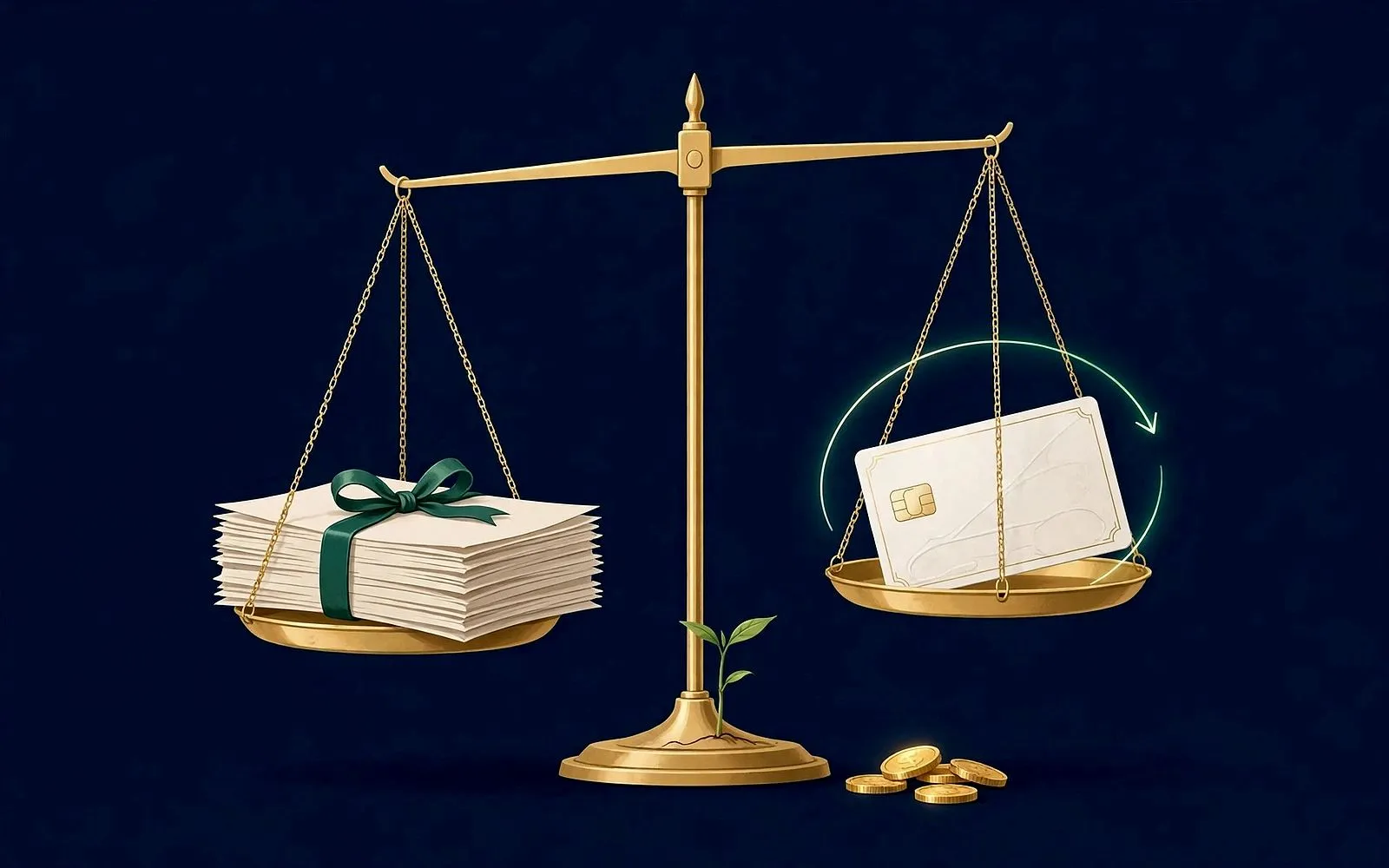
A $5,000 purchase costs $970 in interest on a personal loan but $2,412 on a credit card at the same payment. Here is how to choose the cheaper way to borrow.
In this article
You need $5,000 for a new boiler, a car repair, or a kitchen refresh. Two ways to borrow it sit in front of you: a personal loan from your bank, or the credit card already in your wallet. They feel like the same decision. They are not. At today's average rates, the same $5,000 costs $970 in interest on a personal loan and $2,412 on a credit card — even when you pay the same amount every month. That $1,442 gap is the whole story of this article: how the two products actually charge you, when each one wins, and how to pick the cheaper one before you sign anything.
The rates, right now
Start with the averages, because the gap between them is the reason this choice matters at all.
| Personal loan | Credit card | |
|---|---|---|
| US average rate | 11.90% (24-month bank loan) | 22.36% (accounts charged interest) |
| US, all card accounts | — | 21.19% |
| UK average rate | 6.98% (£10,000 loan); 11.52% (£5,000 loan) | 21.71% (balances charged interest); 24.71% quoted |
| UK, typical purchase APR | 8.1% (£7,500 loan) | 36.0% (Moneyfacts average) |
The US figures come from the Federal Reserve's G.19 consumer credit release of 6 November 2026, which puts the average 24-month personal loan at 11.90% against 22.36% for credit card accounts that actually pay interest. The UK figures are Bank of England data for September 2026: a £10,000 personal loan averages 6.98% quoted, a £5,000 loan 11.52%, while interest-charging credit cards average 21.71% effective — and Moneyfacts' average purchase APR across all cards hit a record 36.0% in June 2026. In both countries the card costs roughly double the loan. Your own rate will differ with your credit score — advertised personal loan APRs in the US run from about 6.2% for excellent credit to nearly 36% for the weakest borrowers — but the ordering almost never flips: for the same borrower, the loan is cheaper than the card.
The card costs roughly double the loan. For the same borrower, at the same credit score, the ordering almost never flips.
The $5,000 test, worked out
Averages are abstract. Here is the same $5,000 purchase, three ways, with the maths done properly. All figures below are our own calculations from the average rates above, so you can check them.
| How you borrow $5,000 | Monthly payment | Months to clear | Total interest |
|---|---|---|---|
| Personal loan, 11.90%, 36 months | $165.83 | 36 | $969.98 |
| Credit card, 22.36%, same payment | $165.83 | 45 | $2,411.79 |
| Credit card, cleared in 36 months | $191.88 | 36 | $1,907.85 |
| 0% purchase card, cleared in 21 months | $238.10 | 21 | $0 |
Read the first two rows together: the same $165.83 a month clears the loan in three years and costs $970 in interest. Put the same debt on a card at the same payment and it takes 45 months and costs $2,412 — $1,442 more, and nine extra months of payments. To clear the card in the same 36 months you would need $191.88 a month, and even then you pay $1,908 in interest, nearly double the loan. The fourth row is the exception that proves the rule: a 0% purchase card beats both, but only if you clear the whole balance before the interest-free window ends — $238.10 a month for 21 months, with no room for a missed payment.
The UK numbers tell the same story. A £5,000 loan at the 11.52% average costs £164.93 a month over three years, with £937 of interest. The same payment on a card at 21.71% takes 45 months and £2,314 of interest. And the bigger the loan, the wider the gap: a £10,000 loan at the 6.98% average costs just £1,112 in interest over three years.
The one-line test: if you will need more than a few months to repay, the personal loan almost always wins. If you can clear the balance within a 0% window or within one statement cycle, the card wins. Everything else is detail.
Why the card costs so much more
The rate gap is only half the story. The two products are built differently, and the structure is what turns a higher rate into a much bigger bill.
Revolving vs fixed. A personal loan is a fixed sum with a fixed term and a fixed payment. Every payment is a step toward a known finish date. A credit card is revolving: there is no finish date, and every new purchase adds to the balance. You can pay it down and run it straight back up again, which is exactly what most people do.
Variable vs fixed rate. Most personal loans lock the rate when you sign. Most credit cards charge a variable rate tied to the prime rate, so when the central bank raises rates, your card rate follows within a billing cycle or two. The Federal Reserve held its target at 3.75–4.00% in October 2026, but card APRs have stayed near record highs even as other rates eased — the average was roughly 13% a decade ago.
Daily compounding. Card interest is usually calculated on your average daily balance and compounds daily. Loan interest is calculated on a fixed amortisation schedule. The difference is small on paper and large over years.
The minimum-payment trap. This is where cards do their real damage. If you pay only the minimum on a $5,000 card balance at 22.36% — the standard formula of that month's interest plus 1% of the balance, with a $25 floor — our calculation shows it takes 231 months, over 19 years, and costs $8,241 in interest. That is more interest than the original purchase. A loan cannot do this to you: the payment is set so the balance reaches zero on a fixed date.
Never pay only the minimum. The minimum is designed to keep the account current, not to clear the debt. If the minimum is all you can afford, the purchase is too big for a card — take the loan, or wait.
When the credit card wins
The card is not always the wrong choice. It wins clearly in four situations.
You can clear it inside a 0% window. The longest 0% purchase offers in the US run to 21 months — the Wells Fargo Reflect, U.S. Bank Shield and BankAmericard cards all offer 21 months at 0% on purchases. In the UK the longest checked in November 2026 is 26 months (TSB Platinum Purchase), with the longest guaranteed period 21 months (Tesco Bank). A $5,000 purchase cleared over 21 months at 0% costs $238.10 a month and zero interest — cheaper than any loan. But the clock starts when the account opens, not when you buy, and a single missed payment can end the 0% deal early. Divide the purchase by the months and set a fixed payment for that amount on day one.
You pay in full every month. Buy on the card, pay the statement balance by the due date, and you pay no interest at all — the grace period, typically 21–25 days after the statement closes, makes the card free credit. This is the only way a card beats a loan on a small purchase.
You want the protection. In the UK, Section 75 of the Consumer Credit Act 1974 makes your card provider jointly liable with the retailer for purchases costing £100 to £30,000 — even if you only paid a deposit by card. If the goods are faulty, never arrive, or the retailer goes bust, you can claim from the card company. A personal loan gives you no such protection. In the US, card purchases carry chargeback and dispute rights under the Fair Credit Billing Act. For a big purchase from a seller you are not sure about, paying by card — even part of it — is worth real money.
You want rewards or flexibility. Cashback or points on a purchase you would pay off anyway is free money, and a card lets you borrow a little, repay it, and borrow again without a new application. A loan is a one-off lump sum: once you have spent it, there is no more.
When the personal loan wins
A large, one-off purchase you will repay over years. A boiler, a roof repair, a car, a wedding — anything over roughly $2,000–$3,000 that you cannot clear in a few months. The fixed term forces the discipline the card never will.
You want a finish date. The loan's greatest feature is not the rate; it is the end. Thirty-six fixed payments and the debt is gone. No minimum-payment drift, no new purchases creeping onto the balance, no rate rises mid-way through.
Your credit score is good. The best loan rates go to the best scores — Bankrate's April 2026 data puts the average personal loan rate at 12.04% for a borrower with a 700 FICO score, with the lowest advertised rates near 6.2%. If your score is strong, the loan's advantage is at its widest.
You are consolidating expensive card debt. Moving a balance from a 22% card to a 12% loan with a fixed payoff date is the single most reliable way to cut the cost of existing debt — provided you stop using the card afterwards. (We covered consolidation in depth in our debt consolidation guide.)
A loan's greatest feature is not the rate. It is the end: thirty-six fixed payments and the debt is gone.
The hidden costs that change the answer
The headline rate is not the whole price on either side. Check these before you compare.
Origination fees (loans). Many US personal loan lenders charge an origination fee, typically 1% to 10% of the loan amount, deducted from the money you receive. A 5% fee on a $5,000 loan means you must borrow $5,263 to get $5,000 in hand, and our calculation puts the true cost at $1,284 in interest plus fees — still far cheaper than the card, but the gap narrows. Some lenders charge no origination fee at all — SoFi, Discover and LightStream among them — though they may price that into a slightly higher rate. Always compare the APR, which includes the fee, not the interest rate alone.
Annual fees (cards). Most straightforward cards have no annual fee, but rewards cards can charge $95 to $695 a year. A fee wipes out the value of cashback on a modest purchase.
Early repayment (loans). In the UK, early settlement charges are capped by law — up to 28 days' additional interest if less than a year remains, or up to one month's interest if more remains. In the US, most personal loans have no prepayment penalty, but check: a few lenders still charge one.
Late fees. Both products charge them, and a late card payment can also end a 0% introductory offer. Set up autopay for at least the minimum on any card, and for the full payment on any loan.
What each one does to your credit score
Borrowing affects your score differently depending on the product, and this matters if you plan to apply for a mortgage or another loan soon.
Credit utilisation. Card balances count toward your utilisation ratio — the share of your available credit you are using. Our earlier guide explains the 30% rule: keeping utilisation below 30% protects your score, and a $5,000 balance on a $10,000 limit is 50%. A personal loan is instalment debt, not revolving, so it does not count toward utilisation at all. If your score matters right now, the loan is the safer choice.
New accounts and inquiries. Both products trigger a hard inquiry when you apply, which dings your score by a few points for a few months. A new card also lowers the average age of your accounts. Neither effect is large, but do not apply for both in the same month.
Payment history. This is the biggest factor in most scoring models, and it cuts both ways: a loan's fixed payment is easy to automate and never changes, while a card's minimum changes every month and is easy to miss. The product that gets paid on time, every time, is the one that helps your score.
The decision in 60 seconds
| Your situation | Cheaper choice | Why |
|---|---|---|
| Can clear it in full this month | Credit card | Grace period means zero interest, plus rewards and protection |
| Can clear it inside a 0% window (up to 21–26 months) | 0% purchase card | Zero interest beats any loan — if you set the fixed payment on day one |
| Large purchase, 2–5 years to repay | Personal loan | Half the rate, fixed finish date, no minimum-payment drift |
| Buying from a seller you don't fully trust | Credit card | Section 75 (UK, £100–£30,000) or chargeback rights |
| Already carrying card debt | Personal loan | Consolidate at ~12% instead of ~22%, with a payoff date |
| Weak credit score | Check both | Loan rates can reach ~36% for weak credit — compare real offers, not averages |
| You might keep spending on the same card | Personal loan | A loan can't be re-borrowed; a card balance can grow again |
Frequently asked questions
Is a personal loan always cheaper than a credit card?
Almost always, for the same borrower repaying over more than a few months. The average US personal loan is 11.90% against 22.36% for cards charged interest. The exceptions are a 0% purchase card cleared inside its window, and a card paid in full every month, where the interest is zero.
How much can I save by using a loan instead of a card?
On a $5,000 purchase repaid at $165.83 a month, the loan costs $970 in interest and the card $2,412 — a saving of $1,442, and the loan finishes nine months sooner. The saving grows with the amount borrowed and shrinks if you repay faster.
Does taking a personal loan hurt my credit score?
Briefly, by a few points, because of the hard inquiry and the new account. Over time it usually helps: instalment loans don't count toward credit utilisation, and a fixed payment that is always on time builds a clean payment history.
Can I use a 0% card and a loan together?
Yes, and sometimes it is the smartest move: put the purchase on a 0% card, pay it down aggressively, and if the 0% window is about to end with a balance left, move the remainder to a personal loan rather than letting it revert to 22% or more. Just don't take the loan and then run the card back up.
What if my credit score is poor?
Then compare real offers, not averages. Personal loan APRs for weak credit can reach 30–36%, which may be no better than a card — and some cards designed for rebuilding credit charge similar rates. Get quotes from at least three lenders, check for origination fees, and consider whether delaying the purchase while you improve your score saves more than borrowing now.
Key takeaways
- The average US personal loan costs 11.90%; the average card charged interest costs 22.36%. In the UK the gap is similar: 6.98% on a £10,000 loan vs 21.71% on interest-charging cards.
- On a $5,000 purchase at $165.83 a month, the loan costs $970 in interest over 3 years; the card costs $2,412 over 45 months — $1,442 more.
- Paying only the minimum on a $5,000 card at 22.36% takes over 19 years and $8,241 in interest. Never pay only the minimum.
- A 0% purchase card beats both — up to 21 months in the US, 26 in the UK — but only if you clear the balance before the window ends.
- Cards win on protection: Section 75 covers UK card purchases of £100–£30,000, even if only the deposit was paid by card.
- Watch the fees: origination fees of 1–10% on loans, annual fees on rewards cards. Compare APRs, not headline rates.
The right answer is rarely about which product is "better" in general — it is about your repayment horizon. Under a few months, the card is free. Inside a 0% window, the card is unbeatable. Beyond that, the loan's lower rate and fixed finish date save real money: $1,442 on a $5,000 purchase at today's averages, and far more if you would otherwise have drifted along on minimum payments. Before your next big purchase, do the 60-second check: how many months until it is paid off, and what does each route cost over exactly that period? The answer usually makes itself.
Sources
- Federal Reserve — G.19 Consumer Credit
- Bankrate — Personal Loan Origination Fees
- NerdWallet — What Is a Personal Loan Origination Fee?
- ClearScore — Average credit card interest rates in the UK (2026)
- BorrowingData — Interest rate statistics in the United Kingdom 2026
- UK Markets Today — 0% Purchase Credit Cards UK 2026
- Upgraded Points — Best 0% APR Credit Cards
- Which? — Section 75 of the Consumer Credit Act
- SoFi — Personal Loan Origination Fees
The MoneyHabit editorial desk researches, writes and reviews every article against our editorial policy.
The Sunday Habit
One useful money idea, every week.
A short, practical email every Sunday — no spam, no selling your address, unsubscribe anytime.
Advertisement
More in Debt & Credit Education

Debt & Credit Education · Guide
Personal Loan Consolidation: How It Works (2026)
A personal loan can turn several high-interest card balances into one fixed payment — but only if the maths works. Here is how to check, step by step.
17 November 2026 · 10 min read
Debt & Credit Education · Guide
How Credit-Card Interest Is Really Calculated
Your card's interest charge comes from a simple formula: average daily balance x daily rate x days. Here is the maths - and why paying early changes everything.
15 November 2026 · 10 min read

Debt & Credit Education · Guide
I Can't Afford My Credit Card Payments: What to Do First
A viral Ramsey clip says what millions are thinking. Here is the exact order: call your issuer, ask for a hardship plan, and get free help.
13 November 2026 · 9 min read