Guide
Save $10,000 in 100 Days? The Viral Challenge, Checked
A viral reel promises $10,100 in 100 days: save $2 on day one, add $2 a day. The maths checks out — but the last 10 days cost $1,910. Here's the honest verdict.
In this article
- How the $10,000 in 100 days challenge actually works
- The catch: the challenge is back-loaded
- "Where does the money come from?" — the commenters are right to ask
- Who this challenge actually works for
- Three versions that are easier to finish
- 1. The reverse challenge — start big, end small
- 2. The flat-rate version — $101 a day
- 3. The weekly auto-save — $192 a week
- Where to put the $10,100 once you have it
- Frequently asked questions
- Key takeaways
A short video is doing the rounds on Instagram and Facebook this week: a man in a car, speaking straight to camera, promising that anyone can save $10,000 in 100 days. The method sounds almost too simple. Save $2 on day one. Add $2 every day after that. By day 100 you are putting away $200, and the total in the pot is $10,100.
The reel, posted by Early Walker on 19 November, has been shared widely enough that the comments are now a debate of their own. Some viewers say they are starting immediately. Others ask the obvious question: where is the money supposed to come from? Both sides have a point. The maths in the video is correct — and that is exactly what makes it worth checking properly, because the hard part of this challenge is not the arithmetic. It is the shape of the cost curve, and what happens in the final two weeks.
How the $10,000 in 100 days challenge actually works
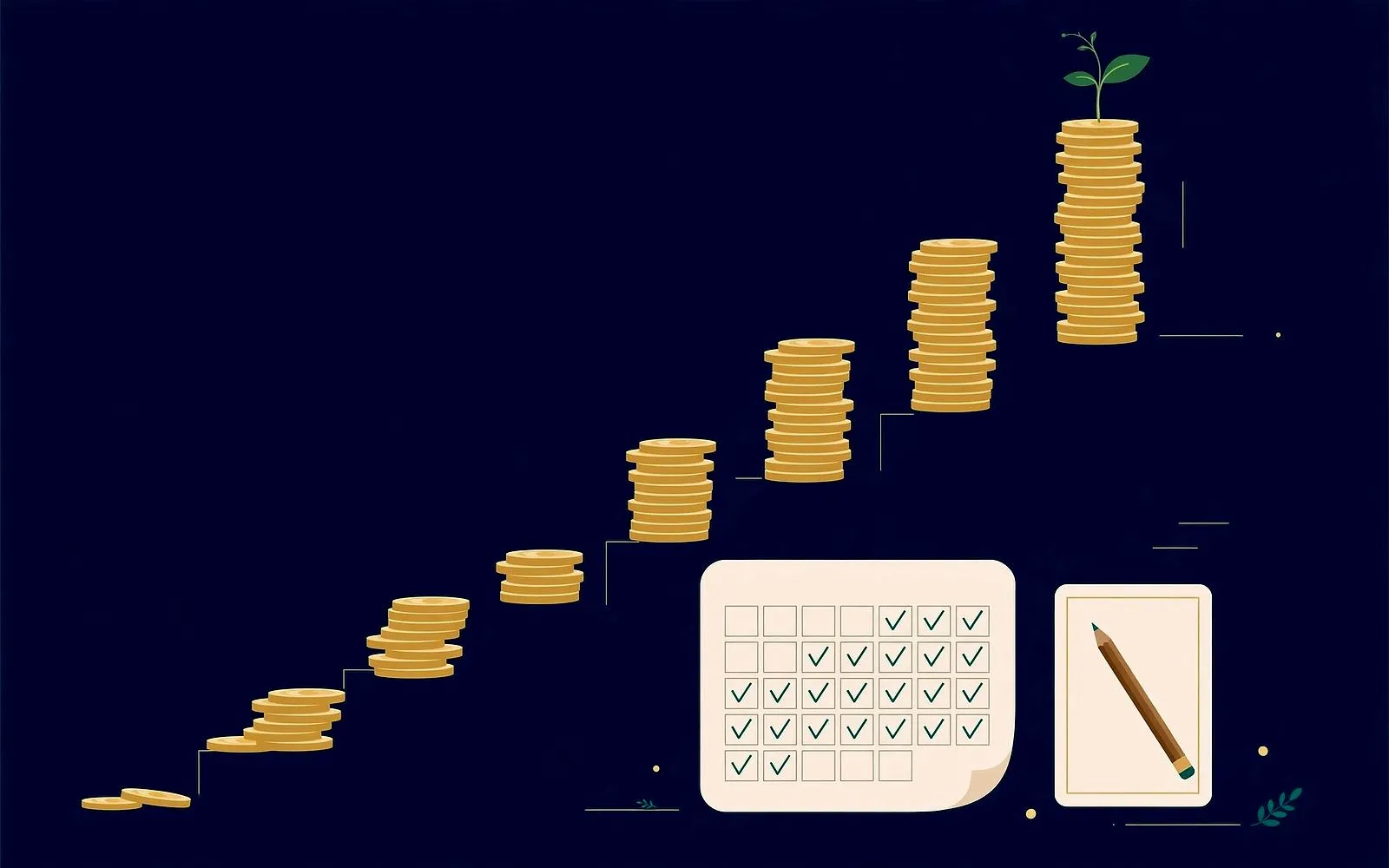
The challenge is an arithmetic series, the kind most of us last met in school. On day one you save $2. On day two, $4. On day three, $6. Each day you add $2 to the previous day's amount, so on day n you save $2 × n. On day 100, that is $200.
Add it all up and the total is $10,100 — slightly more than the round $10,000 in the title, because the series overshoots by $100. The milestones the creator quotes in the video check out exactly:
| Day | That day's saving | Total saved so far |
|---|---|---|
| 25 | $50 | $650 |
| 50 | $100 | $2,550 |
| 75 | $150 | $5,700 |
| 100 | $200 | $10,100 |
So the headline claim is not a trick. The maths is right, the milestones are right, and the creator is upfront that the later days get harder. What the video does not spell out is just how much harder — and that is where most people who start this challenge will quietly stop.
The catch: the challenge is back-loaded
Look at the challenge week by week and the problem jumps out. The first week costs $56 in total. The second week costs $154. By week ten you are putting away $938 in a single week, and the final full week costs $1,330. The last two days alone — $198 and $200 — cost $398, which is more than the first two weeks combined ($210).
| Week | Days | That week's total |
|---|---|---|
| 1 | 1–7 | $56 |
| 5 | 29–35 | $448 |
| 10 | 64–70 | $938 |
| 14 | 92–98 | $1,330 |
Put another way: the first 25 days build $650. The last 25 days demand $4,400 — nearly seven times as much, in the same number of days.
The final 10 days alone cost $1,910 — almost a fifth of the entire total.
"Where does the money come from?" — the commenters are right to ask
The most common objection in the comments is also the most important one. "I only get paid once a month," one viewer wrote. Another asked where the cash is supposed to come from when the daily amounts climb past $100. These are not excuses. They are the central design flaw of any daily challenge built for people paid monthly.
Most salaries arrive once or twice a month. A daily saving schedule does not match that rhythm. The money for day 60's $120 has to come from a paycheque that landed two weeks earlier and has already been partly spent, or from cutting spending that day — much harder to do on demand than to plan in advance.
The creator's answer in the video is that people routinely spend $200 on a dinner, a pair of shoes, or clothes to impress others, and could redirect that money instead. There is a grain of truth in that — most of us have discretionary spending we could trim. But a one-off $200 dinner is not the same as $200 every day for the last ten days. The first is a choice. The second is a second rent payment.
There is also the income question. Bankrate's 2026 Emergency Savings Report found that only 47% of Americans could cover a $1,000 emergency expense, and just 30% would pay it from savings. A quarter of adults have no emergency savings at all. For someone in that position, a challenge that demands $1,910 in its final ten days is not a savings plan. It is a setup for failure — and the worst outcome is not quitting. It is quitting and concluding that saving "doesn't work for me."
The honest test: look at your last three months of bank statements and find $10,100 of spending you could genuinely have skipped. If you cannot find it, pick a smaller, steadier target instead.
Who this challenge actually works for
None of this means the challenge is useless. It works well for a specific group of people, and if you are in that group it can be genuinely effective:
- People with daily cash income. If you are paid daily or weekly — tips, gig work, cash-in-hand jobs — a daily saving habit matches how money actually arrives.
- People with a windfall to park. A tax refund, a bonus, or a sold item can fund the expensive final weeks in advance, so the daily amounts never bite.
- People who already have a surplus. If your budget already leaves $400–$500 a week unspent, the challenge is a fun way to give that surplus a job.
- People who need a game, not a lecture. Some savers stick with a challenge precisely because it is one. The daily streak and the visible progress are real motivation, and they count.
Three versions that are easier to finish
1. The reverse challenge — start big, end small
Run the same series backwards. Day one is $200, day two is $198, and the amounts shrink by $2 every day until day 100 is $2. The total is exactly the same $10,100, but the hardest days come first, when your enthusiasm is highest, and the last week costs just $56.
2. The flat-rate version — $101 a day
Divide $10,100 by 100 days and save $101 every day. Same total, same 100 days, zero surprises. Set up a daily automatic transfer and you never have to think about it.
3. The weekly auto-save — $192 a week
Forget the daily rhythm entirely. Saving $192 a week for a year builds $9,984 in 52 weeks — $16 short of the same target, on a schedule that matches a weekly or monthly paycheque. Automate it for payday and the money leaves before you can spend it.
| Method | Total | Time | Hardest single week | Best for |
|---|---|---|---|---|
| Original 100-day challenge | $10,100 | 100 days | $1,330 | Daily income, gamifiers |
| Reverse challenge | $10,100 | 100 days | $1,330 (week 1) | Front-loaders |
| Flat $101 a day | $10,100 | 100 days | $707 | Steady earners |
| $192 a week auto-save | $9,984 | 52 weeks | $192 | Most people |
| 52-week challenge ($1 to $52) | $1,378 | 52 weeks | $364 | First-time savers |
| $50 a week auto-save | $2,600 | 52 weeks | $50 | Starting from zero |
If $10,000 in 100 days is genuinely out of reach, that does not mean the idea has failed you. The 52-week challenge — save $1 in week one, $2 in week two, up to $52 in the final week — builds $1,378 in a year and is a far better first step. And the Well Kept Wallet guide to building your first $10,000 makes the same point in plainer terms: start with one month of expenses, clear high-interest debt first, keep the money in a high-yield savings account, and automate $50 a week.
Do not fund this challenge with debt. Never put daily savings on a credit card, skip a minimum debt payment, or raid rent and bill money to keep a streak alive. A savings challenge that creates debt is worse than no challenge at all — high-interest card debt costs far more than any savings habit earns.
Where to put the $10,100 once you have it
Finishing the challenge is only half the job. Where the money sits decides what it earns — and the gap between a good account and a bad one is enormous. Bankrate's November 2026 roundup puts the best high-yield savings accounts at up to 4.40% APY, while the national average sits at 0.56%. On a $10,000 balance, that is roughly $440 a year in interest at the top rate, versus about $56 at the average. Many big banks still pay 0.01% on standard savings — about $1 a year on $10,000.
Keep the money in an account that is FDIC-insured (or NCUA-insured at a credit union) and easy to reach in an emergency. That is the whole point of the exercise: the $10,100 is most valuable as a cushion, not as an investment. Once you have three to six months of expenses saved, the money beyond that can go toward investing — but the first $10,000 belongs somewhere safe and accessible.
For UK readers, the same logic applies with different products: an easy-access savings account paying a competitive rate, or NS&I Premium Bonds if you prefer the prize-draw format — just remember that Premium Bonds pay prizes, not guaranteed interest. The principle is identical on both sides of the Atlantic: the account matters as much as the habit.
Frequently asked questions
Does the maths in the video really add up?
Yes. Saving $2 on day one and adding $2 each day gives $10,100 after 100 days, not $10,000 — the series overshoots the round number by $100. The milestones quoted in the video ($650 by day 25, $2,550 by day 50, $5,700 by day 75) are all exactly right.
What happens if I miss a day?
Nothing, unless you let it end the challenge. The creator himself says to do what you can if the full version is too much. Missed days can be caught up later, or you can simply restart the count — the money you have already saved is still yours either way.
Is $10,000 in 100 days realistic on a normal salary?
For most people, no — not in this form. Saving $10,100 in 100 days means finding about $3,000 a month, every month, for over three months. That is more than many households have left after rent, bills, food, and transport. The weekly $192 auto-save reaches $9,984 in a year and fits a normal budget far better.
What should the $10,000 be for?
An emergency fund is the best first use. With only 47% of Americans able to cover a $1,000 emergency, a $10,000 cushion changes the maths of everyday life: a broken car or a lost job becomes an inconvenience instead of a crisis. After that, the money can go toward debt, a deposit, or investing — in that order.
Key takeaways
- The viral maths is correct: $2 on day one, adding $2 daily, totals $10,100 in 100 days.
- The challenge is heavily back-loaded — the last 25 days cost $4,400, against $650 for the first 25.
- Daily saving does not match monthly pay, which is why most people stall in the final weeks.
- The reverse challenge and the flat $101-a-day version reach the same total with a kinder cost curve.
- A $192 weekly auto-save builds $9,984 in a year and fits a normal budget far better.
- Park the money in a high-yield savings account — up to 4.40% APY beats the 0.56% national average by roughly $384 a year on $10,000.
- Never fund a savings challenge with debt or by skipping bills.
The $10,000 in 100 days challenge deserves its viral moment. The maths is honest, the goal is a good one, and for the right person it works. But a savings plan should be judged by whether you can finish it, not by whether it looks impressive on day one. Pick the version that fits your pay cycle, automate it, and put the money somewhere it earns properly. The best challenge is the one you actually complete.
Sources
- Early Walker — 'How to Save $10,000 in 100 Days' (Instagram reel, 19 Nov 2026)
- Early Walker — 'How to Save $10,000 in 100 Days' (Facebook reel, 19 Nov 2026)
- Bankrate — Best high-yield savings accounts of November 2026
- Bankrate — 2026 Emergency Savings Report
- Well Kept Wallet — '6 Rules for Building Your First $10,000' (Instagram, 18 Nov 2026)
The MoneyHabit editorial desk researches, writes and reviews every article against our editorial policy.
The Sunday Habit
One useful money idea, every week.
A short, practical email every Sunday — no spam, no selling your address, unsubscribe anytime.
Advertisement
More in Budgeting & Saving

Budgeting & Saving · Guide
Save $9,150 in 26 Paychecks? The Viral Challenge, Graded
The viral 26-paycheck challenge promises $9,150 in a year — but the maths does not quite add up. We checked the numbers and built a version that works.
6 November 2026 · 10 min read

Budgeting & Saving · Explainer
Her 1K Stack: The $7-a-Day Pink Bucket Challenge
Jasmine Danyell's viral pink bucket turns $7 a day into a $1,000 cushion. We checked the maths, the catches, and the smarter way to run it.
18 November 2026 · 10 min read

Budgeting & Saving · Guide
How to Save for a House Deposit While Renting
Average UK rent is £1,406 a month — yet a deposit is still reachable. The real target, the Lifetime ISA bonus, and a month-by-month plan to get there.
14 November 2026 · 8 min read