Habit
Build What Pays You Before What Costs You
A viral animation says buy the house before the car. The maths behind it is real — but the rule needs a reality check before you follow it.
In this article
- The 10-coin animation everyone is sharing
- What the rule gets right: cars shrink, houses (usually) grow
- Where the animation cheats: a home you live in does not pay you
- The corrected rule: sequence, not either-or
- Car first, house first, or invest first? The honest comparison
- When buying the car first is the right call
- When buying the house first is the right call
- Frequently asked questions
- Key takeaways
- The bottom line
The 10-coin animation everyone is sharing
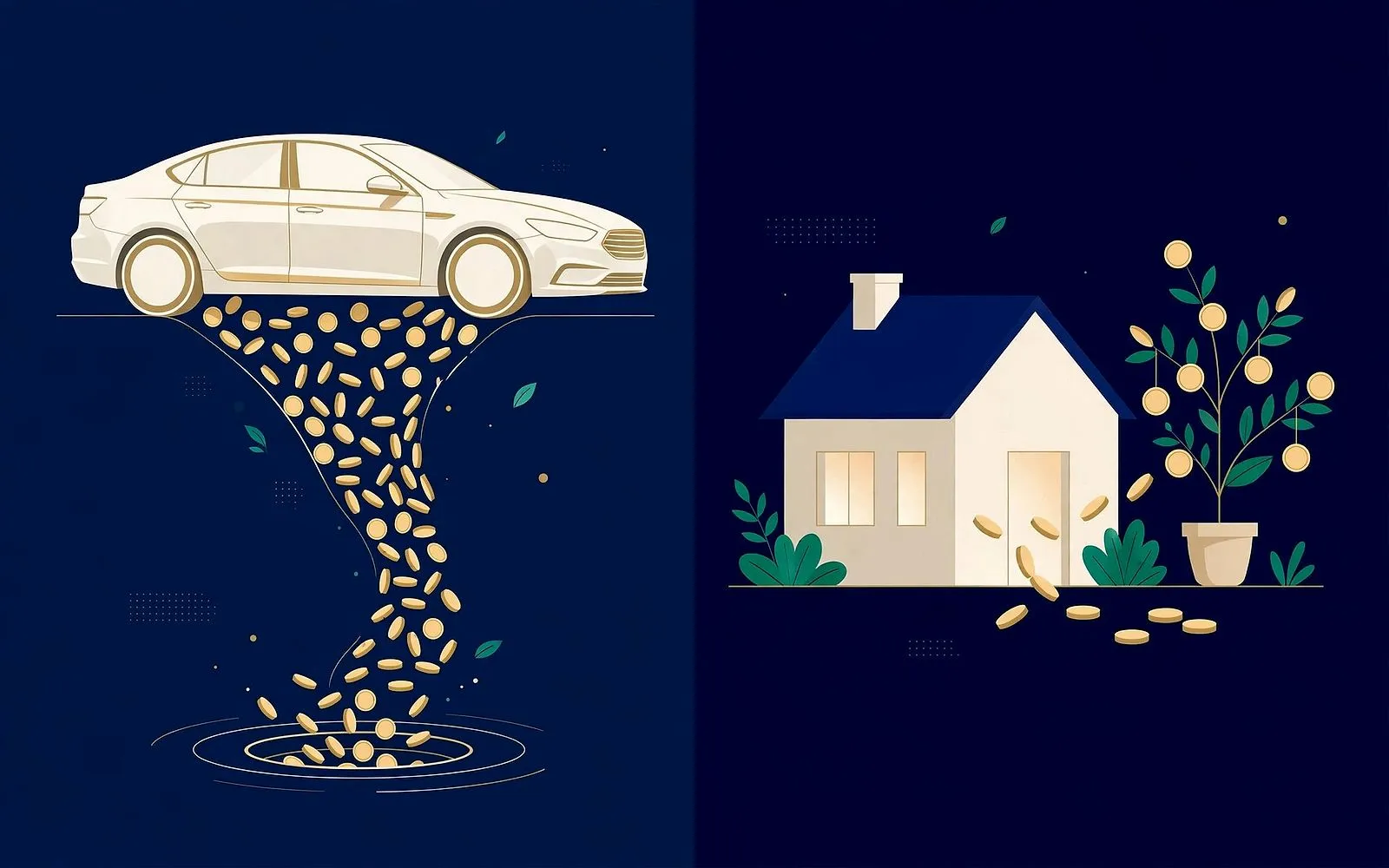
A short animation posted on 18 November 2026 has collected more than 110,000 likes, and it makes its point in about fifteen seconds. Two stick figures each start with ten gold coins. The figure labelled "spends first" buys a car straight away. The coins drain to zero, the house stays a dashed outline that is never built, and the figure ends hunched over, owning only the car. The figure labelled "builds first" puts the coins into a house first. The house becomes solid, coins come back, and only then does the figure buy the car — ending with ten coins, a house and a car. The caption reads: "Build what pays you before what costs you."
It is a satisfying little story, and the comment section shows why it travelled so far. Plenty of people agree from experience: they bought a home early, rented part of it out, and never looked back. Plenty of others push back just as hard: a car is not a luxury when there is no bus to your job, and a house is not an income machine when you live in it. Both sides are right about something. The rule is worth following — but only after you check the maths the animation skips.
What the rule gets right: cars shrink, houses (usually) grow
The animation's core claim is about direction of travel. A new car loses value from the moment you drive it away, while a home has historically gained value over time. The numbers behind that claim are stark. Kelley Blue Book's average depreciation model puts a new car at 84% of its price after one year and 45% after five — a 16% loss in year one and roughly 55% over five years. CARFAX's 2026 data is gentler, at about 12.5% in the first year, and iSeeCars' study of more than 950,000 five-year-old vehicles puts the five-year loss at 41.8%. Whichever source you trust, the direction is the same: a car is a depreciating asset, and the steepest drop comes first.
Against that, the average new vehicle sold for a record $51,109 in October 2026, according to Cox Automotive and Kelley Blue Book. Edmunds' third-quarter 2026 financing data shows the average buyer financing $44,664 at 7.0% APR over 70.5 months, paying $787 a month and $9,938 in total interest over the life of the loan. One in four new-car loans now runs 84 months or longer. AAA's Your Driving Costs study for 2026 puts the full cost of owning a new vehicle — depreciation, fuel, insurance, maintenance, finance charges — at $12,863 a year, or $1,071.92 a month. That is the real price of the shiny car in the animation's first panel.
Houses point the other way. The Federal Housing Finance Agency's house price index shows US home prices rising roughly 4.3% a year on average from 1975 to 2025, and Zillow's index shows about 4.2% a year since 2000. The median existing home sold for $416,700 in October 2026, according to the National Association of Realtors — up 0.4% on a year earlier, the 40th consecutive month of year-over-year price gains. At 4.3% a year, a $416,700 home gains about $17,900 in value in a year, while a $51,109 car loses about $8,200 in its first year on Kelley Blue Book's model. That is the gap the animation is dramatising, and it is real.
Buy the thing that puts money in your pocket before the thing that takes money out of it. The hard part is knowing which is which — because a house you live in takes money out too.
Where the animation cheats: a home you live in does not pay you
Here is the catch the fifteen-second version leaves out. In the animation, the house returns coins to its owner. A home you live in does not do that. It pays you nothing each month. What it does is appreciate slowly while charging you every month for the privilege.
Run the numbers at today's rates. The 30-year fixed mortgage averaged 7.33% in October 2026, according to Freddie Mac, and stood at 7.11% in the weekly survey of 12 November. On the median $416,700 home with 20% down, the loan is $333,360 and the principal-and-interest payment is about $2,292 a month. In the first year of that loan, roughly $24,400 of your payments is interest — money that is gone, not equity. The home's 4.3% appreciation adds about $17,900 in value, and the principal you repay in year one is only around $3,100. Add property tax, insurance and maintenance, and the house costs you more than it gains in year one. It is a forced savings plan with a roof, not an income stream.
That does not make buying a house wrong. It makes the animation's promise wrong. The house only "pays you" in the reel's sense if someone else pays to live in it — a rented room, a spare unit, a house hack — or if you hold it for many years while the mortgage balance shrinks and the value compounds. Over a decade at 4.3% a year, that $416,700 home is worth roughly $635,000. The car, over the same decade, is worth scrap value. Time is what turns a house into the asset the animation shows, and time is exactly what a fifteen-second video cannot show.
The other cheat is the car itself. The animation treats the car as a pure want. For millions of people it is a tool that earns the money: no car, no shift, no paycheque. The top comment thread under the reel makes exactly this point — in places with no public transport, the car is what gets you to the job that funds everything else. A car that carries you to work is not the enemy of wealth. A $787-a-month car loan on a $51,109 new car, when a reliable used car costs half as much, is.
The corrected rule: sequence, not either-or
The useful version of the viral rule is not "house before car". It is "income before outgo, and needs before wants". The order that actually builds wealth looks like this:
- Cover the emergency first. One month of expenses in a high-yield savings account, then build toward three to six months. Without this, every surprise becomes debt, and debt is the most expensive liability of all.
- Kill high-interest debt. A credit card at 20% or more costs you more than any investment earns. Paying it off is a guaranteed, tax-free return.
- Buy the smallest car that does the job. If you need a car, buy reliability, not newness. The average used-car listing price in 2026 sits around $27,000–$30,500 — roughly $20,000 less than the average new car — and a one- or two-year-old car has already taken the steepest depreciation hit.
- Put the difference into something that pays you. This is the step the animation is really about. The $787 average new-car payment, invested at a 7% average annual return, grows to roughly $56,000 over five years. That is an illustration, not a promise — returns vary and can be negative — but it shows the scale of what a big car payment displaces.
- Then buy the house — when the numbers work. A home becomes the asset the reel promises when the monthly cost is affordable on your income, you plan to stay put for at least five to seven years, and you have the emergency fund to absorb a broken boiler without a credit card. Until then, renting while your investments compound is not falling behind.
The test is simple: if it stopped working tomorrow, would this purchase still be worth what it costs? A house you can afford passes. A car you need passes. A new car bought on a seven-year loan to impress people who do not pay your bills does not.
Car first, house first, or invest first? The honest comparison
| Order | What happens in year one | Best for | Watch out for |
|---|---|---|---|
| New car first | $51,109 car loses roughly $8,200 in value; $787 a month leaves your account for 70 months | Almost nobody — unless the car directly earns income | Negative equity: you owe more than the car is worth for years |
| Used car first | Reliable car for roughly $27,000–$30,500; the steepest depreciation is already behind it | Anyone who needs wheels to earn | Repair bills — keep an emergency fund for them |
| House first | $416,700 home gains about $17,900 in value but costs roughly $24,400 in first-year mortgage interest, plus tax, insurance and upkeep | Stable income, long stay, affordable payment | At 7%+ mortgage rates the house costs more than it gains early on |
| Invest first | $787 a month compounding; no depreciation, no repair bills, full flexibility | Anyone not ready to settle in one place | Returns are never guaranteed; discipline is the whole strategy |
When buying the car first is the right call
Buy the car first — or at least before the house — when your job depends on it and there is no realistic public transport, when the car lets you take a better-paying job or extra shifts, or when your current car is unreliable and one breakdown away from costing you a paycheque. In those cases the car is not a liability in the animation's sense. It is the tool that funds the house.
What matters is how you buy it. A $15,000–$20,000 reliable used car bought with cash or a short loan does the same job as the $51,109 new car for roughly $30,000 less, and the money you do not spend on the payment is the money that builds the house deposit. The mistake is not buying a car. The mistake is buying the most expensive version of a car on the longest loan the dealer will offer, then wondering why the house deposit never grows.
When buying the house first is the right call
The house-first order works when three things are true at once. First, the payment is comfortable — not just affordable on a good month, but affordable after the emergency fund, the retirement contribution and real life. Second, you will stay put. Transaction costs on buying and selling run to roughly 8–10% of the price in the US, so a home bought and sold within a few years usually loses money even if prices rise. Third, you have cash left over after the deposit. A house with no emergency fund is one broken roof away from a credit card balance at 20%.
If those three hold, the house does what the animation promises, just more slowly than fifteen seconds suggests. The mortgage balance falls a little every month, the value rises a little most years, and after a decade the gap between the two is real wealth. Add a rented room and the house genuinely starts paying you — the one version of the reel that is literally true.
Do not stretch for a house because a video made renting feel like failure. At a 7.33% mortgage rate, the interest on a median home costs more in year one than the home gains in value. Buying before you are ready is how a wealth-building asset becomes a wealth-draining liability.
Frequently asked questions
Is a house an asset or a liability?
Both, depending on how you use it. A house you live in is an asset on paper — it has value — but it costs you money every month and pays you nothing until you sell it or rent part of it out. A rented property is an income-generating asset. Ask whether it puts money in your pocket or takes it out, month by month.
Should I buy a car or save for a house deposit first?
If you need a car to earn, buy the cheapest reliable one that does the job and keep saving. If you can manage without a car for now, skipping the car payment is the fastest way to grow a deposit. The $787 average new-car payment is $9,444 a year that is not going into your deposit.
Does the "build first" rule work in the UK?
The principle travels, but the numbers change. UK car finance often runs through PCP deals with a large final balloon payment, and UK house prices, stamp duty and mortgage rates differ from US figures. The sequence is the same — emergency fund, expensive debt, cheap reliable transport, then the deposit — but check UK-specific rates and taxes rather than using the US figures in this article.
What if I already bought the expensive car?
Do not panic-sell it at a loss without doing the maths. Work out what you owe versus what it is worth, what a cheaper replacement would cost, and whether the payment is actually stopping you saving. If the payment is manageable and the car is reliable, the cheapest option is often to keep it, pay it off, and drive it for ten years.
Is renting really throwing money away?
No. Rent buys flexibility and transfers the costs of repairs, tax, insurance and interest-rate rises to someone else. In the first year of a median-priced home at today's mortgage rates, the interest alone exceeds the home's expected appreciation. Renting while you build savings and invest the difference is a legitimate build-first strategy.
Key takeaways
- The viral rule is directionally right: new cars lose roughly 16% of their value in year one, while US homes have appreciated about 4.3% a year over the long term.
- But a home you live in does not pay you monthly. At a 7.33% mortgage rate, first-year interest of roughly $24,400 exceeds the home's roughly $17,900 first-year gain in value.
- The average new car now costs $51,109, with a record $787 monthly payment over 70.5 months. A reliable used car at roughly half the price does the same job.
- The corrected order is: emergency fund, kill expensive debt, buy the cheapest reliable car you need, invest the difference, then buy the house when the payment is comfortable and you will stay put.
- A car you need to earn is a tool, not a trap. The trap is the most expensive version of it on the longest loan.
The bottom line
"Build what pays you before what costs you" earned its 110,000 likes because the instinct is sound: put your money into things that grow before things that shrink. Just do not let a fifteen-second animation do your financial planning. A house is not an income stream because a cartoon says so, and a car is not a mistake because it has wheels. Check the numbers for your own life — the payment, the rate, the time you will stay — and then build in the order that actually leaves you richer. This week, the one move that fits almost everyone is the smallest one: work out what your car really costs you each month, all in, and ask what that money would be doing if it went into your deposit or your investments instead. The answer is usually the whole point of the video.
Sources
- DEMIC — 'Build What Pays You Before What Costs You' (Facebook reel, 18 Nov 2026)
- Edmunds — New-Car Financing Records Pile Up in Q3 2026 (1 Oct 2026)
- CARFAX — Car Depreciation: How Much Value Does a Car Lose Per Year? (2026)
- MotorJudge — Car Depreciation Statistics for 2026 (iSeeCars / Kelley Blue Book)
- National Association of Realtors — Existing-Home Sales Decreased 5.5% in October (12 Nov 2026)
- Freddie Mac — Primary Mortgage Market Survey
- Housing-Market.org — Average Home Appreciation Per Year (FHFA / Zillow)
- FixnFigure — Car Depreciation Calculator and Cost of Ownership (AAA Your Driving Costs 2026)
The MoneyHabit editorial desk researches, writes and reviews every article against our editorial policy.
The Sunday Habit
One useful money idea, every week.
A short, practical email every Sunday — no spam, no selling your address, unsubscribe anytime.
Advertisement
More in Money Habits

Money Habits · Guide
Salary Negotiation: The 30-Minute Prep That Pays
Most workers never ask for more pay — and the data says two in three who do get it. A 30-minute prep plan, the numbers to quote, and scripts that work.
9 November 2026 · 15 min read

Money Habits · Habit
The 24-Hour Rule: Stop Impulse Buys Before They Happen
Wait a day before buying anything unplanned. The 24-hour rule turns impulse into a decision — here's the science, the maths, and how to automate it.
9 November 2026 · 14 min read
Money Habits · Habit
The Windfall Protocol: Decide Before the Money Lands
Bonuses, tax refunds and pay rises feel like free money — which is why they vanish. A protocol, decided before the cash lands, puts every dollar to work.
8 November 2026 · 12 min read