Guide
Claiming Social Security at 62: The Maths That Decide It
Claiming at 62 cuts your Social Security check by 30% for life; waiting to 70 pays 77% more. Break-even ages, the earnings-test trap, and when early is right.
In this article
- The three ages that matter: 62, 67, 70
- The break-even ages: when waiting catches up
- When claiming at 62 is the right call
- When waiting wins — and by how much
- The earnings test: the trap that catches working 62-year-olds
- Spouses and survivors: the decision is rarely yours alone
- Taxes: up to 85% of your benefit can be taxable
- How the UK handles the same question
- Frequently asked questions
- Key takeaways
Sixty-two is the earliest age you can claim Social Security — and the most popular wrong answer in retirement planning. Roughly 30% of people claim before their full retirement age, most of them at 62, the first month checks become available. The reason is understandable: the money is right there, and waiting feels like leaving cash on the table. But the maths runs the other way for most healthy people — claiming at 62 permanently cuts your monthly check by 30%, and waiting until 70 pays 77% more every month than claiming at 62. Here are the exact numbers, the break-even ages, and the four situations where claiming early is genuinely the right call.
The three ages that matter: 62, 67, 70
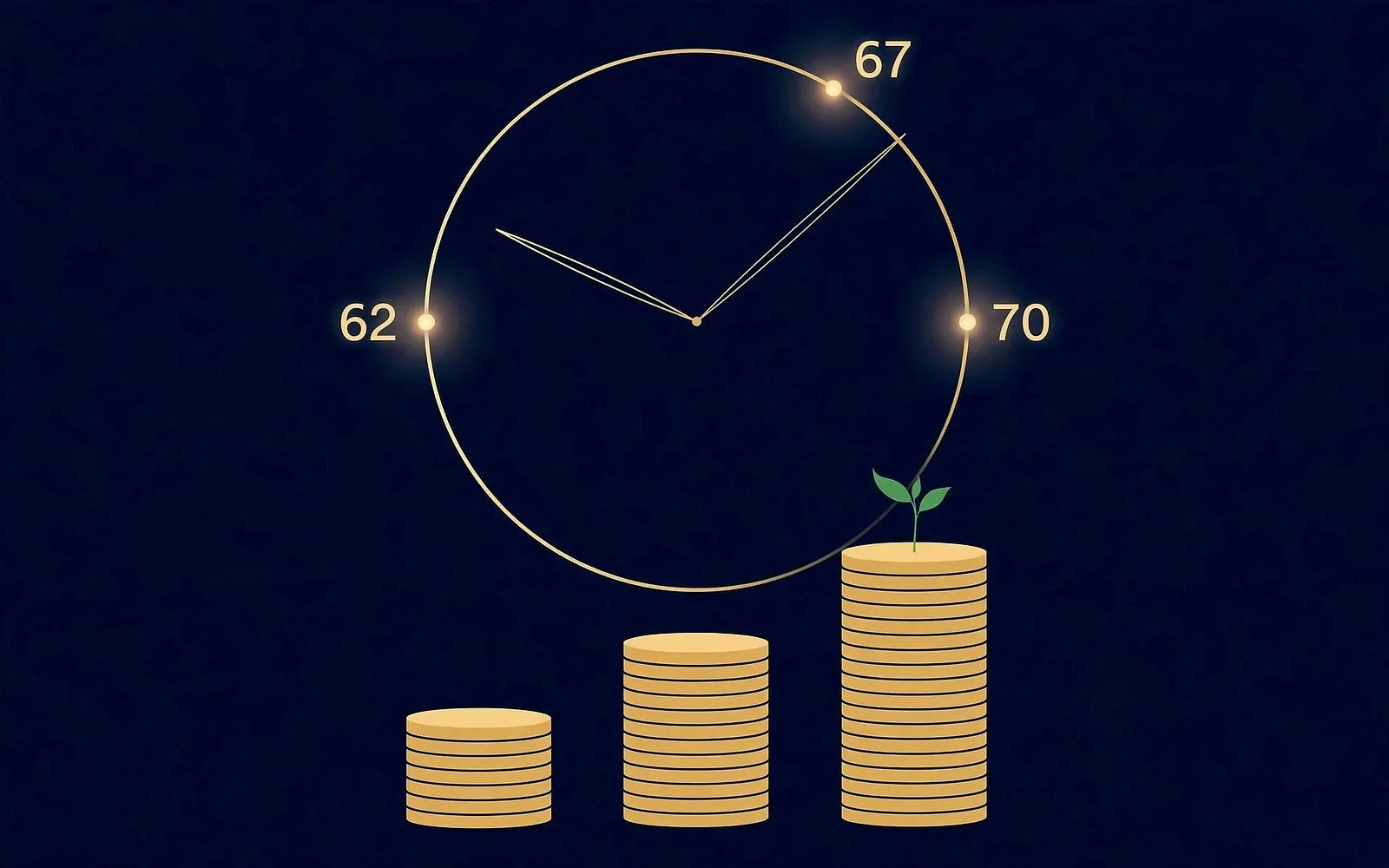
Everything turns on three ages. Your primary insurance amount (PIA) is the monthly benefit you receive at your full retirement age (FRA) — 67 for anyone born in 1960 or later, 66 to 66 and 10 months for those born 1943–1959. Claim earlier and the check shrinks for life; claim later and it grows, up to age 70. There is no benefit to waiting past 70.
The adjustment is fixed by law: 5/9 of 1% per month for each of the first 36 months before FRA, then 5/12 of 1% per month after that. With an FRA of 67, claiming at 62 means 60 months early — 36 × 5/9% = 20%, plus 24 × 5/12% = 10% — a 30% permanent reduction. Past FRA, delayed credits add 8% a year until 70, a 24% gain.
| Claiming age | Share of your full benefit | On a $2,000 FRA benefit | 2026 maximum benefit |
|---|---|---|---|
| 62 | 70% | $1,400 a month | $2,969 a month |
| 67 (FRA) | 100% | $2,000 a month | $4,152 a month |
| 70 | 124% | $2,480 a month | $5,181 a month |
The 2026 maximums require earnings at or above the taxable maximum for 35 years. The average retired worker receives about $2,071 a month in 2026, after the 2.8% cost-of-living adjustment. On that average benefit, claiming at 62 pays roughly $1,450 a month; waiting to 70 pays roughly $2,568 — a $1,118-a-month difference, every month, for life, with every future COLA applied to the larger base.
The 30% cut is permanent — and it compounds. It does not disappear when you reach 67. Every cost-of-living adjustment after you claim is applied to your reduced check, so the gap between the early and late claimer grows in dollars every year even though the percentage stays the same.
The break-even ages: when waiting catches up
The honest way to compare claiming ages is cumulative: add up everything each choice pays over a lifetime and find the age where the totals cross. Before that age, the early claimer has received more in total; after it, the late claimer pulls ahead and never looks back. Using a $2,000 FRA benefit in today's dollars, with no COLA:
62 vs 67 breaks even at about age 78 years 8 months: the age-62 claimer banks $84,000 first, and the $600-a-month gap takes about 140 months to close. 67 vs 70 breaks even at about age 82 years 6 months ($72,000 banked first, $480-a-month gap). 62 vs 70 — the widest gap — breaks even at about age 80 years 5 months ($134,400 banked first, $1,080-a-month difference).
Those ages only matter next to how long people live. The Administration's life table puts a 65-year-old man at about 83 and a woman at about 86. More than 1 in 3 of today's 65-year-olds will reach 90, and about 1 in 7 will reach 95. For a couple both aged 65, there is roughly a 50% chance at least one spouse lives to about 90 — well past every break-even age above.
Break-even is a lifespan question, not a verdict. If you live past 80, waiting to 70 paid more in total. If you die before 78, claiming at 62 did. Nobody gets to know which side of that line they are on — which is why health, not the calendar, should drive the decision.
One caveat: the chart ignores COLA. Every annual adjustment is a percentage of your check, so the larger check from waiting grows faster in dollars, pulling break-even slightly earlier. It also ignores taxes and the survivor benefit — both usually favour waiting.
When claiming at 62 is the right call
Waiting is the better bet for the average healthy person, but averages are not people. Claiming at 62 is right when any of these is true:
- Your health is poor, or your family history is short. If a realistic life expectancy is below the late 70s, the early claimer wins outright. A smaller check you collect beats a larger one you never live to see.
- You need the money now. If the alternative is credit-card debt at 22% interest or draining your last savings, the 30% cut is cheap by comparison.
- You have no savings to bridge the gap. Waiting only works if you can afford it. Nearly 4 in 10 Americans aged 46 to 60 say they are "not at all confident" they could maintain their standard of living in retirement — for them, 62 is not a choice, it is the plan.
- You are the lower earner in a couple and your spouse is waiting. The lower earner claims early for cash flow now; the higher earner waits until 70 to maximise the benefit that survives them both.
Do not claim at 62 to "get your money back before the system runs out." Even under official projections, payroll taxes alone would still cover roughly three-quarters of scheduled benefits if Congress changed nothing — the system does not go to zero. Claiming early out of fear locks in a 30% cut for a risk that does not justify it.
When waiting wins — and by how much
Waiting is worth real money in three situations. First, good health and longevity in the family: if you are likely to live into your mid-80s or beyond, every break-even calculation above says the late claimer ends up ahead — and the margin grows yearly. On a $2,000 FRA benefit, claiming at 70 and living to 90 pays roughly $125,000 more in total than claiming at 62.
Second, you are still working. Claiming while earning triggers the earnings test below, which can withhold much of the early checks. Third, you are the higher earner in a marriage: your benefit becomes your spouse's survivor benefit, so waiting until 70 buys the largest cheque for whoever lives longest. And inflation protection: Social Security rises with prices every year, for life, with no fees and no market risk — the "price" of a bigger one is simply waiting.
The earnings test: the trap that catches working 62-year-olds
Claim at 62 and keep working, and Social Security claws money back. In 2026, if you are under FRA for the whole year, it withholds $1 for every $2 you earn above $24,480. In the year you reach FRA, the limit rises to $65,160 and withholding softens to $1 for every $3 above it, counting only earnings before your birthday month. Once you reach FRA, there is no limit.
Only wages and net self-employment income count — pensions, investment income, rent and IRA or 401(k) withdrawals do not trigger withholding, though they can make more of your benefit taxable. Withheld money is not lost: at FRA, the Administration recalculates your benefit upward for the months you were not paid. But that does not undo the 30% reduction, and a decent salary can swallow most of the cheque meanwhile — on the average $2,071 benefit, a $45,000 salary means about $10,260 withheld in 2026, roughly five months of checks gone.
| Your situation in 2026 | Earnings limit | Withholding |
|---|---|---|
| Under FRA for the whole year | $24,480 | $1 per $2 over the limit |
| Reaching FRA during 2026 | $65,160 | $1 per $3 over the limit (earnings before birthday month only) |
| FRA or older all year | No limit | None |
Working past 62? Do the earnings-test maths before you file. Earning $40,000 while claiming at 62 means about $7,760 withheld in 2026 — over five months of the average early check. If you are still earning a full salary, you are usually better off not claiming until you stop work or reach FRA.
Spouses and survivors: the decision is rarely yours alone
For married couples, the decision is joint. A spouse can claim a spousal benefit of up to 50% of the worker's FRA benefit — but only at the spouse's own FRA. Claim it at 62 and it falls to about 32.5%, and never grows. The spousal maximum is based on the worker's FRA amount, not the age-70 amount: even if the higher earner waits until 70, the spouse's benefit tops out at 50% of the FRA figure.
The survivor benefit is where waiting pays twice. A widow or widower can claim as early as 60 (50 if disabled), worth up to 100% of the deceased spouse's actual benefit — including delayed retirement credits. When the higher earner waits until 70, they raise their own cheque by 24% and the cheque their spouse will live on after they are gone. For couples, the higher earner should usually be the one to wait.
Taxes: up to 85% of your benefit can be taxable
Whether your benefit is taxed depends on "combined income" — adjusted gross income plus non-taxable interest plus half your benefit. Under $25,000 (single) or $32,000 (married filing jointly), none is taxed; between those and $34,000 / $44,000, up to 50% is taxable; above them, up to 85%. The thresholds have never been indexed to inflation, so more retirees cross them yearly. Claiming early can worsen the bite: a smaller cheque is still taxable, and wages from continued work push combined income higher.
How the UK handles the same question
The UK State Pension age is 66, rising to 67 by 2028 — and you cannot claim it early at all. There is no 62 equivalent. You can defer — about 1% per 9 weeks, roughly 5.8% a year, a smaller reward than America's 8% — but the same logic. Britain makes the decision for you; America lets you trade a smaller cheque now for a bigger one later, and leaves you to do the maths.
Frequently asked questions
Is 62 the earliest I can claim Social Security?
Yes — 62 is the earliest age for retirement benefits on your own record, and you must be 62 for the whole month to receive one for that month. Survivor benefits can start at 60, or 50 if disabled.
Does the 30% reduction ever go away?
No. Claim at 62 with an FRA of 67 and the 30% cut applies for life, including after you pass 67. The one exception is the earnings test: months when your benefit was withheld for working are credited back at FRA, slightly raising your cheque — but the early-claiming reduction is never restored.
What if I claim at 62 and then go back to work?
The earnings test applies: in 2026, $1 is withheld for every $2 you earn above $24,480 while under FRA. Withheld months are credited back at FRA, but high earnings can reduce your cheque to zero for the year.
Should both spouses claim at the same age?
Usually not. The most common strategy is for the lower earner to claim earlier for cash flow and the higher earner to wait until 70, because the higher earner's benefit becomes the survivor benefit. The right split depends on the age gap, health, and each benefit's size — your my Social Security statement shows both numbers.
Key takeaways
- Claiming at 62 with an FRA of 67 cuts your benefit by 30% for life; waiting to 70 raises it 24% above the full benefit — a 77% gap between the two cheques.
- Break-even is about 78y 8m (62 vs 67) and 80y 5m (62 vs 70) — the average 65-year-old lives to 83 (men) or 86 (women).
- Claiming at 62 while working triggers the 2026 earnings test: $1 withheld per $2 earned above $24,480.
- For couples, the higher earner's benefit becomes the survivor benefit — waiting until 70 protects the spouse who lives longest.
- Claim at 62 if you need the income, your health is poor, or you have no bridge savings. Wait if you are healthy, still working, or the higher earner.
The question is not really "should I claim at 62?" — it is "what am I buying with the wait, and can I afford it?" If you can bridge the gap with savings or part-time work under the earnings-test limit, waiting buys the largest inflation-protected income stream most people will ever own. If you cannot, claiming at 62 is not a mistake: it is the system working as designed, paying you when you need it. Either way, get your own numbers first — log in to my Social Security at ssa.gov and compare the estimates for 62, 67 and 70 side by side. Your earnings record, your benefit, your decision — and now you know the maths behind it.
Sources
- SSA — 2026 Cost-of-Living Adjustment Fact Sheet
- SSA — What is the maximum Social Security retirement benefit payable?
- SeniorSimple — Early vs Full Retirement Benefits
- Northvale Money — Full Retirement Age by Birth Year: 2026 Chart and Rules
- The Penny Hoarder — Is Taking Social Security at 62 a Huge Mistake?
- Benefora — Social Security Break-Even Age & Life Expectancy Chart
- RealCostReport — How Much Working Cuts Your Social Security in 2026
- Fidser — When to Claim Social Security: Break-Even Calculator Guide
The MoneyHabit editorial desk researches, writes and reviews every article against our editorial policy.
The Sunday Habit
One useful money idea, every week.
A short, practical email every Sunday — no spam, no selling your address, unsubscribe anytime.
Advertisement
More in Financial Literacy

Financial Literacy · Explainer
Is Social Security a Scam? The Maths Behind the Claim
A viral post says investing your $7,500 a year beats Social Security’s $3,000 a month. We recomputed the maths — and the real numbers tell a different story.
13 November 2026 · 9 min read

Financial Literacy · Guide
Your 401(k) Balance by Age: The Milestones That Matter
The median 401(k) is $44,115 — far below the $167,970 average. Here's what savers hold at every age, and the milestones that matter more.
17 November 2026 · 10 min read
Financial Literacy · Explainer
Is Buying a House a Bad Investment? The Maths
A viral reel says buying a house is a bad investment next to the S&P 500. The numbers partly agree — but the full maths is more complicated.
16 November 2026 · 10 min read