Guide
The Debt-Free Date: Work Backwards to a Payoff Deadline
Pick the date you want to be debt-free, then work out the exact monthly payment that gets you there — with real numbers on the average $6,659 balance.
In this article
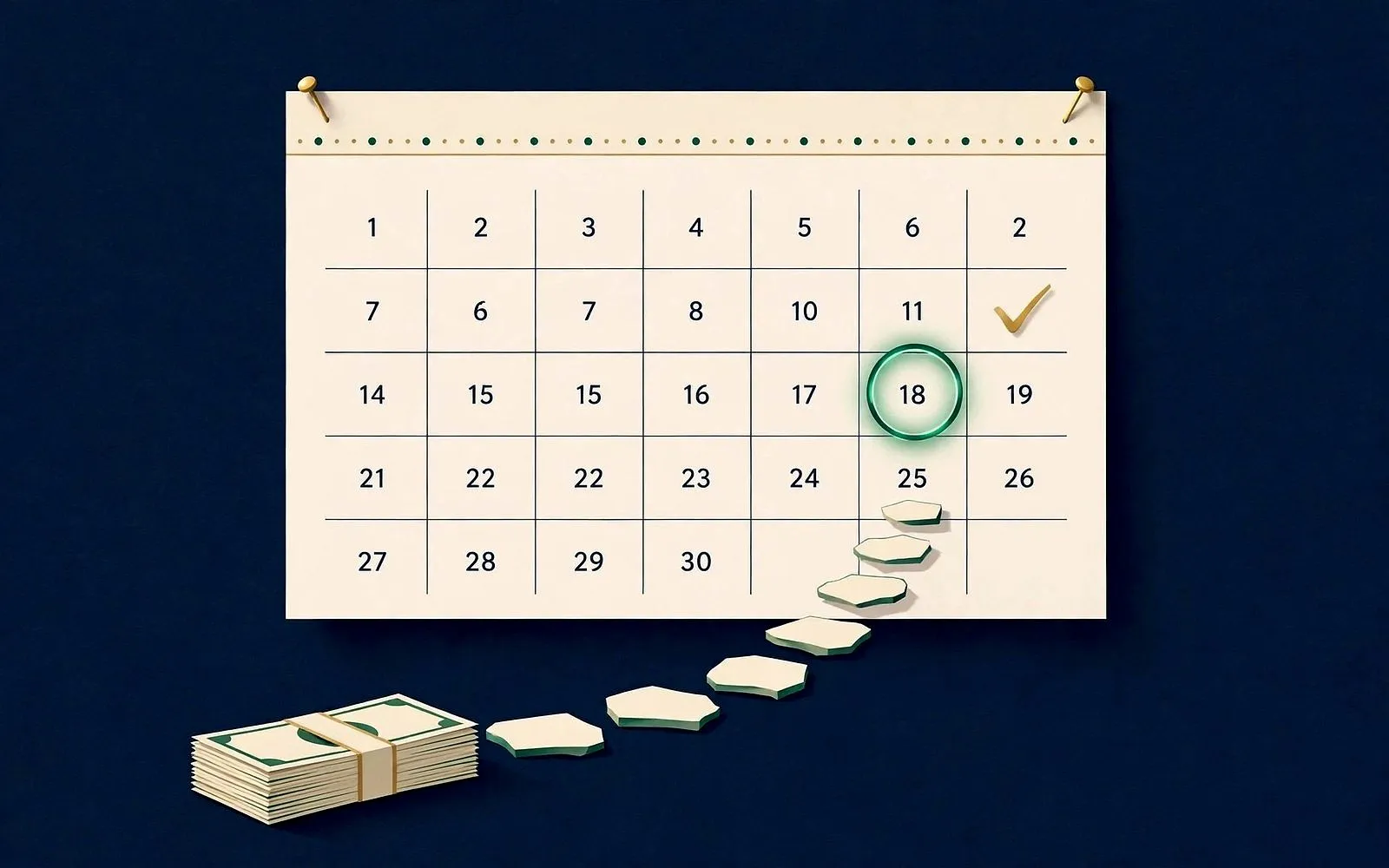
Most debt advice starts the same way: pay more than the minimum. It is true, and it is useless — because "more" is not a number, and a goal without a number drifts. There is a better way to plan a payoff, and it starts at the other end: pick the date you want to be debt-free, then work out the exact monthly payment that gets you there. The date comes first; the payment follows.
This is not a motivational trick. It is arithmetic. Every balance, APR and deadline produces one specific monthly payment, and once you know that number you can decide whether the date is realistic — or whether the date needs to move. Your credit card statement already does a version of this: since the CARD Act took effect in 2010, US issuers must print the monthly payment that would clear your balance in three years. This guide shows you how to do the same calculation for any date you choose, using the average American card balance as the worked example.
Why a date works better than a goal
A vague goal — "pay off my cards" — has no deadline, so it never feels urgent. A date — "debt-free by 8 November 2028" — turns the same debt into a monthly bill with a known end. Three things change when you fix the date first:
- The payment becomes a fact, not a guess. Instead of wondering whether $200 a month is "enough", you know exactly what $200 buys: a finish date. If the date is too far away, you raise the payment. If the payment is unaffordable, you move the date.
- The cost of delay becomes visible. Stretching a payoff by a year is not free. On a typical balance it costs hundreds or thousands in extra interest — money you can see in a table before you choose.
- Progress becomes measurable. Every month you are either on schedule or behind it, and a missed month has a clear fix: recalculate the payment for the same date, or move the date and keep going.
The numbers in this guide use the average American cardholder: a $6,659 balance in March 2026 (Experian) at 22.36% APR on accounts charged interest in August 2026 (Federal Reserve G.19).
The maths in 60 seconds
You only need two ideas. First, your card charges interest every month on the balance you still owe. At 22.36% APR, the monthly rate is 22.36% ÷ 12, or about 1.86%. On a $6,659 balance, the first month's interest alone is $124.08. That is the floor: any payment below one month's interest never shrinks the balance at all.
Second, the payment that clears a balance in a chosen number of months comes from the standard loan formula. If B is your balance, r is your monthly rate (APR ÷ 12), and n is the number of months to your date:
Payment = B × r ÷ (1 − (1 + r)−n)
You do not need to do this by hand — free payoff calculators use exactly this formula, and your statement already prints the 36-month version of it. What matters is what the formula says: a shorter deadline always means a higher payment, and the relationship is not linear. Cutting a year off a payoff usually costs far less per month than people expect, because interest stops compounding against you.
The one rule that matters: the plan only works if you stop adding to the balance. New purchases push the date back, because every dollar of new spending has to be paid off too. Freeze the card — or at least the spending on it — the day you pick your date.
Worked example: the average card balance
Take the average balance, $6,659, at the average APR of 22.36%. Here is the monthly payment for six different debt-free dates, with the total interest each one costs. All figures are our own calculations using the formula above, assuming no new spending and a fixed APR:
| Debt-free by | Monthly payment | Total interest | Total paid |
|---|---|---|---|
| 12 months | $624.40 | $834 | $7,493 |
| 18 months | $438.85 | $1,240 | $7,899 |
| 24 months | $346.64 | $1,660 | $8,319 |
| 36 months | $255.55 | $2,541 | $9,200 |
| 48 months | $211.10 | $3,474 | $10,133 |
| 60 months | $185.28 | $4,458 | $11,117 |
Read the table from both directions. Moving the date from five years to three costs about $70 more a month — and saves roughly $1,917 in interest. The biggest savings come from the first year you cut: interest is heaviest early, when the balance is largest.
Now compare that with doing nothing special. Paying only the minimum — typically 1% of the balance plus that month's interest, with a $25–$35 floor — on the same $6,659 at 22.36% takes about 19 years and costs about $10,902 in interest, more than one and a half times the original balance. That is the real price of having no date at all.
What each extra $50 buys you
Most people cannot jump straight to the payment their dream date needs. So look at it from the other side: what does each step up in monthly payment buy? Same balance, same APR, our own calculations:
| Monthly payment | Debt-free in | Total interest |
|---|---|---|
| $150 | 96 months (8 years) | $7,605 |
| $200 | 53 months (4 years 5 months) | $3,835 |
| $250 | 38 months (3 years 2 months) | $2,628 |
| $300 | 29 months (2 years 5 months) | $2,015 |
| $350 | 24 months (2 years) | $1,641 |
The jump from $150 to $200 a month — $50 — cuts the payoff almost in half, from eight years to under four and a half, and saves about $3,770 in interest. Small increases pay off disproportionately because they attack the balance while it is still large, when each dollar of principal avoided also avoids months of interest on that dollar.
Watch the floor: if your payment is only just above one month's interest, almost all of it goes to the lender and the balance barely moves. On $6,659 at 22.36%, a $150 payment clears just $26 of principal in month one. A payment that feels like progress can still be a trap — check the months column, not the feeling.
Three debts, one date
Most households do not have one debt; they have several. The date method still works — set one date for all of them and one total monthly budget, then aim the extra money at the most expensive debt first. Here is a worked example, our own simulation:
- Card A: $2,800 at 25.99% APR
- Card B: $4,100 at 22.36% APR
- Card C: $6,659 at 19.99% APR
- Total owed: $13,559. Total minimums: roughly $340 a month.
Pay the minimum on every card, then send everything else to the highest-APR card (Card A). When Card A clears, its freed-up minimum rolls into Card B, and so on — the avalanche order, with the payments snowballing forward. With a total budget of $650 a month, all three cards are gone in 27 months, with $3,429 of interest paid. Paying only the minimums on the same three cards takes about 21 years and costs about $21,190 in interest.
The steps for your own debts:
- List every debt with its balance, APR and minimum payment. Add the minimums — that is the floor your budget must cover.
- Pick one date and one total monthly budget for all of them. Use a calculator to check the date against the budget, or the budget against the date.
- Attack the highest APR first with every spare dollar, while minimums keep the others current. This order costs the least interest overall.
- Roll payments forward. When a card clears, its old minimum joins the attack on the next card. Your total payment stays the same; the date pulls closer.
Picking a date you can actually keep
A date that demands a payment you cannot afford will fail in month two, and a failed plan teaches you to stop planning. Choose the date the way you would choose any deadline: ambitious enough to matter, realistic enough to survive.
- Anchor it to something real. A birthday, the new year, the month your car loan ends. Dates tied to your life are easier to remember than "24 months from now" — and write it where you will see it.
- Test the payment against your budget. Work out the monthly payment for your date, then check it against what is genuinely left after essentials. If the payment needs money you do not have, move the date out — a 36-month plan you finish beats an 18-month plan you abandon.
- Leave a buffer. Budget the payment at about 90% of what you think you can afford. The buffer absorbs the months when life costs more, so one expensive month does not break the plan.
- Recalculate, don't quit. If income drops or an emergency hits, run the numbers again for the same date with a lower payment — or keep the payment and move the date. Adjusting the plan is succeeding, not failing.
When the date does not fit your budget
Sometimes the honest answer is that no affordable payment reaches a reasonable date. That is not a reason to give up; it is a signal to change the numbers themselves. Three levers move the maths in your favour:
- Lower the rate. A 0% balance-transfer offer pauses interest entirely for 12–21 months — but only if you clear the transferred balance before the promotional rate ends, or the remainder jumps back to 20%+ APR. A personal loan averages 11.86% on a 24-month term, according to the Federal Reserve — roughly half the average card rate.
- Negotiate. Card issuers have hardship programmes that can cut your APR or fix a payment for a period, especially if you call before you miss a payment. Asking costs a phone call; the worst answer is no.
- Get free help. In the US, the credit-counselling number printed on your statement connects you to a non-profit counsellor, and the National Foundation for Credit Counseling lists accredited agencies. In the UK, StepChange, National Debtline and Citizens Advice all give free, confidential debt advice — never pay for debt advice in the UK when the same help is free.
If the total debt is more than you could repay in a reasonable time even at a lower rate, that is what these services are for. A debt-management plan that stretches repayment over three to four years at a reduced rate still ends with a date — and a date you can keep is the whole point.
A payoff plan is not a test of willpower. It is a calculation: a date, a payment, and a rate. Change any one of the three and the other two move — so change the one you can actually change.
Making the date stick
The plan is set in an afternoon; keeping it is a monthly habit. Four small systems do most of the work: automate the fixed payment for the day after payday, so the money leaves before it can be spent; stop the leak by removing the card from one-click checkout and saved wallets; check in for five minutes a month — balance, payment made, months remaining; and mark the milestones — half the balance gone, the first card cleared, one year to go. Payoff plans fail quietly when they feel endless; milestones make the end visible.
Frequently asked questions
What if I cannot afford the payment my date needs?
Move the date, not the goal. Run the numbers for 36 or 48 months instead of 24 and take the payment you can hold every month. A longer date you actually finish costs less than a short date you abandon — and you can always raise the payment later when income rises, which pulls the date forward again.
Does the date method work for loans as well as cards?
Yes — the same formula applies to any fixed-rate debt, and it is how loans already work: a loan term is simply a debt-free date the lender chose for you. The method is most powerful on credit cards precisely because cards have no built-in end date.
Should I pay the highest APR first, or the smallest balance?
Highest APR first (the avalanche) costs the least interest overall. Smallest balance first (the snowball) clears a whole debt sooner, which some people find more motivating. The difference in total interest is usually small; the method you will actually stick with is the right one.
What happens if I miss a month?
One missed month does not break the plan — it moves the date by roughly one month, plus a little interest. The danger is treating a missed month as a failed plan and stopping. Recalculate the payment for your original date, or move the date by a month, and restart the autopay the same day.
Is a balance transfer worth it to hit my date?
Often, yes — if you clear the transferred balance before the 0% period ends and the transfer fee (usually 3–5%) is less than the interest you would have paid. Work out the payment needed to clear it in time, set that as your autopay, and do not use the old card for new spending while the transfer runs.
Key takeaways
- Pick the debt-free date first, then calculate the monthly payment it requires — a date turns "pay more" into a number.
- On the average $6,659 balance at 22.36% APR, $255.55 a month clears it in 3 years ($2,541 interest); $346.64 clears it in 2 years ($1,660).
- Your payment must beat one month's interest — $124.08 on the average balance — or the debt never shrinks.
- Minimums only on that balance take about 19 years and cost about $10,902 in interest.
- With several debts, use one date and one budget, attack the highest APR first, and roll freed payments forward.
- If the payment does not fit, lower the rate, negotiate, or get free help — and move the date rather than abandoning the plan.
Your next step takes ten minutes. Write down every balance and APR, pick a date — your next birthday is a good one — and run the numbers for that date. If the payment fits, set the autopay today. If it does not, move the date out by six months and set the autopay anyway. Either way, you will have done something most people with card debt never do: given the debt an end date.
UK note: the same method works in pounds, and the numbers are just as stark. MoneyHelper gives the example of a £2,000 balance at 22% APR paid at the typical 2.5% minimum: about 14 years to clear. Under FCA rules, the minimum on cards opened since April 2011 must at least cover that month's interest and charges plus 1% of the balance — and if you have paid more in interest than principal over 18 months, your lender must contact you about "persistent debt" and offer help after 36 months. StepChange's July 2026 polling found 15% of UK adults — more than 8 million people — consider their monthly card repayments a fairly or very large burden. Free help is available from StepChange, National Debtline and Citizens Advice; the Bank of England's average quoted credit card rate was 24.71% in August 2026.
Sources
- Experian — Average Credit Card Debt in 2026 ($6,659 average balance)
- Walnut — Credit Card Debt Statistics 2026 (Federal Reserve G.19 APR figures)
- Digicalcy — Credit Card Payoff Calculator (payoff formulas and worked example)
- BestMoney — Credit Card Payoff Calculator (payment vs payoff-time table)
- MoneyHelper — Help if you're struggling to clear your credit card debt (persistent debt)
- The Penny Pincher — Only making minimum credit card payments? (StepChange research)
- HanaHow — How long it takes to pay off a credit card on minimum payments (UK)
The MoneyHabit editorial desk researches, writes and reviews every article against our editorial policy.
The Sunday Habit
One useful money idea, every week.
A short, practical email every Sunday — no spam, no selling your address, unsubscribe anytime.
Advertisement
More in Debt & Credit Education
Debt & Credit Education · Guide
Gen Z Is Paying Off Debt With Pennies. Does It Work?
A viral meme says Gen Z is paying off debt 92 cents at a time with the Ditch app. We checked the maths, the fees and the reviews to see what it can really do.
7 November 2026 · 10 min read

Debt & Credit Education · Guide
Avalanche vs Snowball: Which Debt Payoff Method Wins
Which pays off debt faster: attack the highest-interest debt first, or the smallest balance? We ran the numbers - the answer isn't only about math.
23 October 2026 · 7 min read

Debt & Credit Education · Guide
Micro-Payments: The Daily Debt Trick Going Viral
Creators are paying off debt a few dollars at a time and posting every payment. Here's how micro-payments work and when the maths helps.
17 November 2026 · 10 min read