Guide
Gen Z Is Paying Off Debt With Pennies. Does It Work?
A viral meme says Gen Z is paying off debt 92 cents at a time with the Ditch app. We checked the maths, the fees and the reviews to see what it can really do.
In this article
One of the most-shared money posts of the week is a joke about being broke. A carousel that has passed 10,000 likes on Instagram opens with the line "GEN Z IS SO BROKE THEY'RE PAYING OFF THEIR DEBT WITH PENNIES" — a man proudly holding rolls of pennies — and then walks through the maths: $1.20 contributed to a debt after buying a $23.40 toilet mini-golf game, a 92-cent payment toasted like generational wealth, and a punchline about becoming debt-free by 2087. A second version of the same joke, on another large account, has another 2,400 likes.
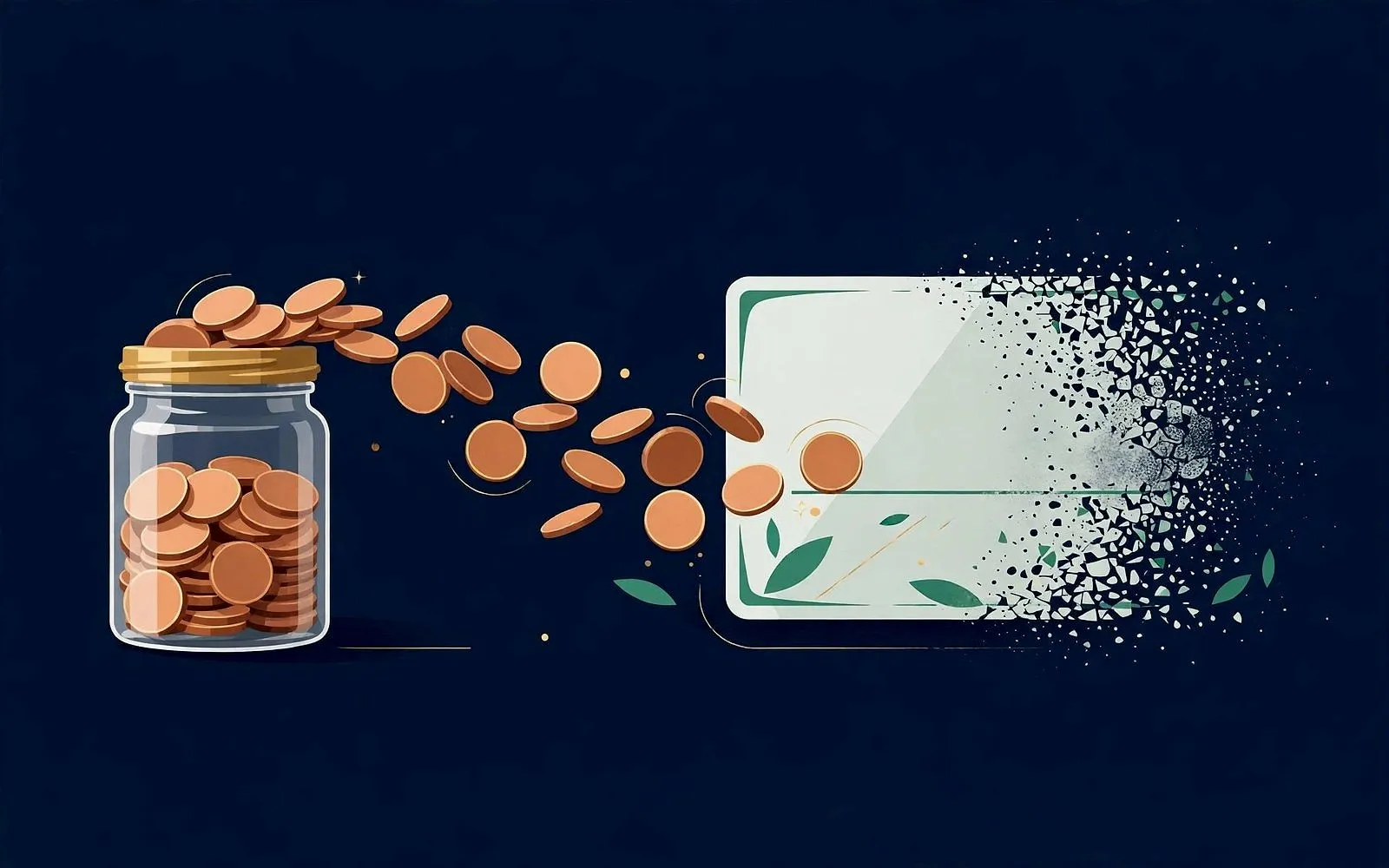
The app at the centre of the joke is real. It's called Ditch, and its whole pitch is that the spare change from your everyday spending can be routed straight to your debts. The joke lands because the numbers in it are real — but the question the memes dodge is the one that matters: can pennies actually move a credit card balance, or is this just a feel-good subscription?
Here's the honest answer: the pennies can work, but only if the app costs less than it saves you, and only if the money actually reaches your lender. The details decide everything.
What Ditch actually does
Ditch is an Atlanta fintech that launched its round-up product in May 2024. You link your bank accounts and your debts, and the app rounds every card purchase up to the next whole dollar. Buy a coffee for $4.30 and 70 cents is earmarked for your debt. Those round-ups accumulate, and the app sends them to your lender as extra payments — on top of whatever minimum payment you already make.
The app also offers a personalised payoff plan, debt tracking across multiple loans, budgeting tools, and an AI assistant that answers questions about your spending. It connects to lenders through a service called Method, and it has recently started selling an employer version: companies can match part of an employee's debt payments, the way some match 401(k) contributions.
That is the pitch. Now the maths.
The maths: what pennies are actually worth
Every card purchase produces between 1 cent and 99 cents of round-up — about 50 cents on average. So what you collect depends almost entirely on how often you swipe:
| Card purchases per month | Round-ups collected | Per year |
|---|---|---|
| 40 | $20 | $240 |
| 60 | $30 | $360 |
| 100 | $50 | $600 |
| 100, with a 2x multiplier | $100 | $1,200 |
Some apps offer multipliers — 2x or 3x on each round-up — which is how the numbers get serious. But a multiplier is not free money: a 2x round-up on a $4.30 coffee takes $1.40 out of your account, not 70 cents. You are still paying it; it just feels smaller because it rides along with a purchase.
Now put those round-ups against a real balance. The average Gen Z credit card balance is $3,483, according to Experian's March 2026 data, and the average APR on accounts assessed interest is 22.15%, according to the Federal Reserve. Here is what happens to that balance at different monthly payments — our own calculation at 22.15% APR:
| Monthly payment | Months to pay off | Total interest paid |
|---|---|---|
| $100 | 56 months | $2,147 |
| $150 ($100 + $50 of round-ups) | 31 months | $1,107 |
That is the real story of the meme. An extra $50 a month — roughly what 100 card purchases a month generates in round-ups — cuts more than two years off the payoff and saves about $1,040 in interest on a typical Gen Z balance. The pennies are not a joke. But notice what does the work: it is the extra $50 a month, every month, not the fact that it arrived in 50-cent pieces.
Round-ups work because automation beats willpower. The 50 cents is not the trick — the trick is that the money moves before you can spend it on something else.
Why Gen Z is the audience for this
Gen Z carries the smallest average balance of any adult generation — $3,483, against $9,560 for Gen X and $7,013 for millennials — but the trend underneath is the worrying part. Gen Z balances grew fastest, credit limits rose 6.7% in a year, and borrowers aged 18 to 29 have the highest rate of card balances moving into serious delinquency, at 10.08%. Total US credit card debt stands at about $1.26 trillion, according to the New York Fed's Q2 2026 report.
That combination — small balances, high APRs, rising delinquency — is exactly where small extra payments have the biggest proportional effect. A $3,483 balance is the kind of debt that round-ups can genuinely dent. A $9,560 balance at the same APR is a different problem, and pennies alone will not solve it.
The catch: fees, delays, and the subscription
This is where the meme's punchline has a point. Ditch is free to download with a one-week trial, but it is a subscription product with in-app purchases, and the company says it generates revenue by taking a percentage of each round-up transaction. There is also a processing fee to send a payment to your lender. None of that is fatal — but it changes the maths. If the app takes a cut of every round-up and charges to move the money, a $30 month of round-ups might deliver $25 or less to your card.
Check that the money actually lands. User reviews of Ditch report real problems: round-ups that are tracked but not automatically deducted at the time of purchase, payments that left the user's account but had not reached the creditor, and delays blamed on the Method connection. If you use any round-up app, check your lender's statement — not just the app's dashboard — to confirm each extra payment arrived.
Other reviews complain that the app could not connect to their student loan servicer at all, and that they were paying a subscription for a dashboard rather than a working payoff. That is the worst version of this product: you pay monthly for the feeling of progress while the balance barely moves.
Before you pay for any debt app, ask three questions: what is the monthly fee, what percentage or processing fee comes out of each payment, and does it connect to your actual lender? If the answers are vague, the free version of the same habit — a standing order from your bank — does the same job for nothing.
Round-ups vs the other ways to kill a balance
| Method | Typical extra per month | Cost | Best for |
|---|---|---|---|
| Round-up app (e.g. Ditch) | $20–$50 | Subscription + % of round-ups + processing fee | People who won't make manual extra payments |
| DIY standing order | Whatever you set — $25, $50, $100 | Free | Anyone with a fixed payday |
| Debt snowball | Smallest balance first, then roll payments forward | Free | Motivation from quick wins |
| Debt avalanche | Highest APR first | Free | Lowest total interest |
| Balance transfer card | 0% intro APR, usually 12–21 months | 3–5% transfer fee | Good credit + a payoff plan before the intro ends |
The honest ranking is simple: the avalanche saves the most money, the snowball keeps the most people going, and round-ups are a good on-ramp to either — a way to start paying extra before you have the discipline or the cash flow for a fixed larger payment. What round-ups are not is a substitute for a plan. A $3,483 balance at 22.15% still costs over $1,100 in interest even with round-ups helping. The app is a tool, not a rescue.
How to make pennies actually work
If you want to try the round-up route — with an app or without one — do it like this:
- Start with the real number. Write down every balance, its APR, and its minimum payment. Round-ups help most on the highest-APR card, not the smallest one.
- Set a floor, not just a ceiling. Round-ups alone might give you $20 in a quiet month. Add a fixed extra payment — even $25 — so slow months still move the balance.
- Verify the first three payments. Check your lender's statement, not the app. If a payment does not arrive, stop and fix it before another month passes.
- Count the fees. Add up the subscription, the percentage cut, and the processing fee. If they eat more than about a fifth of your round-ups, switch to a free standing order.
- Use a multiplier only if your budget allows it. A 2x round-up doubles your payoff — and doubles the cash leaving your account. If it causes an overdraft, it has cost you more than it saved.
The free version: most banks let you set up a round-up or a small automatic transfer yourself — Monzo and Starling offer free round-ups in the UK, and most US banks allow a recurring transfer on payday. Same habit, same automation, zero subscription.
Frequently asked questions
Does paying debt with round-ups actually work?
Yes, if the money genuinely reaches your lender and the fees are small. About $50 a month of round-ups on a $3,483 balance at 22.15% APR cuts the payoff from roughly 56 months to 31 and saves about $1,040 in interest, by our calculation. The mechanism is the extra payment, not the size of each piece.
Is the Ditch app free?
No. It is free to download with a one-week trial, then it is a subscription with in-app purchases, and the company takes a percentage of each round-up transaction plus a processing fee to send payments. Check the current price in the app store before signing up — subscription prices change.
How much do round-ups add up to in a year?
At about 50 cents per purchase, 60 purchases a month gives you roughly $360 a year; 100 purchases a month gives you about $600. A 2x multiplier doubles those figures — but it also doubles what leaves your bank account.
Will round-ups hurt my credit score?
No — extra payments help. Paying more than the minimum lowers your balance faster, which lowers your credit utilisation, one of the biggest factors in your score. Just make sure the payments actually post; a payment that leaves the app but never reaches the lender helps nobody.
What if my balance is much bigger than $3,483?
Round-ups still help, but they are not enough on their own. On a $9,000 balance at 22% APR, $50 a month of round-ups barely covers the interest. In that case, pair round-ups with a fixed extra payment, or look at a balance transfer or a formal debt management plan — and talk to a non-profit credit counsellor if minimum payments are a struggle.
Key takeaways
- The viral joke is based on a real product: Ditch rounds up card purchases and sends the spare change to your debts.
- The maths checks out — about $50 a month of round-ups on a typical $3,483 Gen Z balance at 22.15% APR saves roughly $1,040 in interest and cuts the payoff by more than two years.
- Fees are the catch: subscription, a percentage of each round-up, and a processing fee can eat a meaningful share of the money.
- Some users report payments that never reached their lender — always verify extra payments on your lender's statement, not just in the app.
- The free alternative — a standing order or your bank's own round-up feature — delivers the same habit for nothing.
Gen Z is not really paying off debt with pennies. It is paying off debt with automation — small amounts, moved before temptation gets to them. That is a genuinely good idea, and the memes are right to celebrate it. Just make sure the app you pay for is moving your money, not just counting it. Set up the round-ups, verify the first payments land, and then let the pennies do their quiet work.
UK note: UK banks including Monzo and Starling offer free in-app round-ups, and UK credit cards work the same way — extra payments cut interest fastest on the highest-APR card. If you are struggling with repayments, StepChange and Citizens Advice offer free, impartial debt help.
Sources
- FBOY Instagram carousel — Gen Z paying debt with pennies (Nov 6, 2026)
- Ditch: Pay Off Debt Faster — App Store
- Hypepotamus — Atlanta Fintech Ditch Evolves With Debt Repayment Perks
- Dime Time — How Do Round-Up Apps Help You Pay Off Debt? (2026 Guide)
- Walnut Invest — Credit Card Debt Statistics (2026)
- Capital One — Average Credit Card Debt in America
The MoneyHabit editorial desk researches, writes and reviews every article against our editorial policy.
The Sunday Habit
One useful money idea, every week.
A short, practical email every Sunday — no spam, no selling your address, unsubscribe anytime.
Advertisement
More in Debt & Credit Education

Debt & Credit Education · Guide
Still Paying for Last Christmas? Clear Holiday Debt Fast
38% of Americans are still paying off last year's gifts — and half of them plan to charge this year's too. Here's the payoff plan that breaks the cycle.
11 November 2026 · 10 min read
Debt & Credit Education · Guide
Pay Off Debt or Invest First? The Maths That Settles It
Two viral reels say opposite things about debt vs investing. The maths settles it: compare your debt's guaranteed cost with what investing might earn.
9 November 2026 · 13 min read
Debt & Credit Education · Guide
Should You Sell a Rental to Pay Off Debt?
A viral Ramsey Show call split the internet: sell a $130,000 rental to clear $49,000 of debt, or keep it? The maths — and the risks — on both sides.
8 November 2026 · 14 min read