Guide
How Much House Can You Afford? The 28/36 Rule
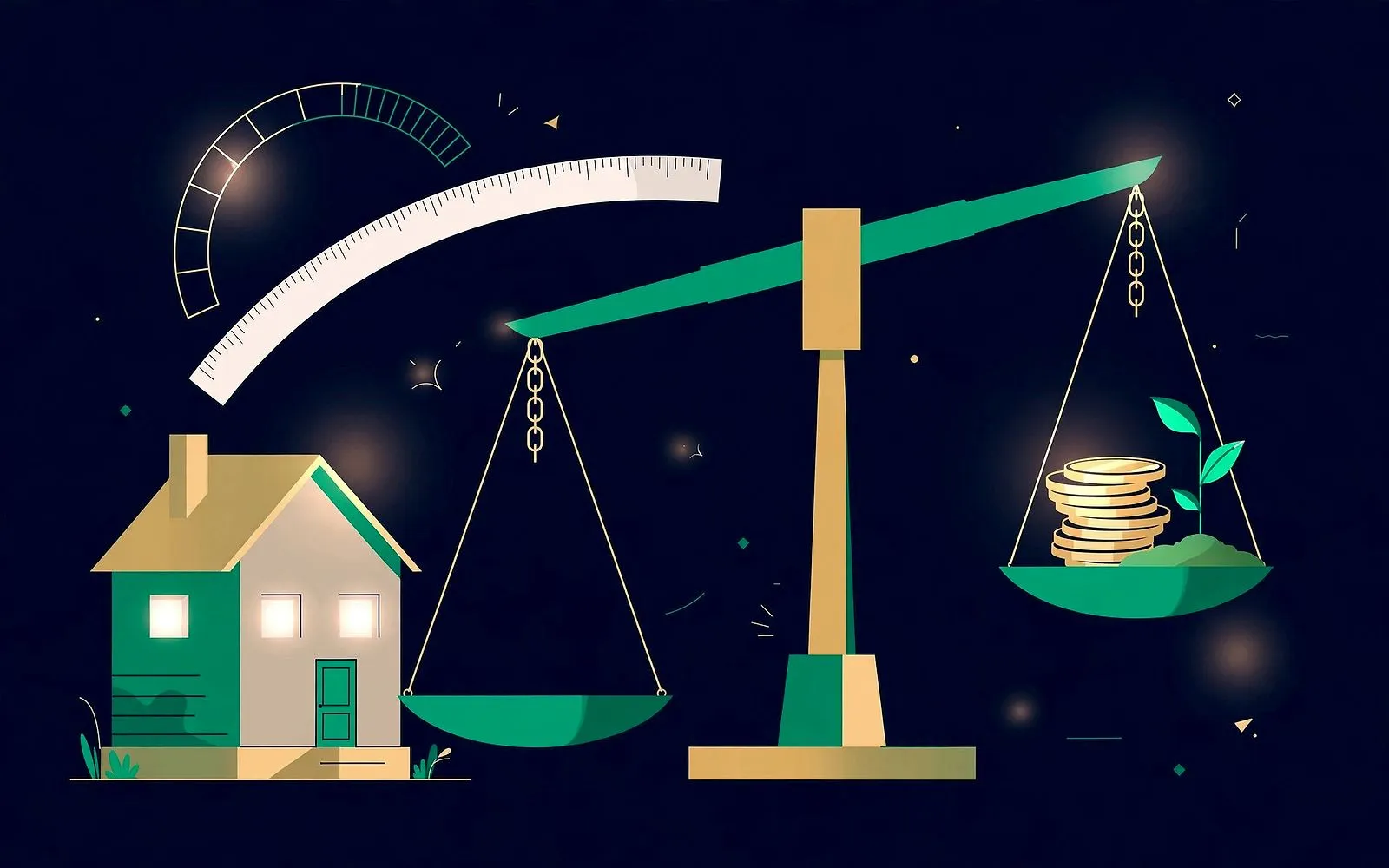
The 28/36 rule turns your salary into a house price in five minutes. Here is how it works, what lenders actually allow, and the 2026 numbers.
In this article
- What the 28/36 rule actually says
- Worked example: a $100,000 salary
- From monthly payment to home price: what each income buys
- How much the rate matters
- What lenders will actually approve
- The costs the rule forgets
- The UK version: forget 28/36, learn 4.5×
- Five ways to raise your number — honestly
- Frequently asked questions
- Key takeaways
Ask any first-time buyer how much house they can afford and you will usually get one of two answers: the number a mortgage calculator spat out, or a shrug. The calculator's number is the dangerous one — it is the maximum a lender will approve, not the maximum you should pay. The 28/36 rule is the classic check that separates the two. It takes five minutes, needs no login, and in November 2026 — with US 30-year mortgage rates around 7% and the median existing home at $417,500 — it is the difference between a home you can live in and a payment that owns you.
Here is the rule in one sentence: keep your total monthly housing costs at or below 28% of your gross monthly income, and keep all your monthly debt payments combined — housing plus everything else — at or below 36% of gross monthly income. The rest of this guide works it out with real 2026 numbers, shows where lenders will let you stretch past it, and covers the UK version, where the maths works differently.
What the 28/36 rule actually says
The rule has two halves, and both have to pass. They are called the front-end and back-end ratios, and lenders have used them in some form for decades. Fannie Mae describes the 28% housing-expense ratio and the 36% total-debt ratio as its guideline maximums.
The front-end ratio (28%) covers housing only. Take your total monthly housing payment — principal, interest, property taxes, homeowners insurance, mortgage insurance if you pay it, and homeowners association dues — and divide it by your gross monthly income, the figure before tax. The answer should be 28% or less. Note what counts: the whole payment, not just principal and interest. Taxes and insurance are not optional extras; on a typical home they add several hundred dollars a month.
The back-end ratio (36%) covers everything. Add your housing payment to every other monthly debt obligation: car loan, student loan minimums, credit card minimum payments, personal loans, child support or alimony. Divide that total by gross monthly income. The answer should be 36% or less. Groceries, utilities and streaming subscriptions do not count — only debts. This is the ratio lenders care about most, and when they say "DTI" without qualifying it, this is usually the one they mean.
The binding constraint is whichever ratio gives you the smaller housing budget. If your other debts are small, the 28% front-end rule decides. If you carry a car loan and student loans, the 36% back-end rule usually bites first — and that is exactly the situation most first-time buyers are in.
The gross-income trap. Both ratios use gross income, not take-home pay. On a $100,000 salary your gross monthly income is $8,333, but your take-home is more like $6,300–$6,800 after tax. A 28% housing payment is 35% or more of what actually lands in your account. If the rule feels tight, that is why — and it is a feature, not a bug.
Worked example: a $100,000 salary
Take a household earning $100,000 a year. Gross monthly income is $8,333. The front-end ceiling is 28% of that: $2,333 a month for all housing costs. The back-end ceiling is 36%: $3,000 a month for housing plus all other debts.
Now add realistic debts. Say the household has a $350 car payment, a $250 student loan payment and $75 in credit card minimums — $675 a month in total. The back-end rule then allows housing of $3,000 − $675 = $2,325 a month. That is $8 less than the front-end ceiling, so the back-end ratio is the binding constraint, by a whisker.
What home does $2,325 a month buy? Assume property tax and insurance of about $600 a month (roughly 1.1% tax and 0.4% insurance on the home's value, the national averages). That leaves about $1,725 a month for principal and interest. At Freddie Mac's average 30-year rate of 7.18% for the week of 5 November 2026, each $100,000 borrowed costs about $677 a month over 30 years. So $1,725 supports a loan of roughly $255,000 — and with a 20% deposit, a home price of about $320,000. That is the honest answer for a $100,000 household with moderate debts in late 2026, and it is well below the $417,500 national median existing-home price reported by the National Association of Realtors for September 2026.
| Step | Calculation | Result |
|---|---|---|
| Gross monthly income | $100,000 ÷ 12 | $8,333 |
| Front-end ceiling (28%) | $8,333 × 0.28 | $2,333/mo housing |
| Back-end ceiling (36%) | $8,333 × 0.36 | $3,000/mo all debts |
| Other debts | $350 car + $250 student + $75 cards | $675/mo |
| Housing allowed by back-end rule | $3,000 − $675 | $2,325/mo (binding) |
| Less tax and insurance | ≈ $600/mo | $1,725/mo principal & interest |
| Loan supported at 7.18%, 30 years | $1,725 ÷ $677 per $100k | ≈ $255,000 |
| Home price with 20% down | $255,000 ÷ 0.80 | ≈ $320,000 |
Worked maths in this article is the author's own calculation, labelled as such, using the rates and prices cited. Your lender's figures will differ by location, credit score and loan type.
From monthly payment to home price: what each income buys
Run the same maths at other incomes, holding the assumptions steady — 7.18% over 30 years, 20% deposit, about $600 a month for tax and insurance, no other debts — and the picture is stark:
| Gross income | Max housing (28%) | Principal & interest | Loan supported | Home price (20% down) |
|---|---|---|---|---|
| $60,000 | $1,400/mo | $800/mo | ≈ $118,000 | ≈ $148,000 |
| $75,000 | $1,750/mo | $1,150/mo | ≈ $170,000 | ≈ $212,000 |
| $100,000 | $2,333/mo | $1,733/mo | ≈ $256,000 | ≈ $320,000 |
| $150,000 | $3,500/mo | $2,900/mo | ≈ $428,000 | ≈ $535,000 |
| $200,000 | $4,667/mo | $4,067/mo | ≈ $601,000 | ≈ $751,000 |
Two things stand out. First, the median household — earning about $87,460, according to 2025 Census figures — sits just short of affording the median new home ($393,300 in the third quarter of 2026, per the Census Bureau). At 7.18% with 20% down, affording that home on principal and interest alone takes about $91,349 a year; add typical property tax and insurance and the income needed rises to roughly $109,750. Second, other debts change everything. In the $100,000 example above, $1,000 a month of other debts instead of $675 would cut the housing budget to $2,000, the supported loan to about $207,000, and the affordable home to roughly $259,000 — a $61,000 drop caused by debts that have nothing to do with the house.
Your lender's maximum is not your maximum. The 28/36 rule exists because the bank's approval answers a different question from the one you are asking: they ask whether you will probably repay; you should ask whether you can live well while repaying.
How much the rate matters
Rates do more damage to affordability than prices do, because they change what every borrowed dollar costs. On a $300,000 home with 20% down — a $240,000 loan over 30 years — the principal-and-interest payment moves like this:
| 30-year rate | Monthly principal & interest | Income needed (28% rule, P&I only) |
|---|---|---|
| 5.00% | $1,288 | $55,200/yr |
| 6.00% | $1,439 | $61,700/yr |
| 7.18% (Nov 2026) | $1,625 | $69,600/yr |
| 8.00% | $1,761 | $75,500/yr |
Each percentage point of rate costs roughly 9–11% of borrowing power. That is why the same $350,000 home that needed about $50,600 of income in 2021, when rates were near 3%, needs roughly $78,600 at today's rates — a 55% increase driven by the rate alone, not the price. It is also why waiting for rates to fall is a gamble, not a plan: if prices rise while you wait, the saving evaporates. NerdWallet's daily tracker put the average 30-year rate at 6.9% on 10 November 2026, a reminder that the rate you actually get depends on the day, your credit score and your lender — always compare at least three or four offers, since Freddie Mac research suggests that alone can save up to $1,200 a year.
What lenders will actually approve
Here is the uncomfortable part: the 28/36 rule is a guideline, not a law, and lenders routinely approve buyers well past it. That is the gap between "can borrow" and "should borrow", and it is where most affordability mistakes happen.
- Conventional loans (Fannie Mae): the 36% back-end guideline applies to manually underwritten loans, but it can stretch to 45% with strong credit and reserves, and to 50% when the file passes Fannie Mae's automated Desktop Underwriter system.
- FHA loans: often allow back-end ratios up to 50%, with a 3.5% minimum deposit — which is why they are popular with first-time buyers and also why their buyers carry the thinnest margins.
- VA loans: use a different test — residual income, the money left after all obligations — rather than a hard DTI cap, though 41% back-end is the usual benchmark.
- The old 43% cap is gone: the Consumer Financial Protection Bureau's Qualified Mortgage rule once treated 43% back-end DTI as the standard ceiling. That was replaced by a price-based test in July 2021, so 43% no longer gates anything — but you will still see it quoted as though it does.
Approval at 45% or 50% back-end DTI is not a mistake by the lender; the lender is pricing risk, not budgeting your life. At 50% back-end on a $100,000 salary, $4,167 a month goes to debts before groceries, utilities, transport, savings or a single unexpected bill. One broken boiler or one month between jobs, and the maths breaks. The 28/36 rule is conservative on purpose: it leaves room for the rest of your life.
The stretch trap. The most expensive sentence in homebuying is "the bank approved us for this much, so we can afford it." Banks approved millions of borrowers for payments they could not sustain before 2008, and the affordability rules written since then still allow approvals far above the 28/36 guideline. Treat the approval letter as a ceiling set by someone else's risk model, and the 28/36 result as the ceiling set by your own budget.
The costs the rule forgets
Even a careful 28/36 calculation understates the true cost of owning, because several large costs sit outside the mortgage payment entirely:
- Maintenance and repairs: budget about 1% of the home's value a year — $4,000 on a $400,000 home — and treat it as a monthly bill, not a surprise. Roofs, boilers and appliances do not ask permission.
- Private mortgage insurance (PMI): with less than 20% down on a conventional loan, PMI typically adds 0.5–1% of the loan a year until you reach 20% equity. FHA loans charge an annual premium of 0.55% for most of the loan's life.
- HOA dues: these count in the front-end ratio when a lender calculates it, but buyers shopping online routinely forget them. A $300 monthly HOA fee is $300 less house.
- Closing costs: typically 2–5% of the price, paid upfront and not part of the monthly maths — $8,000–$20,000 on a $400,000 purchase.
- The first-year pile: moving, furniture, appliances, window coverings and the dozen small fixes every new home needs. None of it is in the lender's calculation.
A practical fix is to run the 28/36 rule twice: once with the lender's definition of housing costs, and once with maintenance added in. If the second version still fits, the home is genuinely affordable rather than merely approvable.
The UK version: forget 28/36, learn 4.5×
British buyers will rarely hear the 28/36 rule, because UK lenders underwrite differently. The number that matters in the UK is the income multiple: most lenders cap borrowing at around 4.5 times income, a limit the Bank of England enforces by allowing no more than 15% of a lender's new mortgages to exceed it. Some lenders stretch to 5× or 5.5× for high earners or professionals, but 4.5× is the working ceiling for most buyers.
On a £40,000 salary, 4.5× means a maximum loan of £180,000. With a 10% deposit that buys a £200,000 home. The monthly cost of that £180,000 loan at 5.55% — the average two-year fixed rate in Rightmove's October 2026 index — over 25 years is about £1,111, or 33% of gross monthly pay. That is already above the 28% guideline, which shows why the two systems feel different: the UK multiple lets you borrow more relative to income, and the monthly payment shows it.
The UK market in autumn 2026 underlines the point. Nationwide put the average UK house price at £273,566 in October 2026, with annual growth of just 0.5% — the weakest since January 2024. The Lloyds Affordability Review found the average home now costs 7.3 times average earnings, the lowest ratio in 11 years, and 5.9 times for first-time buyers. Yet the typical monthly mortgage repayment has risen to about £1,150, roughly 34% of typical take-home pay, because rates rose faster than wages. Prices have stalled; payments have not. The Bank of England raised Bank Rate to 4% on 5 November 2026, its first increase since August 2023, and average five-year fixed rates were approaching 6% by late October, according to Moneyfacts.
Run the UK maths on the average home: a £273,566 purchase with a 10% deposit means a loan of about £246,000. At 5.55% over 25 years that costs roughly £1,518 a month. To keep that payment at 28% of gross income — applying the US rule as a sanity check — you would need gross pay of about £65,000 a year. The 4.5× multiple would allow a loan of £292,500 on that salary, so the multiple is the looser test and the monthly payment is the stricter one. Whichever country you are in, the payment is the truth; the multiple and the approval are just ways of guessing at it.
UK buyers — three numbers to check before you offer: (1) your maximum loan at 4.5× income; (2) the monthly payment on that loan at today's fixed rate — and at 2 points higher, in case you remortgage into worse rates; (3) the payment as a share of your take-home pay, not gross pay. If the third number is above 35%, the home will feel expensive whatever the lender says.
Five ways to raise your number — honestly
If the 28/36 maths says you can afford less house than you want, there are only a few levers that actually move it, and one that only pretends to:
- Pay down other debts first. This is the most powerful lever, because the back-end ratio is usually binding. Clearing a $350 car payment frees $350 of housing budget — the same effect as a roughly $6,000 pay rise under the front-end rule. Attack the smallest debts first if you need the DTI win quickly.
- Raise the deposit. A bigger deposit shrinks the loan directly and can remove PMI, which shrinks the payment twice. Going from 5% to 20% down on a $320,000 home cuts the loan by $48,000 and drops PMI entirely.
- Improve your credit score. The rate you are offered depends heavily on it. The difference between a 6.9% and a 7.9% rate on a $300,000 loan is about $200 a month — the same as borrowing roughly $30,000 less.
- Buy where the maths works. Property tax rates vary enormously by state and area, and $600 a month of tax and insurance is an average, not a law. A cheaper area or a smaller home in the same area changes the equation more than any budgeting trick.
- Do not just stretch the term. A 40-year mortgage or an interest-only period lowers the monthly payment without lowering the cost — it raises the total interest enormously. If the only way the payment fits is a longer term, the house is too expensive, and the term is hiding it.
Frequently asked questions
Is the 28/36 rule still relevant in 2026?
Yes — arguably more than ever. With rates near 7% and the median home around five times the median household income, the gap between what lenders approve and what is comfortable has rarely been wider. The rule's job is to flag that gap before you sign, not after.
What counts as housing costs in the 28%?
Principal, interest, property taxes, homeowners insurance, mortgage insurance and HOA dues — everything the lender puts in the monthly payment. Maintenance, utilities and council tax (in the UK) sit outside it, which is why you should budget for them separately.
Does the rule use gross or take-home pay?
Gross pay, before tax. That makes the rule stricter than it looks: 28% of gross is often 35% or more of take-home. If you want a more conservative version, run the same maths on take-home pay instead.
Can I get a mortgage above 36% total debt?
Usually, yes. Fannie Mae allows up to 45% on manually underwritten conventional loans and 50% through automated underwriting; FHA loans commonly go to 50%. Approval depends on credit score, reserves and the rest of your file — but approval is not the same as affordability.
How does the UK 4.5× multiple compare with 28/36?
The multiple caps the loan; 28/36 caps the payment. On a £40,000 salary the multiple allows a £180,000 loan, but the payment on that loan is about 33% of gross pay — above the 28% guideline. Use both: the multiple tells you what you can borrow, the payment test tells you whether you should.
Key takeaways
- The 28/36 rule: housing costs at or below 28% of gross monthly income, all debts combined at or below 36%.
- Whichever ratio gives the smaller housing budget is the binding one — with car and student loans, it is usually the 36% back-end rule.
- At 7.18% over 30 years, a $100,000 household with moderate debts can afford roughly a $320,000 home with 20% down — well below the $417,500 median.
- Lenders will approve far more: up to 45–50% total debt on conventional loans and 50% on FHA. Approval is a risk decision, not a budget.
- Each percentage point of mortgage rate costs about 9–11% of borrowing power — rates matter more than prices.
- In the UK, use the 4.5× income multiple for the loan ceiling and the monthly payment as a share of take-home pay for the reality check.
- Budget 1% of the home's value a year for maintenance, and never let a longer loan term disguise a house you cannot afford.
The right question was never "how much will the bank lend me?" It is "how much house can I carry without the payment running my life?" Run the two ratios on your own numbers before you browse a single listing — five minutes with a calculator now is worth years of breathing room later. Then, if the numbers say "not yet", the fix is not a bigger stretch; it is smaller debts, a bigger deposit, or a cheaper home. The house will still be there when the maths says yes.
Sources
- Bankrate — What Is a Debt-to-Income Ratio for a Mortgage?
- Best Money — Debt-to-Income Ratio for a Mortgage
- FinCalWise — 28/36 Rule for Mortgage Borrowing
- Beycome — How Much House Can I Afford? The 28/36 Rule (2026)
- Mortgage Loans Calculator — U.S. Housing Affordability Index 2026
- FreeFinCalc — How Much House Can I Afford in 2026?
- NerdWallet — Today's Mortgage Interest Rates
- BuyRentAuction — UK house prices in autumn 2026
- Rightmove — House Price Index, October 2026
- Money to the Masses — What is going to happen to UK house prices?
The MoneyHabit editorial desk researches, writes and reviews every article against our editorial policy.
The Sunday Habit
One useful money idea, every week.
A short, practical email every Sunday — no spam, no selling your address, unsubscribe anytime.
Advertisement
More in Financial Literacy
Financial Literacy · Explainer
Is Buying a House a Bad Investment? The Maths
A viral reel says buying a house is a bad investment next to the S&P 500. The numbers partly agree — but the full maths is more complicated.
16 November 2026 · 10 min read

Financial Literacy · Guide
The 4% Rule in 2026: Does It Still Work?
Morningstar now puts the safe retirement withdrawal rate at 3.9%, while the rule's own creator says 4.7%. Here's what the 2026 numbers mean for your plan.
14 November 2026 · 9 min read

Financial Literacy · Guide
What Is a REIT? Property Investing Without a House
A REIT lets you own a slice of offices, warehouses and flats without a deposit or tenants. Here is how the 90% payout rule works - and the risks.
12 November 2026 · 14 min read