Guide
Inflation vs Your Pay Rise: Are You Actually Earning More?
Your pay went up 3% — but prices rose 3.7%. Here is how to work out whether your raise is a raise at all, and what to do if it is not.
In this article
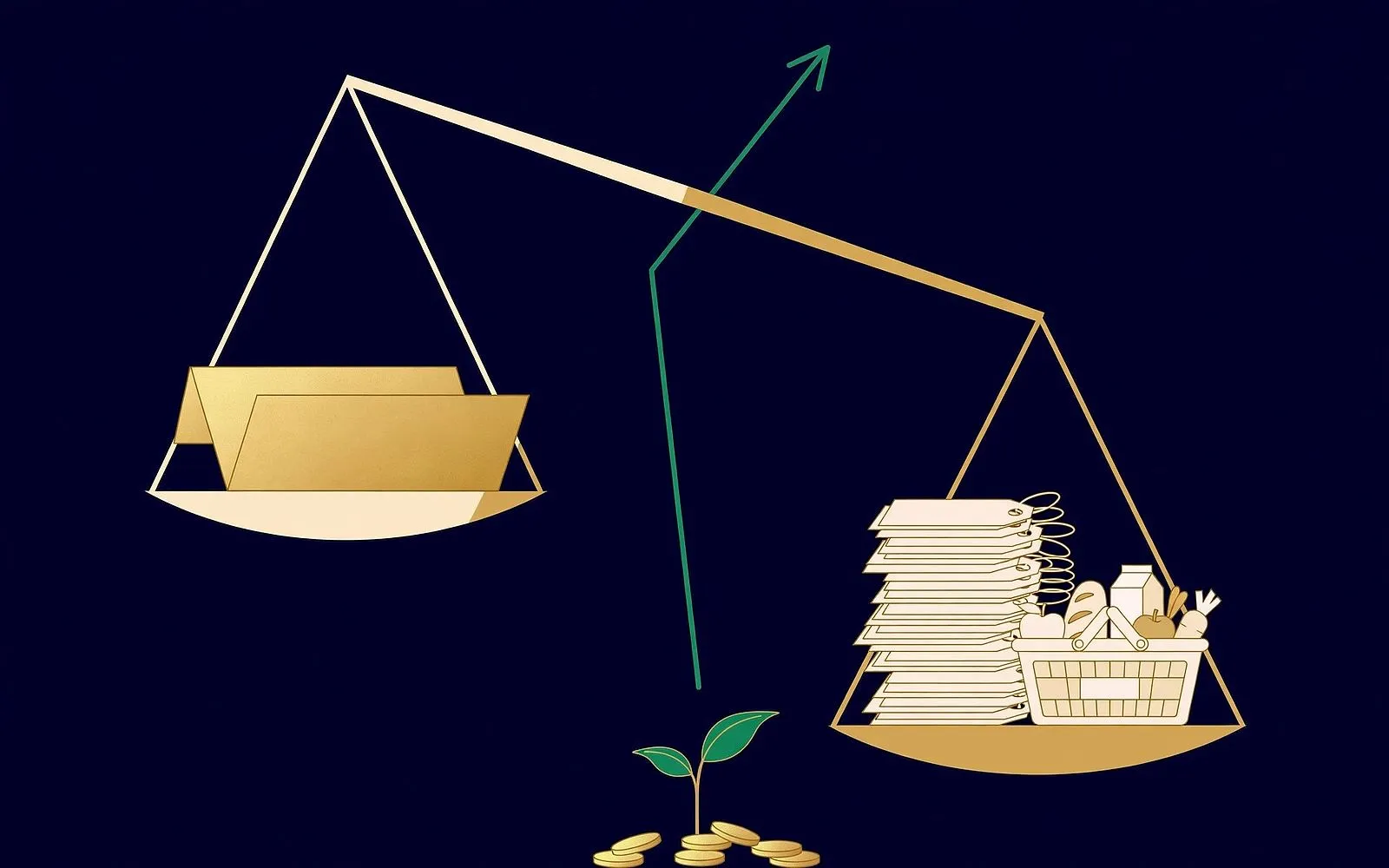
Your pay went up this year. So did prices — and prices went up faster. In the United States, average hourly pay rose 3.1% over the year to October 2026, but consumer prices were rising at 3.7% a year through September. That means the average hour of work bought 0.7% less than it did a year earlier. In the UK, the picture is only slightly better: regular pay rose 3.7% while prices rose 3.1%, leaving real pay up just 0.6%. A pay rise that trails inflation is not a raise. It is a pay cut with better PR — and the only way to know which side of the line you are on is to do the maths yourself.
The 30-second test
Real pay growth is roughly your nominal pay rise minus inflation. If your pay rose 3% and prices rose 3.7%, your real pay fell by about 0.7%. The formula is an approximation — the exact calculation divides rather than subtracts — but for the small percentages involved in pay and prices, it is accurate to a fraction of a point.
| Your pay rise | Inflation | What really happened |
|---|---|---|
| 2% | 3.7% | Real pay fell ~1.7% — a clear pay cut |
| 3.1% | 3.7% | Real pay fell ~0.6% — the US average right now |
| 3.7% | 3.7% | Real pay flat — you stood still |
| 5% | 3.7% | Real pay rose ~1.3% — a genuine raise |
| 3.7% | 3.1% | Real pay rose ~0.6% — the UK average right now |
The break-even number is the one to remember: your pay rise has to beat inflation, not just look generous. A 3% rise in a year when prices climb 3.7% leaves you worse off, however good it felt in the announcement email.
“A pay rise that trails inflation is not a raise. It is a pay cut with better PR.”
What the latest numbers actually say
The US Bureau of Labor Statistics reported on 6 November 2026 that employers added 165,000 jobs in October, with unemployment at 4.1%. Average hourly earnings for private-sector workers reached $38.00, up 3.1% from a year earlier. But the latest consumer price data, for September, showed prices up 3.7% over the year — so real average hourly earnings fell 0.7% over the same period. The October inflation report, due on 10 November, will show whether that gap is closing or widening. The Atlanta Fed's median wage tracker, which follows the same workers over time rather than averaging across everyone, was higher at 3.9% in September — a reminder that the average and the typical worker are not the same person.
In the UK, the Office for National Statistics reported on 20 October 2026 that average regular pay (excluding bonuses) was 3.7% higher in June to August 2026 than a year earlier, and total pay including bonuses was also 3.7% higher. After inflation measured by CPIH — the ONS's lead measure, which includes owner-occupiers' housing costs — regular pay grew just 0.6% and total pay 0.7%. Measured by CPI, the rises were 0.8% and 0.9%. The ONS's separate Annual Survey of Hours and Earnings, published 22 October, put median gross annual pay for full-time employees at £40,911 in April 2026, up 4.5% on the year. Public-sector regular pay grew 6.3% against 3.0% in the private sector — the averages hide very different experiences by sector.
| Measure | US | UK |
|---|---|---|
| Nominal pay growth (latest) | +3.1% (avg hourly earnings, Oct 2026) | +3.7% (regular pay, Jun–Aug 2026) |
| Inflation (latest) | 3.7% CPI (year to Sep 2026) | 3.1% CPIH (avg, Jun–Aug 2026) |
| Real pay growth | −0.7% | +0.6% (CPIH) / +0.8% (CPI) |
| Source | BLS Employment Situation, 6 Nov 2026 | ONS Average Weekly Earnings, 20 Oct 2026 |
| Next update | Oct CPI, 10 Nov 2026 | Next earnings figures, 17 Nov 2026 |
The headline economy is not your economy. US GDP grew at a 3.4% annual rate in the third quarter of 2026, yet the average hour of work bought less than a year earlier. Growth figures describe the country. Only your own pay rise against your own costs describes you.
Work out your own real pay rise in three steps
National averages are a starting point, not an answer. Your pay rise is yours alone, and working it out takes about five minutes.
Step 1: Find your nominal rise. Compare your current gross pay with the same figure a year ago — same job, same hours. If you were on $50,000 and are now on $51,500, that is a 3% rise. Include any change in hours: a 3% rise on a shorter working week is not a 3% rise in hourly terms.
Step 2: Pick the right inflation number. Use the consumer price index for your country over the same 12 months — 3.7% in the US (year to September 2026), 3.1% CPIH in the UK (June to August 2026 average). Your employer's financial year may not match the calendar year, so use the 12 months that match your pay review.
Step 3: Subtract. Nominal rise minus inflation is your real pay change. Then translate it into money, because percentages hide the size of the gap.
Worked example — US. A $50,000 salary with a 3% rise becomes $51,500. But keeping the same buying power at 3.7% inflation would need $51,850. The shortfall is $350 a year — the rise looked like $1,500 of extra money and was really $1,150 short of standing still. (Own calculation, labelled.) At the national average of $38 an hour, a full-time year is about $79,040; a 0.7% real fall is roughly $553 of buying power gone. (Own calculation, labelled.)
Worked example — UK. The median full-time salary of £40,911 with a 3.7% rise becomes £42,425. Keeping pace with 3.1% CPIH inflation would need £42,179 — so the median worker is about £246 a year better off in real terms. (Own calculation, labelled.) That is a genuine gain, but a thin one: one bad month of energy or food prices wipes it out.
Which inflation number counts?
Not all inflation measures are the same, and the one your employer quotes may not be the one that matters to you.
- CPI (US) / CPI (UK): the standard consumer price index. The US figure is 3.7% for the year to September 2026. This is the number most pay discussions should use.
- CPIH (UK only): CPI plus owner-occupiers' housing costs. The ONS's lead measure, averaging 3.1% in June to August 2026. Slightly lower than CPI in the UK right now, which flatters real pay by about 0.2 points.
- Core CPI: prices excluding food and energy. US core inflation was 2.6% — lower, because it strips out the two things that have risen fastest. Useful for economists; useless for your grocery bill.
- Your personal inflation: the only number that truly matters. If you rent, drive and eat out, your costs may be rising faster than the average. If your mortgage is fixed and you cook at home, slower. Track your own spending for a month and compare it with a year ago — that is your real inflation rate.
Do not let anyone quote core inflation at you in a pay negotiation. Core CPI excludes food and energy precisely because they are volatile — but they are also the two categories you cannot opt out of. Your pay needs to cover your actual costs, not an economist's cleaned-up version of them.
Why the averages lie about your pay
Four traps make the national figures misleading for any individual:
Average vs median. Average pay is pulled up by high earners. The US average of $38 an hour is higher than what the typical worker earns, because a small number of very high salaries drag the mean upward. The Atlanta Fed's median wage tracker (3.9%) follows the same workers over time and is often a better guide to what people like you actually received.
Composition effects. Average weekly earnings divide total pay by the number of employees. If low-paid jobs disappear, the average rises even though nobody got a raise. The ONS warns explicitly that its figures are not a measure of pay rates.
Bonuses and hours. Total pay includes bonuses, which are lumpy and unevenly shared. A rise in total pay can reflect a good bonus year for a few, not a pay rise for most. And if your hours were cut, a higher hourly rate can still mean less money in the month.
Tax takes a slice. A pay rise is quoted gross. In the UK, income tax thresholds are frozen, so a rise can quietly push more of your income into the 40% band — fiscal drag in action. In the US, federal tax brackets are adjusted for inflation each year, which softens the effect, but state taxes and benefit thresholds may not be. Always work out the rise in take-home pay, not just the headline percentage.
What to do if your pay is losing to inflation
If your real pay fell, you have four levers — and the order matters.
1. Negotiate with data, not feelings. Go in with three numbers: your real pay change, the market rate for your role, and what you have delivered. “Prices rose 3.7% and my pay rose 2%” is a fact; “I feel underpaid” is an opinion. Ask for the gap to be closed, and ask what the next review date is if it cannot be closed now.
2. Count total compensation. A pay rise is not the only money. A pension contribution increase, a bonus, extra holiday, or a training budget all have real value. But be honest with yourself: a free lunch is not a 2% pay rise, and perks that you would not buy yourself are worth less than their price tag.
3. Check the market. The October jobs report showed 165,000 new jobs in the US and a 4.1% unemployment rate — hiring is happening. If your real pay has fallen two years running, the market may value you more than your current employer does. One external offer, even one you do not take, is the strongest negotiating evidence there is.
4. Protect the gap in the meantime. If your real pay fell 0.7%, your spending needs to fall by the same amount just to stand still. That is the unglamorous truth behind every “budget better” article: when pay lags prices, something has to give, and it is better to choose what gives than to discover it in an overdraft.
“If your real pay has fallen two years running, the market may value you more than your current employer does.”
Frequently asked questions
What pay rise do I need to keep up with inflation?
Exactly the inflation rate over the same period. With US CPI at 3.7%, a 3.7% rise leaves your buying power unchanged; anything less is a real-terms cut. In the UK, with CPIH averaging 3.1%, a 3.1% rise is break-even.
Is a 3% pay rise good in 2026?
On its own, no — not while inflation is running above it. The US average pay rise was 3.1% against 3.7% inflation, so a 3% rise is slightly below average and below break-even. A 3% rise was a good outcome in 2019, when inflation was under 2%. Context is everything.
Does inflation affect my pension and savings too?
Yes, in both directions. A pension contribution that rises with your pay also rises only in nominal terms, and savings earning 4% while prices rise 3.7% are growing just 0.3% in real terms. Check the real return on every pot, not just the headline rate.
My employer says the company cannot afford inflation-matching rises. Is that true?
Sometimes. But company revenue, profits and executive pay are also public or visible in many cases, and they often rise faster than staff pay. Ask what the company's revenue growth was, and whether senior pay kept pace with inflation. If the business genuinely cannot pay more, negotiate non-cash terms — extra holiday, flexible working, training — rather than accepting a silent real-terms cut.
How often should I check my real pay?
Once a year, at each pay review, and once more when a major inflation figure lands. The October CPI report on 10 November 2026 is the next big checkpoint for US workers; UK workers should watch the ONS earnings release on 17 November.
Key takeaways
- US average pay rose 3.1% over the year to October 2026 while prices rose 3.7% — real pay fell 0.7%.
- UK regular pay rose 3.7% against 3.1% CPIH inflation — real pay rose just 0.6%.
- Your break-even pay rise is the inflation rate: 3.7% in the US, 3.1% CPIH in the UK right now.
- Work out your own real pay change in three steps: nominal rise, the right inflation number, subtract — then turn it into pounds or dollars.
- If your pay is losing, negotiate with data, count total compensation, check the market, and protect the gap in your spending.
A pay rise is only a raise if it buys more than it did last year. Check yours before you celebrate it — and if it falls short, the numbers you have just worked out are the strongest case you can take into your next pay conversation.
Sources
- BLS October 2026 jobs report: pay up 3.1%, trails 3.7% inflation
- October 2026 Jobs Report: what to watch for your pay
- U.S. payrolls rise 165,000 as revisions lift earlier job gains
- Wage Growth Statistics 2026 (BLS / Atlanta Fed)
- Are UK wages rising faster than prices? ONS earnings figures
- ONS Average weekly earnings in Great Britain: October 2026
- UK average salary by region: ONS ASHE 2026 median GBP 40,911
- The latest personal finance news for November 2026 (Experian)
- GDP growth vs your paycheck: why 3.4% growth does not feel like prosperity
The MoneyHabit editorial desk researches, writes and reviews every article against our editorial policy.
The Sunday Habit
One useful money idea, every week.
A short, practical email every Sunday — no spam, no selling your address, unsubscribe anytime.
Advertisement
More in Financial Literacy

Financial Literacy · Explainer
Inflation Hit 3.7% While Wages Grew 3%: What It Costs You
Prices rose 3.7% in a year while wages grew 3.0% — so the average pay rise now buys less. Here is what the gap costs you, and five moves to close it.
5 November 2026 · 10 min read

Financial Literacy · Guide
Worried About the Economy? 7 Money Moves That Actually Help
Consumer confidence just hit a 12-year low. Seven practical money moves that protect your money when headlines turn shaky.
19 October 2026 · 6 min read

Financial Literacy · Explainer
She Turned Down $1M for $1,000 a Week: Was She Right?
A 20-year-old turned down $1 million for $1,000 a week for life — and the internet erupted. We ran the numbers on who was right.
19 November 2026 · 10 min read