Guide
Revenge Saving: Turn Money Worry Into a Cash Cushion
Revenge saving is 2026's backlash to doom spending: turn money anxiety into a bigger cash cushion — aggressively, but with a plan that lasts.

Scroll through money feeds this week and you will meet a new mood: revenge saving. After years of doom spending — buying things to cope with bad headlines — a growing crowd is doing the opposite. They are channelling the same anxiety into their savings accounts, deliberately and sometimes aggressively, until the balance itself feels like protection. This is not just another savings challenge. It is a backlash, and like every backlash, it works best with a plan.
What revenge saving actually is
Revenge saving means saving very aggressively, usually after a period of overspending or financial uncertainty. Retirement-planning site Boldin describes it as building a bigger cash reserve out of economic anxiety, in case a job or a paycheck disappears. It flips the "revenge spending" of the post-pandemic years, when pent-up demand went into travel and experiences. Where revenge spending said "I deserve this now," revenge saving says "I deserve to feel safe later."
The trend has a social engine. Creators are posting their no-buy rules, their growing emergency funds, and their "slow and gentle versus every spare dollar" debates — revenge saving versus its gentler cousin, soft saving. The posts land because the feeling behind them is widely shared: prices have climbed for years, job security feels thinner, and watching a savings balance grow feels more rewarding than another parcel arriving.
Revenge saving is not about punishing yourself for past spending. It is about turning worry into something useful — a cushion you can actually stand on.
Why it is having a moment now
Three forces are pushing in the same direction. First, inflation fatigue: years of rising prices for groceries, rent, insurance and transport have left even higher earners feeling that their paychecks stretch less far. Second, job anxiety: layoffs, slower hiring and economic uncertainty make a steady paycheck feel less guaranteed, and people save in advance of trouble, not just during it. Third, the social proof loop: no-buy and low-buy challenges have made frugality public and communal rather than private and embarrassing.
The official numbers back up the mood, at least in the United States. Americans saved 4.1% of disposable income in August 2026, according to the Bureau of Economic Analysis, even as consumer spending jumped 0.9% in a single month. In other words, people are spending and saving at the same time — and many are trying to tilt the balance toward saving.
Revenge saving vs soft saving vs doom spending
It helps to see the three moods side by side, because they are really three answers to the same anxiety:
| Approach | What it looks like | Best for | Watch out for |
|---|---|---|---|
| Doom spending | Impulse buys to soothe bad news | Short-term relief | Debt, regret, and a thinner cushion |
| Revenge saving | Aggressive, intentional saving toward a target | Rebuilding a depleted emergency fund fast | Burnout and rebound splurging if pushed too far |
| Soft saving | Gentler saving pace while still enjoying life now | Long-term consistency without misery | Moving too slowly if you have no cushion at all |
None of these is morally better than the others. The right choice depends on where you are starting from: if you have no emergency fund at all, a focused burst of revenge saving may be exactly right. If you already have a cushion, soft saving will probably carry you further.
The 5-step revenge saving plan
1. Set a finish line, not just a feeling
Revenge saving fails when it has no end. Pick a concrete target: one month of essential expenses first, then three, then six if your income is variable or your job feels exposed. Boldin makes an important point here: an emergency fund has a sensible ceiling. Once yours hits its target, extra cash tends to do better in accounts built for longer goals, such as retirement or investing, than sitting in a savings account for decades.
2. Automate it on payday
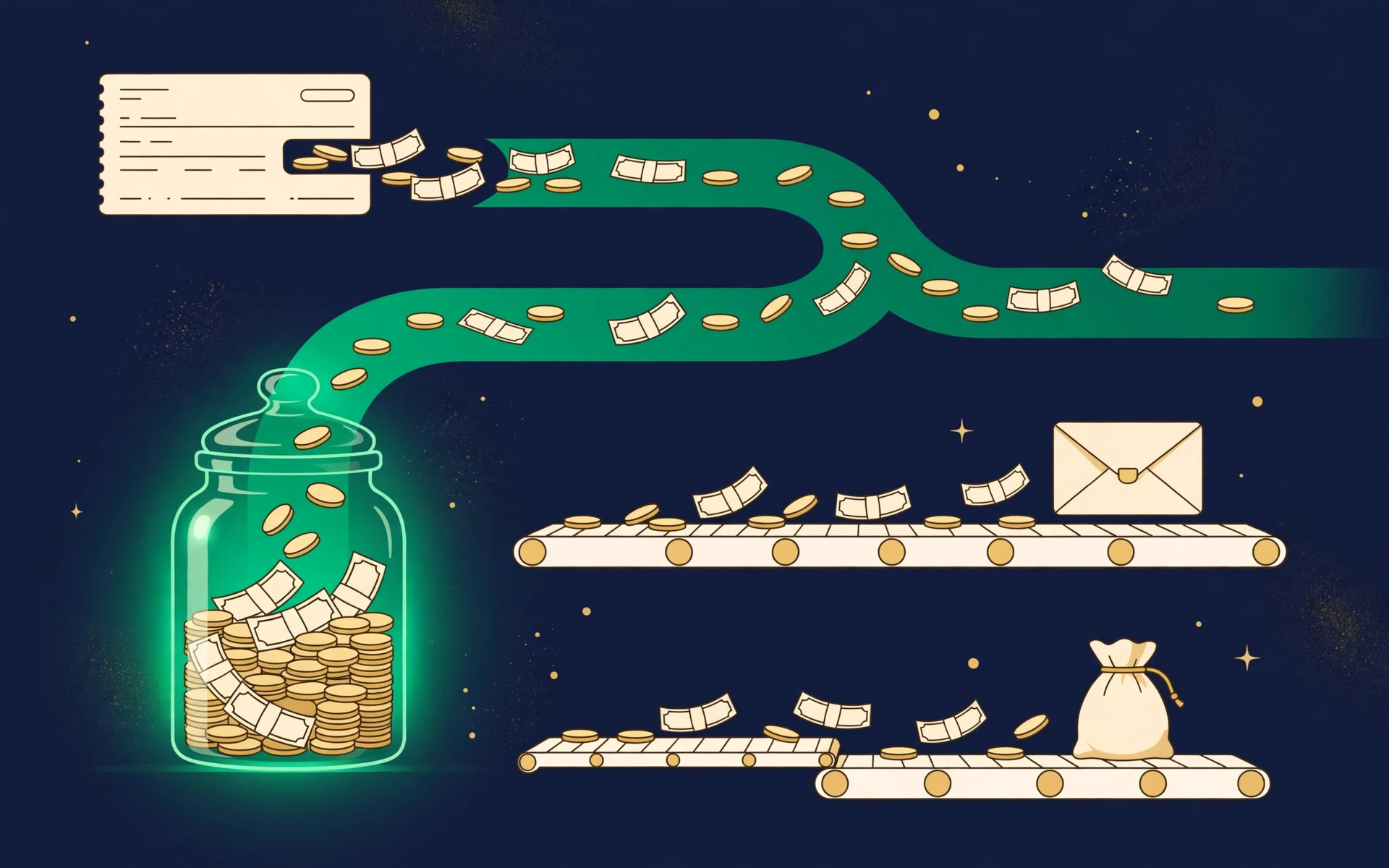
Move the money the day you are paid, before you can spend it. A standing order or automatic transfer into a separate account turns willpower into plumbing. Even a modest automatic amount beats a heroic manual one you abandon in week three.
3. Fund it from named cuts, not vague guilt
List the spending you will pause and for how long: the subscription stack you never open, the takeaway habit, the upgrade you can delay a year. Naming the trade makes it survivable — and it gives you a number to move into savings each month.
4. Clear expensive debt first
This is the step revenge savers most often skip. Saving at around 5% while carrying credit card debt at 20% or more means you are losing money every month, however good the savings balance looks. If you carry high-interest debt, split your spare cash: minimum payments on everything, then attack the highest-rate balance, while still keeping a small starter cushion of a few hundred for true emergencies.
5. Put the cushion somewhere it earns
A cash cushion should be instantly accessible, but it does not have to sit idle. High-yield savings accounts in the US were paying up to 5.00% in late October 2026, against a national average of just 0.38%, according to the Wall Street Journal's rate survey. In the UK, easy-access accounts were paying around 5.00% at the same time. Check the rate, check the withdrawal terms, and check that your deposits are protected — up to $250,000 per depositor per bank under US FDIC insurance, and up to £85,000 per person per banking group under the UK's FSCS.
Try the "one-month-ahead" version: instead of saving an abstract amount, aim to be one full month ahead on bills. When next month's essentials are already funded, every payday stops feeling like an emergency.
Do not cut to zero. Financial counsellors warn that the most aggressive savers — the ones who cut out everything — are the most likely to quit and rebound. Martin Lynch, president of the Financial Counseling Association of America, has cautioned that saving too aggressively simply means "a greater chance of failing." Keep essentials, keep one small joy in the budget, and keep the plan you can actually hold for months.
How to tell if it is working
Measure three things, once a month. First, your cushion in months of essential spending — that is the number that matters, not the raw balance. Second, your high-interest debt balance, which should be falling. Third, your stress level: if the plan makes you dread opening your banking app, it is too tight, and a softer pace will get you further than a perfect plan you abandon.
Frequently asked questions
Is revenge saving just another word for budgeting?
Not quite. Budgeting is the ongoing system; revenge saving is a burst of intensity inside it — a defined period of aggressive saving toward a specific cushion target, driven by a desire to regain control after overspending or uncertainty.
How much should I save?
Start with one month of essential expenses, then build toward three to six months depending on how stable your income is. Once you hit your target, redirect new savings toward longer-term goals rather than piling up cash indefinitely.
Should I save aggressively if I have credit card debt?
Keep a small starter cushion, then prioritise the highest-interest debt. Paying off a card charging 20% or more beats earning 5% on savings — the maths is not close.
What if I burn out and blow the budget?
That is normal, and it is information, not failure. Loosen the plan, keep the automation running at a lower amount, and restart. A softer plan you keep beats a strict plan you quit.
Is revenge saving a US-only trend?
No. The term travels with social media, and the underlying pressures — higher prices, job uncertainty, the desire for a cushion — are showing up in the UK, Canada and beyond, even though account types, rates and deposit protections differ by country.
Key takeaways
- Revenge saving means saving aggressively and intentionally to rebuild a cash cushion after overspending or uncertainty.
- It works when it has a finish line: one month of essentials first, then three to six months.
- Automate the transfer on payday and fund it from named cuts, not vague guilt.
- Clear high-interest debt before piling up savings — the interest maths favours debt payoff.
- Keep the plan survivable: a softer pace you hold for a year beats a brutal pace you quit in a month.
Revenge saving is best understood as a mood with a method. The mood — "enough is enough, I want a cushion" — is powerful, but it is the method that turns it into money in the bank: a target, an automatic transfer, a named cut, and a debt plan. Set yours up this week: pick your one-month essentials number, automate the first transfer for your next payday, and let the worry do something useful for a change.
Sources
- Boldin — 10 Personal Finance Trends in 2026 (and Which Ones Work)
- NerdWallet — What Is Revenge Saving (and Should You Be Doing It)?
- GenZ NewZ — Moneymaxxing and No-Buy Years Are Rewriting Saving in 2026
- Wall Street Journal — Today's High-Yield Savings Rates for October 23, 2026
- fin-sphere — Viral Money Trends 2026: Which Ones Actually Work?
More in Budgeting & Saving

Budgeting & Saving · Guide
Zero-Based Budgeting: Give Every Dollar a Job
Zero-based budgeting assigns every dollar a job before the month begins, so income minus planned spending equals zero. Here's how to build one, with a worked example.
25 October 2026 · 6 min read
Budgeting & Saving · Guide
Pay Yourself First: Automate Savings on Payday
Save first, spend second: set up one automatic transfer on payday so saving happens before spending gets a chance.
24 October 2026 · 6 min read

Budgeting & Saving · Guide
CD vs High-Yield Savings: Which Wins Now?
CDs pay up to 5.25% but lock your cash away; high-yield savings pays up to 5.00% and stays flexible. Here is how to pick a winner after the Fed rate hike.
23 October 2026 · 6 min read