Explainer
Pay by Bank: The Checkout Button That Skips Your Card
Pay by Bank lets you pay straight from your bank account at checkout. It is spreading fast — but you give up card protections. Here is when to use it.
In this article
- What Pay by Bank actually is
- How a Pay by Bank payment works
- Why shops are pushing it so hard
- What is in it for you
- The protection gap: what you give up
- When to use it — and when to reach for the card
- Pay by Bank in the UK vs the US
- What happens next: recurring payments
- Frequently asked questions
- Key takeaways
You have probably seen the button by now. You reach the checkout, and alongside the familiar card fields sits a new option: "Pay by Bank", "Pay with my bank account", or "Online bank payment". No card number to type, no expiry date, no security code. You tap it, your banking app opens, you approve, and the payment is done — straight from your current account to the shop.
This is not a niche experiment any more. In the UK, open-banking payments passed one billion cumulative transactions in early 2026, with 40.16 million payments in June 2026 alone. In the US, three in ten consumers say they have used Pay by Bank in the past year. AliExpress now accepts it at checkout in the UK, France, Spain and Germany, and Octopus Money lets customers fund pensions and investment accounts directly from their bank. Walmart launched its own version in the US in 2025.
So the button is real, it is spreading, and shops are keen for you to press it. The question is whether you should. The honest answer is: sometimes, enthusiastically — and sometimes, definitely not. The difference comes down to one thing most checkouts never mention: the protections you give up when you skip your card.
What Pay by Bank actually is
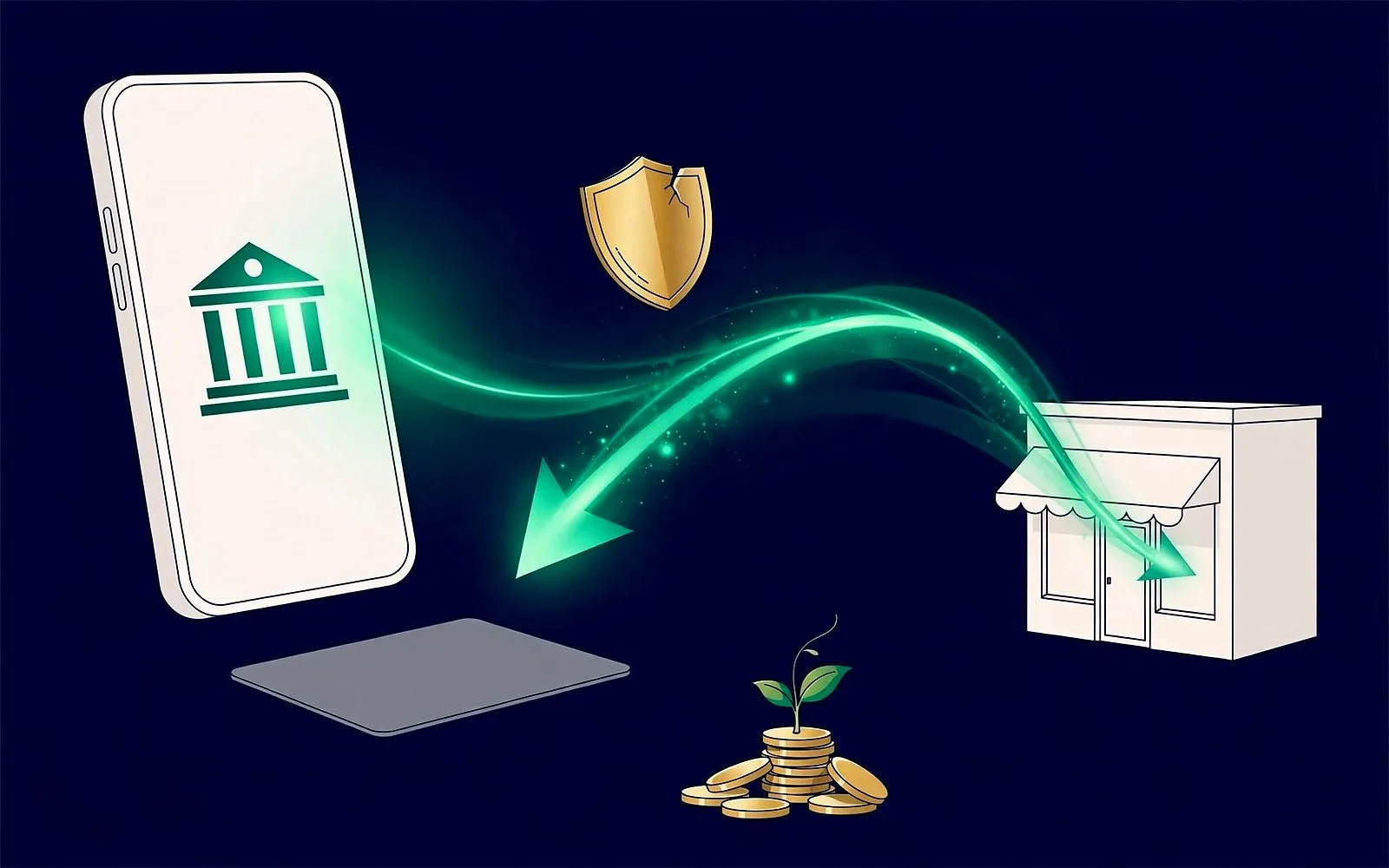
Pay by Bank is a payment made directly from your bank account to a merchant, using open-banking technology. Instead of a card network sitting in the middle — Visa, Mastercard or American Express — a regulated third-party provider connects the shop to your bank and asks your bank to move the money.
It is the same family of technology as the account-linking features in budgeting apps, but used for a one-off payment rather than for reading your transactions. In the UK it runs on the open-banking framework created after a 2018 competition ruling, which forced the nine largest banks to let authorised firms connect to customer accounts with permission. In the US there is no equivalent federal mandate yet, though the Consumer Financial Protection Bureau's Section 1033 rulemaking is advancing rules that would require banks to share customer-permissioned data with third parties.
Two things it is not: it is not a new kind of card, and it is not a wallet like Apple Pay or Google Pay. Those still move money over card networks. Pay by Bank skips the card network entirely, which is exactly why merchants like it — and why the protection picture changes.
How a Pay by Bank payment works
The flow is deliberately boring, which is the point. It usually takes four steps:
- Choose it at checkout. You pick "Pay by Bank" (or a similar label) instead of entering card details.
- Pick your bank. You select your bank from a list. The shop never sees your login details.
- Approve in your banking app. You are sent to your own bank's app or website, where you log in as normal — face ID, fingerprint or password — and confirm the exact amount and the recipient.
- Done. The money moves by bank transfer — Faster Payments in the UK, or ACH, RTP or FedNow in the US — and the shop confirms your order.
Because you approve inside your bank's own app, the merchant never touches your card number, and there is no card to expire, be lost, or be stolen from a database. Some providers also run a real-time balance check at the point of authorisation, so a payment that would bounce can be stopped before it starts.
Why shops are pushing it so hard
The honest reason is money — the shop's money. Every card payment carries a processing fee, and those fees have become enormous. US merchants paid a record $198 billion in card processing fees in 2025. Research published by the Federal Reserve in July 2025 found Pay by Bank could save merchants up to 40% on fees versus credit cards, and as much as 85% for some merchant categories.
That is why Walmart built its own account-to-account checkout in 2025, why AliExpress added Pay by Bank across four European markets, and why payment providers are racing to offer it: 72% of banks and 87% of payment service providers surveyed by Token.io and Open Banking Expo in October 2026 said they already offer or accept it.
Shops also like that there are no stored card details to protect, no expired-card declines, and no chargebacks to fight. A Pay by Bank payment, once made, is effectively final from the merchant's side. Which brings us to the part that matters for you.
What is in it for you
There are real advantages, and they are worth naming:
- Nothing to type. No 16-digit number, no expiry date, no billing address. For mobile checkouts, that alone removes the most error-prone part of paying.
- No card details shared. The merchant never receives your card number, so there is nothing for a data breach at that retailer to expose.
- Instant confirmation. The money moves immediately or near-immediately, and the shop knows it has been paid.
- Discounts, sometimes. Because shops save on fees, some pass a share back. Uber has offered discounts on future rides for Pay by Bank, and Airbnb has started offering it for select transactions. In PYMNTS research, 46% of US consumers said they would prefer cash rewards for using it.
None of that is trivial. But none of it outweighs the protection gap, which is where most people should make their decision.
Pay by Bank is not a safer or riskier version of paying by card. It is a different kind of payment, with a different safety net — and the safety net is thinner in exactly the situations where you most want one.
The protection gap: what you give up
This is the section the checkout button does not show you. When you pay by credit card in the UK, Section 75 of the Consumer Credit Act makes your card provider jointly liable with the retailer for purchases between £100 and £30,000. If the goods never arrive, arrive faulty, or the company goes bust, you can claim from the card provider. Chargeback — available on credit and debit cards — lets your bank reverse a payment for goods not received or not as described, under the card scheme's rules.
Pay by Bank gives you neither. You are making a direct bank transfer, not a card payment, so Section 75 and chargeback simply do not apply. Your rights under the Consumer Rights Act still exist — you can still demand a repair, replacement or refund from the retailer — but you have to get it from the retailer yourself, with no card provider to fall back on.
| Protection | Credit card | Debit card | Pay by Bank |
|---|---|---|---|
| Section 75 (UK, £100–£30,000) | Yes — card provider jointly liable | No | No |
| Chargeback | Yes | Yes | No |
| Consumer Rights Act claim against retailer | Yes | Yes | Yes |
| Reimbursement if tricked by a scammer (UK APP rules) | N/A — different rules | N/A | Yes, if it is an APP scam — up to £85,000 |
| Refund if the seller simply does not deliver | Yes, via Section 75 or chargeback | Yes, via chargeback | No automatic route — you chase the seller |
There is one important nuance. The UK's mandatory authorised push payment (APP) fraud reimbursement rules, in force since 7 October 2024, do cover bank transfers — including Pay by Bank payments, which travel over Faster Payments. If you are tricked into sending money to a criminal, your bank must reimburse you up to £85,000 per claim, usually within five business days, with the cost split between the sending and receiving firms. In the first 18 months of the scheme, 88% of the money lost to in-scope scams — £316 million — was returned to victims.
But the scheme covers scams, not civil disputes. A genuine seller who takes your money and never sends the goods is not an APP scam, and the reimbursement rules do not cover it. That is the gap that matters: fraud, covered; a retailer that fails you, not covered.
The US picture is weaker still. There is no federal reimbursement mandate for a payment you authorised yourself. Regulation E protects you when someone else moves money from your account without authorisation, but if you were tricked into authorising the payment, liability generally rests with you. That is a large part of why only 12.2% of US bank customers currently view Pay by Bank as a substitute for debit cards — and why 6 in 10 say they would shift some spending to it only if it came with buyer protections and a modest incentive, such as a 1% discount.
The one rule to remember: never use Pay by Bank for a purchase you would not pay for by bank transfer. If you would hesitate to wire the money directly, do not let a checkout button dress the same payment up as something safer.
When to use it — and when to reach for the card
Used in the right places, Pay by Bank is genuinely useful. Used in the wrong ones, it quietly removes your best safety net.
| Situation | Best payment | Why |
|---|---|---|
| Paying a utility bill, council tax or a subscription to a big provider | Pay by Bank | Trusted recipient, fixed amount, no delivery risk |
| Funding your pension or investment account (e.g. Octopus Money) | Pay by Bank | You are moving money to yourself, not buying goods |
| Buying from a large, established retailer (Amazon, eBay, Ryanair) | Either — card if you want the safety net | Retailer is reliable, but card protection is free insurance |
| Ordering from a small or unfamiliar online shop | Credit card | Section 75 / chargeback is your only leverage if it goes wrong |
| Big purchases over £100 (UK) or big-ticket items generally | Credit card | Section 75 covers £100–£30,000; Pay by Bank covers none of it |
| Travel, hotels and flights | Credit card | Highest risk of firm failure and cancellation disputes |
| Paying someone you found on social media or a marketplace | Neither — walk away | Bank transfers to strangers are the classic scam setup |
A practical habit: use Pay by Bank for money movement — bills, account funding, payments to organisations you already trust — and keep the credit card for purchases, especially anything over £100, anything from a seller you have not used before, and anything where delivery is weeks away.
Pay by Bank in the UK vs the US
The same button means different things on either side of the Atlantic, because the plumbing underneath is different.
| United Kingdom | United States | |
|---|---|---|
| Scale | Over 1 billion cumulative open-banking payments by early 2026; 40.16 million in June 2026 alone | About 30% of consumers have tried it, but it is only ~1.5% of consumer retail transactions |
| Rails | Faster Payments — near-instant, mandated open-banking framework since 2018 | ACH, RTP and FedNow; no federal open-banking mandate yet |
| Where you will see it | Amazon, Booking.com, eBay, JustEat, Ryanair, AliExpress | Walmart, Uber, Airbnb (select transactions), bill payments and account transfers |
| If a scammer tricks you | Mandatory reimbursement up to £85,000 under PSR rules | No federal mandate for payments you authorised; Regulation E covers unauthorised transfers only |
| If the seller does not deliver | No Section 75, no chargeback | No chargeback; card protections do not apply |
| Who is driving it | Regulation + 300+ authorised third-party providers | Merchants chasing lower fees; 72% of Gen Z and 66% of Millennials say they are open to it |
The UK is years ahead on infrastructure, but the protection gap is identical in both countries. The US is catching up fast on adoption — Flywire and Trustly extended Pay by Bank to the US and Canada in August 2026, settling over ACH with real-time balance checks — yet the consumer-protection question is still unresolved on both sides. In the Token.io survey, there was no consensus on who should be responsible when a Pay by Bank payment goes wrong: 20% of businesses said a central scheme should resolve it, 24% said the customer's bank, and 18% were unsure.
What happens next: recurring payments
Today Pay by Bank is mostly a one-off checkout option. The next phase is recurring payments — variable recurring payments (VRPs), which let you authorise a regular payment that can vary in amount, as a transparent alternative to direct debits and card-on-file subscriptions. The UK Payments Initiative, a new payment scheme, launched in June 2026 to enable commercial VRPs, and 89% of UK survey respondents said they were already seeing merchant demand for them.
In the October 2026 Token.io survey, 59% of industry respondents said recurring-payment and one-click capabilities are essential for Pay by Bank to become a genuine alternative to cards in Europe, with subscriptions and bill payments identified as the biggest opportunity (62%), ahead of e-commerce (59%). The same logic applies in the US, where PYMNTS found bill payments are the category most likely to shift: 32% of digital-bank users' bill payments could move to Pay by Bank if discounts and buyer protection were offered, versus 22% of all consumers.
If VRPs take off, the protection question becomes more urgent, not less. A one-off payment to a shop you chose is one thing; a standing permission for a company to pull varying amounts from your account is another. Before authorising any recurring Pay by Bank payment, check three things: that you can cancel it as easily as a direct debit, what happens if a payment is taken in error, and whether the provider offers any dispute process of its own. If the answers are vague, keep the direct debit.
Quick check before you tap Pay by Bank: Is the seller established and trusted? Is the amount under £100 or a bill, not a purchase? Would you be comfortable paying by bank transfer? If the answer to any of those is no, use your credit card instead — the protection is worth more than the convenience.
Frequently asked questions
Is Pay by Bank safe?
The connection itself is safe: you log in through your own bank's app, the merchant never sees your credentials, and no card details are stored or shared. The risk is not the technology but the missing protections — if the seller fails you, there is no Section 75 or chargeback to fall back on. It is safe to use with trusted recipients; it is not the right tool for risky purchases.
Does Pay by Bank cost me anything?
For consumers, no — there is generally no fee. The economics run the other way: merchants pay less than they do for card processing, which is why they offer it. Some merchants share the saving as a discount or reward, and 46% of US consumers say they would prefer cash rewards for using it.
What happens if the goods never arrive?
You have to pursue the retailer directly under the Consumer Rights Act. There is no chargeback and no Section 75 claim. If you paid by bank transfer because you were tricked by a scammer, the UK's APP reimbursement rules may apply (up to £85,000) — but a genuine seller failing to deliver is a civil dispute, not a scam, and is not covered.
Can I get a refund on a Pay by Bank payment?
Only from the seller. Unlike a card payment, your bank cannot reverse it for you because the goods were faulty or never arrived. If the payment itself was unauthorised — someone else moved money from your account — your bank must refund you under unauthorised-payment rules, in the UK by the next business day.
Does Pay by Bank affect my credit score?
No. It moves money you already have; there is no borrowing, no credit check and no effect on your credit file. That is also why it offers no credit-card-style protections — the two things are two sides of the same coin.
Key takeaways
- Pay by Bank pays a shop straight from your bank account using open banking — no card number, no card network, no card fees for the merchant.
- It is already big in the UK (over 1 billion payments) and growing in the US (30% of consumers have tried it, but only 1.5% of retail transactions).
- The catch is protection: you lose Section 75 and chargeback, so a seller that does not deliver leaves you chasing them yourself.
- UK scam reimbursement (up to £85,000) covers authorised push payment fraud, not civil disputes with genuine sellers; the US has no equivalent mandate for payments you authorised.
- Use it for bills, account funding and trusted recipients. Use a credit card for purchases over £100, unfamiliar sellers and travel.
Pay by Bank is a genuinely better way to move money — faster, cheaper and with less of your data floating around the internet. It is just not a better way to buy things. The trick is to treat it as what it is: a bank transfer with a nicer button. Use it wherever you would happily make a bank transfer, and keep your credit card for everywhere else. That single rule keeps the convenience and the protection, each in the place where it belongs.
Sources
- Which? — Open banking and Pay by Bank
- Token.io / Open Banking Expo — Pay by Bank Signals & Trends 2026 (via Intelligent Fin.tech)
- The Paypers — Token.io survey maps Pay by Bank growth needs
- Open Banking Limited — UK Open Banking milestones (via Baba-Int)
- PYMNTS / Trustly — Pay by Bank Gains Take but Card Rewards Keep Loyalty
- PYMNTS / Trustly — Pay-by-Bank Could Win 32% of Bill Payments
- Nuvei — Why US merchants are adding Pay by Bank in 2026
- Flywire and Trustly extend open banking to North America
- PSR APP fraud reimbursement protections (via BotMinds)
The MoneyHabit editorial desk researches, writes and reviews every article against our editorial policy.
The Sunday Habit
One useful money idea, every week.
A short, practical email every Sunday — no spam, no selling your address, unsubscribe anytime.
Advertisement
More in Financial Technology
Financial Technology · Explainer
The Card-Freeze Button: When to Use It (and When Not To)
Your banking app's freeze button can stop a thief in seconds — but it won't stop subscriptions. Here's what it blocks, what slips through, and when to use it.
16 November 2026 · 10 min read
Financial Technology · News
Your Payday App Wants to Be a Bank: Dave's Charter Bid
Dave filed to become a national bank on 16 November. Here's what the charter would change for its users — and why consumer groups are alarmed.
19 November 2026 · 10 min read

Financial Technology · Explainer
AI Agents Are About to Shop With Your Card
Visa just expanded Agentic Ready so AI assistants can pay with your card. Here is how it works, the controls you get, and who pays when it goes wrong.
18 November 2026 · 10 min read