Guide
The 5 Worst Things Money Can Buy
A viral list names five purchases that quietly drain your wealth. We ran the numbers — and found the cheaper alternative to each.
In this article
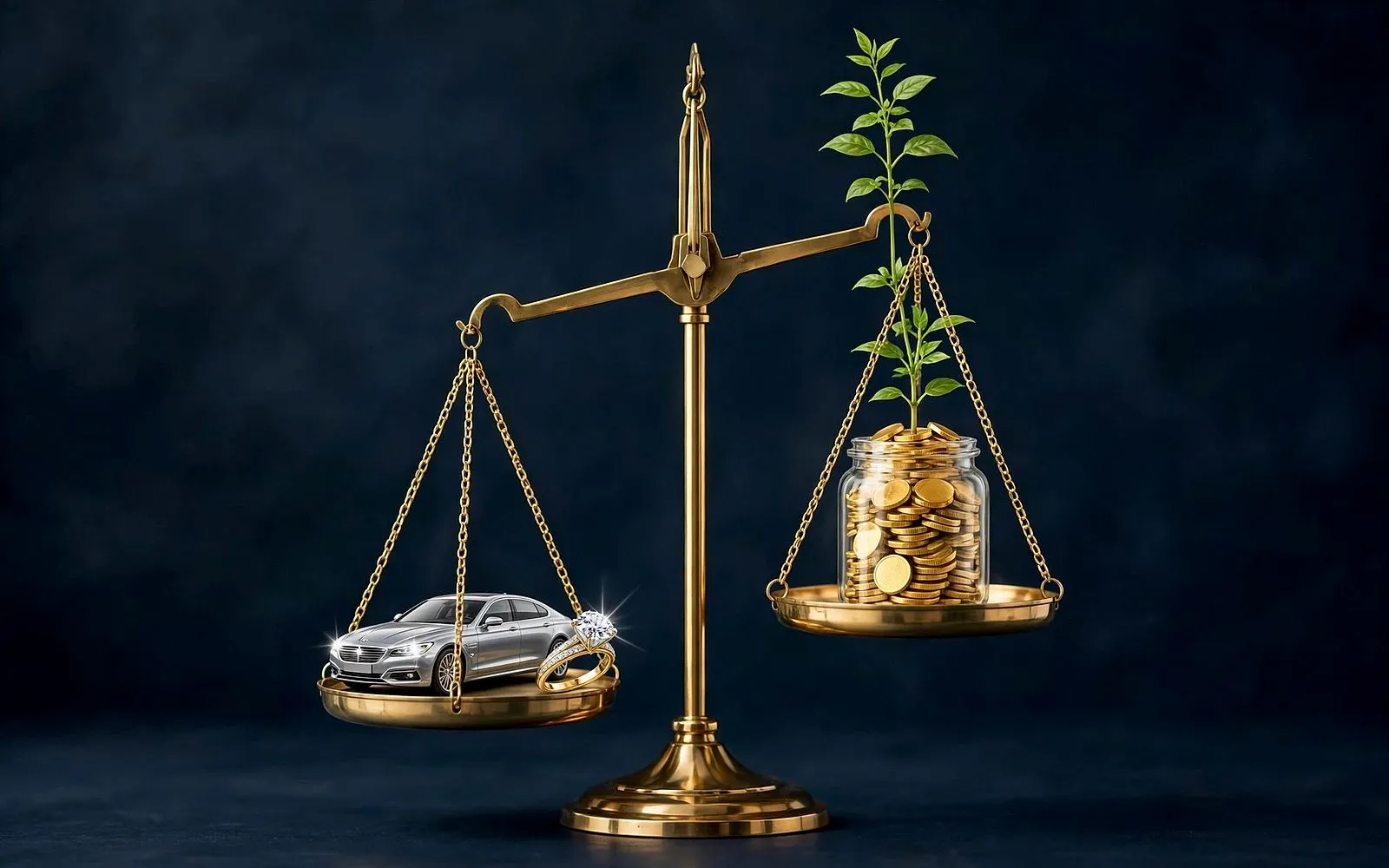
A short video has been doing the rounds this month: creator James Beckett, posting as Money Stocker, lists the "5 worst things money can buy" — a car on finance, a mined diamond ring, insurance policies you may already own, "stuff" instead of experiences, and an expensive financial advisor. We ran the numbers on all five. Four hold up well, one needs a correction, and each one has a cheaper alternative that keeps most of the pleasure and little of the waste.
This is not a ban on nice things. The question is always the same: what does it cost, what do you actually get, and is there a version that gives you nearly the same thing for far less? Here are the five, counted down, with the maths.
5. A brand-new car on finance
A new car is the fastest way most people ever lose money. Kelley Blue Book puts the first-year loss at about 20% of the car's value, and roughly 30% over the first two years. The 2026 iSeeCars study of more than 950,000 five-year-old vehicles found the average car loses 41.8% of its value in five years. On the average new car — $49,855 at the July 2026 Cox Automotive average transaction price — that is roughly $10,000 gone in the first year and about $20,800 over five years, before a single repair bill.
Finance makes the wound deeper. The average new-car payment reached $765 a month in the second quarter of 2026, against $542 for a used car, according to Experian — a gap of $223 a month, or about $13,400 over a five-year loan term, before interest.
Buying new is fine if you keep the car for a decade — the per-year cost then falls sharply. The expensive mistake is the short cycle: buying new, financing it over five or six years, and trading it in after three.
The cheaper version: buy a two- or three-year-old car, ideally one coming off a lease with a full service history. Someone else has already paid for the steepest part of the depreciation curve — roughly the first 30% — and you still get most of the car's useful life.
4. A mined diamond ring
Here is the most startling price gap in this list. A one-carat round diamond, G colour and VS2 clarity, cost about $4,850 as a mined stone in mid-2026 — and about $1,060 as a lab-grown stone of the same grade. That is a 78% discount for a stone that is chemically, physically and optically identical: same carbon crystal, same hardness of 10 on the Mohs scale, same brilliance. Across the market, lab-grown diamonds typically retail for 70% to 90% less than mined stones of equivalent quality.
Two honest caveats, which the reel skips. First, resale value: a mined diamond typically holds 50% to 60% of its retail price on the secondary market, while a lab-grown stone holds roughly 10% to 20%. Second, mined diamond prices themselves have fallen — the average one-carat natural stone dropped from about $8,007 in September 2021 to about $3,898 in September 2026, according to Rapaport data. A ring is not an investment either way.
But if the ring is a symbol, not a store of value, the lab-grown stone wins where it counts: same look, same durability, same grading, a fraction of the price. The money saved — about $3,790 on a one-carat stone — is a honeymoon or an emergency fund.
The most expensive part of a diamond is not the stone. It is the story you were told about what the stone has to cost.
3. Insurance policies you already own
This one is mostly a British story, but the principle travels. In the UK, packaged bank accounts bundle travel insurance, mobile phone insurance and breakdown cover for a flat monthly fee — typically £11.50 to £18 a month. Lloyds' Silver account costs £11.50 a month (£138 a year) and Lloyds values the included cover at £318 a year, based on Consumer Intelligence research: £157 for travel insurance, £59 for breakdown cover and £102 for phone insurance. Buying the same three covers separately can easily cost £150 to £300 a year.
The waste happens in two directions. Some people pay for a packaged account and then buy the same insurance again, because they never checked what their bank already includes — the duplicate policy is pure loss. Others pay £138 a year for a bundle they barely use: no holidays, an old phone, a car that already has breakdown cover. Lloyds, Halifax and Bank of Scotland are raising packaged-account fees from 13 January 2027 — Silver goes from £11.50 to £13 a month — which makes the annual check even more worthwhile.
The American version is the premium credit card: many include travel insurance, phone protection and rental-car cover, and cardholders still buy the same cover again at the checkout. Once a year, list every policy you already hold before buying another one.
The trap to avoid: a packaged account only saves money if you would buy at least two of the covers anyway. If you would buy none of them, the "free" insurance costs you £138 a year for nothing. Check the age limits on travel cover too — some policies stop covering older travellers.
2. "Stuff" instead of experiences
This is the softest item on the list, and the best supported by research. In a 2003 study published in the Journal of Personality and Social Psychology, psychologists Leaf Van Boven and Thomas Gilovich found that people consistently reported more happiness from experiential purchases — holidays, meals out, concerts — than from material purchases of similar cost. A 2014 review by Gilovich and colleagues at Cornell summarised why: experiences strengthen social relationships, become a bigger part of who we are, and invite fewer envy-inducing comparisons than things do.
The financial version of the same point is simpler: things depreciate, clutter and demand maintenance, while experiences are consumed once and remembered for years. That does not mean never buy anything — a good mattress, a reliable washing machine and warm winter boots are infrastructure, not "stuff". The waste is the discretionary pile: the third pair of trainers, the upgraded gadget that does what the old one did.
A practical rule helps: for any non-essential purchase over £100 or $100, wait 72 hours. If you still want it, and you can name where it will live and what it replaces, buy it. If you cannot, the money stays put.
1. An expensive financial advisor you don't need
The reel calls a 1.5% advisor fee "daylight robbery". That needs a correction first: 1.5% is the top of the range, not the norm. The 2026 State of Financial Planning Fees study from Envestnet puts the average assets-under-management fee at 0.96% a year. Even so, the maths is sobering. On a $500,000 portfolio, 1% is $5,000 every year; on $1 million, it is $10,000 every year, usually billed quarterly. Over 30 years, a 1% annual fee can reduce the ending balance by roughly a quarter, assuming a 7% gross annual return — an illustration, not a prediction.
None of this makes advisors a bad idea. Good advice pays for itself at the moments that matter: a messy divorce, a business sale, a disabled child, a tax problem, or a portfolio so large that one mistake costs more than a decade of fees. The waste is paying a percentage-of-assets fee for a service you barely use — an annual review meeting and a portfolio that looks much like a cheap index fund.
The alternatives have never been cheaper. Robo-advisors typically charge 0.25% to 0.50% a year for automated allocation and rebalancing. An hourly advisor averages about $307 an hour, and a one-off comprehensive plan averages about $2,926.
| Purchase | What it typically costs | Smarter alternative | Typical saving |
|---|---|---|---|
| New car on finance | ~$10,000 lost in year one; $765/mo average payment | Two- or three-year-old car, kept long-term | ~$13,400 over five years on payments alone |
| Mined diamond ring (1 ct) | ~$4,850 for G/VS2 | Lab-grown stone, same grade | ~$3,790 on the stone |
| Duplicate insurance | £138/yr packaged account + separate policies | Audit what your bank and cards already cover | £150–£300/yr |
| "Stuff" over experiences | Varies — the pile adds up | 72-hour rule; spend on experiences | More lasting happiness per pound |
| Expensive advisor (1% AUM) | $5,000/yr on $500,000 | Robo-advisor (0.25%) or hourly advice | ~$3,750/yr on $500,000 |
The three-question test
Every item on this list fails the same simple test, and the test works on anything you are about to buy. First, what does this cost over its whole life — interest, depreciation, fees and resale value included? Second, what am I actually buying: the thing itself, or the feeling of having bought it? Third, is there a version that gives me 90% of the benefit for half the price? If yes, the expensive version has to justify itself.
Try it this week: pick the most expensive thing you bought in the last year and run the three questions on it. Then check one thing you may already own: the insurance bundled with your bank account or credit card. Between the two, most people find at least one purchase they would not make again — and one policy they have been paying for twice.
Frequently asked questions
Is buying a new car ever worth it?
Yes — if you keep it for a long time. Depreciation is front-loaded, so a new car kept for ten years costs far less per year than one traded in after three. What rarely pays is the short cycle of buying new and trading in early, especially on finance.
Are lab-grown diamonds real diamonds?
Yes. They are real diamonds with the same carbon crystal structure, the same hardness and the same optical properties as mined diamonds — the US Federal Trade Commission's jewellery guides treat them as diamonds. The difference is origin and price, not chemistry. The trade-off is resale value: lab-grown stones typically resell for 10% to 20% of the purchase price, against 50% to 60% for mined stones.
Do I need a financial advisor at all?
It depends on complexity, not wealth alone. A straightforward saver with an index-fund portfolio may need nothing more than an occasional hourly session. A percentage-of-assets fee makes sense when your financial life is genuinely complicated — a business, estate planning, tax problems — and you want someone to manage it all. If your advisor's main output is an annual meeting, you are probably overpaying.
Key takeaways
- A new car loses about 20% of its value in the first year and 41.8% over five years on average — buying two or three years old skips the steepest part of the curve.
- A lab-grown diamond costs 70% to 90% less than a mined stone of the same grade, and the two are chemically identical — but lab-grown stones resell for far less.
- Check what insurance your bank account and credit cards already include before buying another policy; a packaged account only pays if you would buy the cover anyway.
- Experiences deliver more lasting happiness than things — the 72-hour rule separates wants from habits.
- A 1% advisor fee costs $5,000 a year on a $500,000 portfolio; match the fee model to the need — hourly or flat-fee for simple questions, percentage fees only for complex finances.
The reel that started this article is right about the shape of the problem and slightly wrong on one detail: the typical advisor fee is about 1%, not 1.5%. The lesson is not that these five things are always terrible — it is that the default version of each one is the expensive version, and the cheaper version is usually sitting right next to it. Run the three-question test on your next big purchase, audit the insurance you already own, and keep the difference. Over a decade, it is the deposit, the holiday, or the emergency fund you thought you could not afford.
Sources
- Experian — What Is Depreciation on a Car?
- MotorJudge — Car Depreciation Statistics for 2026 (iSeeCars study)
- TheDiamondPrice — Natural vs Lab Diamond Price Report 2026
- Idyl — Lab-Grown vs Mined Diamonds 2026
- NerdWallet — What Will a Financial Advisor Cost You?
- Harness — Average Financial Advisor Fees in 2026
- BankingGeek — Best Packaged Bank Account UK 2026
- MoneySavingExpert — Lloyds, Halifax and Bank of Scotland packaged account fee hikes
- Van Boven & Gilovich (2003) — To Do or to Have?, Journal of Personality and Social Psychology
The MoneyHabit editorial desk researches, writes and reviews every article against our editorial policy.
The Sunday Habit
One useful money idea, every week.
A short, practical email every Sunday — no spam, no selling your address, unsubscribe anytime.
Advertisement
More in Smart Spending
Smart Spending · Guide
Borrow, Don't Buy: The Library of Things Guide
Why buy a drill you'll use for 13 minutes in its lifetime? Borrow tools, cleaners and party gear for a few pounds a week — here's the maths.
15 November 2026 · 10 min read
Smart Spending · Guide
Home Sales Hit a Record Low: Buy Now or Wait?
Pending home sales just hit their lowest level since 2001. Here is what the freeze means for buyers — and the maths that decides whether to buy now or wait.
19 November 2026 · 10 min read
Smart Spending · Guide
How to Spot a Fake Review Before You Buy
Fake reviews are now illegal in the US and UK — but enforcement is slow. Here's how to spot them before you buy.
15 November 2026 · 10 min read